
A bank and an independent advisory firm may use estate and tax planning technology to help clients answer many of the same questions. How will their wealth transfer? How do their estate documents fit together? What planning opportunities deserve attention?
But the environments in which that technology must operate can look very different.
For an advisory firm, the priority may be bringing sophisticated planning into everyday client conversations through a secure, dependable platform. A large financial institution needs those same capabilities, but may also have specific requirements around infrastructure isolation, vendor risk, integrations, resource allocation and change management.
That is where single-tenant architecture becomes relevant.
The vast majority of Wealth.com customers use our multi-tenant environment. For most firms, that is the appropriate deployment model. For institutions with additional infrastructure and operating requirements, Wealth.com also offers a dedicated, single-tenant environment.
What does single-tenant architecture mean?
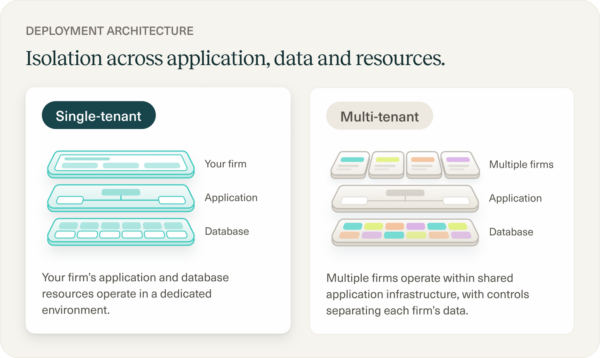
Tenancy describes how a software platform’s application environment and supporting resources are organized across customers.
In a multi-tenant environment, multiple firms operate within shared application infrastructure, with controls separating each firm’s data.
In a single-tenant environment, one firm’s application and database resources operate within a dedicated environment. Wealth.com’s single-tenant deployment also includes isolated compute resources and firm-specific security controls across networking, encryption, identity and monitoring.
The important distinction is that sharing infrastructure is not the same as sharing access to information. A multi-tenant deployment uses controls to maintain separation between firms within the shared environment. Single tenancy changes how that separation is implemented and how the environment can be configured and operated for an individual institution.
Why institutional requirements can be different
A family’s estate and tax information deserves protection whether its advisor works at an independent RIA or a national bank.
What changes is not the importance of the information. It is the organizational environment surrounding it.
For a large financial institution, evaluating a planning platform may involve questions that extend well beyond the advisor experience. Which application and database resources are dedicated to the institution? How are access and monitoring scoped? Can integrations accommodate the institution’s systems? How will changes be coordinated?
These are questions about how technology fits within an operating model.
One useful way to think about single tenancy is to ask where the application, data and resource boundaries sit. Wealth.com’s dedicated deployment establishes those boundaries around an individual firm’s application and database environment, with firm-specific controls supporting assessment and oversight.
That can be valuable when an institution needs a more specifically scoped environment rather than additional functionality in the software itself.
At institutional scale, how a platform is deployed can matter alongside what it enables advisors to do.
Three reasons institutions may choose a dedicated environment
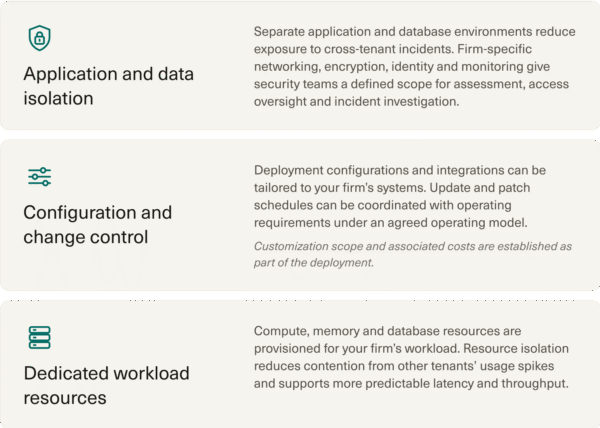
The value of single tenancy becomes clearer when translated from architecture into the work technology and security teams need to perform.
1. A defined environment for security oversight and vendor risk
Separate application and database environments reduce exposure to cross-tenant incidents. Firm-specific networking, encryption, identity and monitoring also give security teams a defined scope for assessment, access oversight and incident investigation.
For an institution evaluating a planning platform, that scope matters. It helps focus the review on the environment supporting its own deployment: the relevant application, database, resources and controls.
Wealth.com’s single-tenant offering is designed to reduce cross-tenant dependencies and provide a clearly scoped environment for vendor-risk assessment.
The benefit is not a promise that risk disappears. It is a more defined deployment boundary within which the institution and its technology provider can assess and manage it.
2. Configuration and change management aligned with the institution
The value of enterprise software depends partly on how well it fits the systems and processes already in place.
Consider an institution introducing a planning platform alongside its existing technology. The evaluation may include not only whether an integration is available, but how it will be configured and how subsequent changes will be coordinated with operations.
Wealth.com’s single-tenant deployment allows configurations and integrations to be tailored to a firm’s systems. Update and patch schedules can also be coordinated with operating requirements under an agreed operating model. Customization scope and associated costs are established as part of the deployment.
This is a practical distinction. The value is not unlimited customization or unrestricted control over updates. It is the ability to establish an agreed approach to configuration and change that reflects the institution’s requirements.
For a bank or large wealth management organization, that alignment can be an important part of making a platform workable across the enterprise.
3. Resources provisioned for the firm’s workload
Single tenancy also changes how resources are allocated.
In Wealth.com’s dedicated environment, compute, memory and database resources are provisioned for the firm’s workload. Resource isolation reduces contention from other tenants’ usage spikes and supports more predictable latency and throughput.
For an institution assessing a broad deployment, this provides a concrete topic for capacity planning: what resources its workload requires and how those resources will be provisioned.
Estate and tax planning deserve a place in the infrastructure conversation
Estate and tax planning involve more than a set of calculations or reports. They bring sensitive information about a family’s finances, documents and relationships into the planning process.
Wealth.com’s single-tenant deployment is designed to establish a defined environment for that estate, tax and family information.
For an institution considering how to deliver planning across its organization, the evaluation should therefore address both sides of the decision.
The wealth management team needs to understand how the platform will support advisors and clients. The technology and security teams need to understand how the deployment will fit the institution’s requirements.
Those conversations should inform one another. A strong advisor experience does not remove the need for infrastructure diligence, and a well-defined deployment does not replace the need for useful planning capabilities.
Institutions should be able to evaluate both without treating one as an afterthought.
Does every wealth management firm need single tenancy? No.
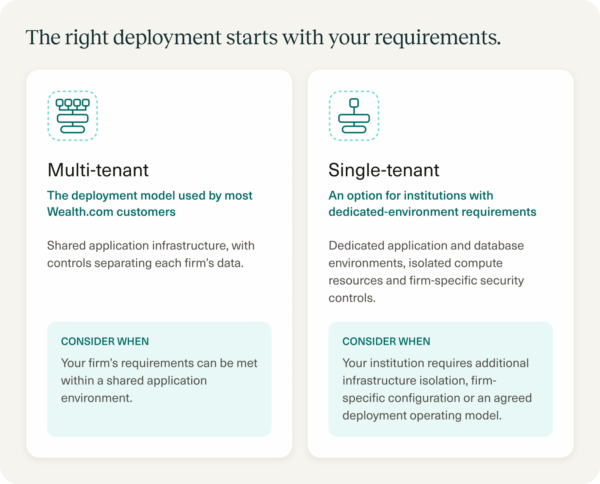
Single tenancy is not a required next step for every growing advisory firm.
The vast majority of Wealth.com customers operate in our multi-tenant environment. Choosing that deployment does not mean a firm places less importance on security or that its clients’ information deserves less protection.
It means a dedicated application and database environment may not be necessary to meet that firm’s requirements.
There is also an investment associated with operating a separate deployment. Wealth.com’s single-tenant offering supports dedicated application and database environments, firm-specific networking and encryption, dedicated identity and monitoring, environment provisioning and ongoing operational support.
Those resources and operating arrangements should serve a defined need.
For most advisory firms, the decision will not turn on whether dedicated infrastructure sounds more sophisticated. It should turn on whether their requirements call for that infrastructure and the associated operating model.
The same principle applies to large organizations. Size alone should not decide the architecture. The institution’s requirements should.
What institutions should ask planning technology providers
A useful evaluation moves beyond asking whether a provider offers single tenancy. It examines what the offering actually includes and how it will operate.
Five questions provide a starting point:
- What is dedicated, and what remains shared? Ask the provider to identify the application, database and workload resources within the dedicated environment, along with any remaining dependencies.
- How are security controls scoped to our institution? Review the approach to networking, encryption, identity, monitoring and access oversight, including the scope available for incident investigation.
- What can be configured, and under what terms? Clarify integration options, customization boundaries, associated costs and responsibility for ongoing support.
- How will updates be coordinated? Establish the operating model for change scheduling rather than assuming that a dedicated environment gives the institution unrestricted control.
- What investment and operational support does the deployment require? Understand how resources will be provisioned, how the environment will be supported and how the arrangement fits the institution’s vendor-risk assessment.
The answers matter more than the label. They turn “single tenant” from an architectural description into a deployment an institution can evaluate.
Built for independent firms and institutional requirements
Wealth.com’s approach is to support different deployment needs without making every customer adopt the same infrastructure model.
For most customers, that means using our multi-tenant environment to bring estate and tax planning into the advisory relationship.
For institutions requiring a dedicated deployment, it means separate application and database environments, isolated compute resources, firm-specific security controls and an agreed approach to configuration, change management and operational support.
Wealth.com is the only estate and tax planning provider to offer single-tenant capabilities. Our enterprise experience also includes successful deployments at three of the top five U.S. banks.
Our philosophy is straightforward: an independent advisory firm should not need a bank’s deployment model to deliver sophisticated planning. A bank should not have to set aside its institutional requirements to access the same planning capabilities.
The right technology partner should understand both.
Enterprise planning is about what the software enables. At institutional scale, it is also about how that software fits the organization.
Explore Wealth.com for Enterprise
Talk with our team about your institution’s estate and tax planning needs, deployment requirements and operating model. Learn more at https://www.wealth.com/for-enterprises/.