What Is a Financial Power of Attorney?

Financial Power of Attorney Explained

So much of estate planning is thinking through how you want things handled after you die, before you start actually making a documented plan. The idea of a financial power of attorney (FPoA) flips that a bit, because it’s about appointing someone to handle your affairs in case you become incapacitated and can’t make your own decisions. The process seems complex, but we’ll simplify it so you can make sense of the basics you need to know to include this important element in your estate plan.

What Role Does a FPoA Play in Estate Planning?

In a nutshell, a financial power of attorney is a document in which you appoint a trusted person to act on your behalf to make financial decisions. In establishing a FPoA, you hand over the legal reins to another person to conduct financial transactions, sign documents, or make other legal decisions as if they were you. This might happen for only a limited period of time (during a serious illness or after an accident, for example), or it can take effect immediately upon signing and last up to your end of life. Once your FPoA is completed, your trusted person, the agent, sometimes called an attorney-in-fact or fiduciary, can be responsible for managing your financial affairs. You will need to use a second document, called an Advance Health Care Directive (sometimes known as health care proxy or health care power of attorney), to designate who should handle all of your medical decisions. There are several types of FPoA, so consider the specific needs of your estate before selecting one.

Durable Power of Attorney

The type of FPoA most commonly used in estate planning is a durable power of attorney. “Durable” indicates that your agent has your permission to act on your behalf even though you are incapacitated or disabled. In other words, the FPoA is effective until you either revoke the document or have passed away.

You can spell out your agent’s powers, responsibilities and restrictions in the FPoA. The powers vary from state to state but usually include the ability to:

  • Sell or manage property and real estate
  • Sign legal documents and checks
  • Manage personal and business-related financial accounts
  • Pay medical bills (but not make healthcare decisions)
  • File taxes and settle claims on your behalf

Hire professional assistance, such as a lawyer or advisor

Non-Durable Financial Power of Attorney

When an FPoA is not “durable,” your agent’s powers end when you become incapacitated or disabled. In other words, you want to supervise your agent’s use of the FPoA powers. This can be a good option for transactions that are not driven by estate planning needs. For example, you might grant your advisor a non-durable FPoA to conduct time-sensitive trades on your behalf.

In addition, you may be comfortable allowing your agent to change your estate plan or the rights of your beneficiaries; because these are such sensitive powers, in most states, you must affirmatively grant each estate planning power.

Why Include a Durable Power of Attorney in Your Estate Plan?

A complete estate plan should provide not only for death, but incapacity and unavailability. Putting a FPoA in place allows someone to continue managing your financial affairs if you cannot sign important documents yourself in case of emergency, a routine surgery, or even travel abroad.

Keep in mind that to complete your FPoA, it must be signed in accordance with your specific state’s requirements, which might mean signing before a notary public or witness(es).

The wealth.com platform makes it straightforward to get your Financial Power of Attorney drafted and securely stored in our Vault, and provides state-specific guidance on how to fill out and sign your FPoA.

Get this guide to Financial Power of Attorney as a printable PDF

Download PDF

Will vs. Trust

What’s the Difference and Which One Is Right for Me?

TL/DR: In simple terms, a Will is a legal instruction to the court about what should happen to what you own after you have passed away. A Trust is a contract you make with someone whom you trust about what you own, regardless of whether you have passed away. There are many types of Trusts, but the Revocable Trust (or Living Trust) is most commonly used as a substitute for a Will. The Revocable Trust may offer you some advantages that a Will doesn’t, as this article will explain.

_______________________________________________________________

In climactic movie scenes and music videos when a family gathers to hear how the dead person’s fortune will be split up, it’s always the deceased’s Will being read out loud for the big reveal. In real life, however, a Will doesn’t get read out loud; instead, the executor sends a copy to all known beneficiaries.

Even without a dramatic reading, you might still have concerns about keeping your last wishes private. A Will becomes a publicly available document on the probate court’s docket. Probate is often how the press learns the details of a celebrity’s assets and who the heirs are after the celebrity has died.

If maintaining your privacy is important to you, consider making a Trust – and not a Will – the centerpiece of your estate plan.

A Revocable Trust (or Living Trust)* can be a great alternative for many reasons, beyond privacy. These fall into four main categories:

  1. Avoiding the court process at death
  2. Keeping your wishes private
  3. Planning for your incapacity
  4. Learning a new set of words

Note that just because most Americans have a Will* and not a Trust does not mean that you should have a Will. Depending on your situation and wishes, a Revocable Trust may be the best option for you.

If, after we dig deeper into each of the differences, you’re still not sure, take our quiz here.

_____

*1 The rest of this article may refer to this type of Trust as simply “Trust.” A Revocable Trust (or Living Trust) is not to be confused with an Irrevocable Trust. Learn more about this topic here.

*2 A lot more people have a will (60% of the people we surveyed in our estate-planning research who have an estate plan) vs. a trust (38% have a living or revocable trust, and just 19% have an irrevocable trust).

Avoiding the Court Process at Death

The main reason people choose a Trust is to simplify the court process that happens at death, which is called “probate.” If you die with a Will that distributes your assets (or without an estate plan at all), a probate judge will oversee how your assets will be distributed.

This process can be difficult and expensive and take a long time. If one or more factors indicate that probate will be more onerous for your estate, you should consider putting in place a Trust to avoid probate. These factors are:

(a) You live in a state that tends to have a complicated or expensive probate process.

(b) You own real estate (or tangible objects of significant value) that is located in a state other than your home state.

(c) You own assets that are complex and may require more active court supervision, like stock that is not publicly traded.

Unpacking each of these factors:

(A) Some states charge probate or court fees based on the size of your estate (i.e., how much you owned in your name at death). Attorneys may charge up to tens of thousands of dollars to help your executor navigate probate. All those fees are first paid from your assets, so there will be less left to distribute among your loved ones. And even when your assets are not particularly complex, probate in your home state could tie up your assets for up to two years. If you live in a state like this, a revocable trust will allow you to put more control in the hands of your trustee and “bypass” much of the probate process.

(B) If you own real estate or personal property in another state, dying with only a Will means that your executor must start probate processes not only in your home state, but in all the other states as well. By putting the property located in other states in your revocable trust,* your trustee will be able to avoid these “offshoot” probate proceedings.

(C) If you own assets that are a little more complex, such as stock that is not publicly traded, your executor will have to coordinate more closely with the probate court to make sure the stock is properly transferred to the appropriate beneficiaries. This can lengthen the time for probate.

If you anticipate that probate would be costly and time-consuming for your loved ones, a Revocable Trust might be the best option for you.

____

*If you place the real estate or personal property in an entity like a limited liability company (LLC), you may also be able to avoid probate, but that analysis must be done by an attorney licensed to practice law in the state where your real estate or personal property is located.

Keeping Your Wishes Private

As part of the probate process, a Will becomes part of the public record. Revocable Trusts typically avoid probate (unless there is an issue like an angry family member who brings a legal claim against your Trust). With a Revocable Trust, your estate plan is more likely to remain private.

Information that will become public if part of your Will include:

(a) Who you consider to be your family members.

(b) Who you want to exclude from receiving your assets or having a trusted role in your estate plan.

(c) Who will receive your assets, and how much of your assets they will receive.

(d) How you would like your last remains to be handled.

If you would prefer to keep these details private, a Revocable Trust might be the best option for you.

When They Become Effective

A Will does not become effective until you die, whereas a Trust is effective immediately on the day you create it. As a result, a trust has legal effect before your death – i.e., while you are alive but either incapacitated or unavailable. If it is important for you that someone take over responsibility for your financial affairs immediately if something were to happen to you, then a Revocable Trust gives you a more powerful vehicle compared to a Will or a financial power of attorney.

Ensuring that “it’s business as usual,” can be especially important if you own a closely-held business and you are expected to be involved in the day-to-day operations or in making high-level decisions by voting your shares. Your succession planning for your business should include transferring your shares into a Trust so that your trustee can step into your shoes if something happens to you.

Learning a New Set of Words

A Trust can be used as an alternative to a Will, but the vocabulary will be different and less familiar to most people, which contributes to the feeling that Trusts are more complicated than Wills. For example, instead of referring to an “executor” or “personal representative,” the trusted individual who will manage your affairs is called a “trustee.”

That being said, if there are factors indicating that you should have a Revocable Trust, you should not let legal terms discourage you from using a Trust as the centerpiece of your estate plan.

What Are Common Misconceptions about What a Trust Can Do For Me That a Will Can’t?

1. If you have a Revocable Trust, you won’t need a Will.

Even if you have a Revocable Trust, you will still need a Will. If you pass away with any assets in your own name, you need a Will to make sure all of those assets go into your Trust, where the Trust will instruct where those assets will go. This type of Will, which accompanies a Revocable Trust, is much shorter than a standalone Will and is commonly known as a “pour-over Will.” This is important because some assets must be owned in your own name while you’re alive, like a retirement account, and you may not get around to putting all your assets in the name of your Trust before you pass away.

You will also need a pour-over Will to name an executor and guardian(s) for your children, if any.

2. As long as I have a Revocable Trust, my loved ones will definitely avoid probate.

A Will must go through probate, whereas a Revocable Trust has the opportunity to avoid probate.

First, you will need to “fund” your Trust, which means transferring as much of your assets as possible into your Revocable Trust. Some courts, like in California, may allow you to avoid a full-blown probate if you show that you intended to fund your trust by signing a general assignment of all your assets into the trust. Other states will instead require that you actually re-title any real estate and change the owner on your bank accounts and other assets.

Lastly, the probate court may become involved to resolve any issues among your beneficiaries or trustees. For example, someone may call into question whether your Will and Trust are not valid.

3. A Revocable Trust will make it harder for someone to sue my estate.

We all fear that someone will be unhappy with the wishes of the decedent or how the estate administration is being handled and bring a lawsuit against the estate. Having a Revocable Trust instead of a Will will not deter a motivated person from suing against your assets at your death.*

Note that a Revocable Trust should not be confused with an Irrevocable Trust, which may offer some level of asset protection. Asset protection means that a creditor (for example, someone to whom the Trust beneficiary owes money for an accident) may not be able to reach the Trust assets because the assets are considered to be separate from the beneficiary and cannot be used to fulfill the beneficiary’s debt.

4. If I anticipate that my estate will owe death taxes, I must have a Revocable Trust.

Tax planning for estate and generation-skipping transfer taxes can be accomplished with either a Will or a Revocable Trust as the centerpiece of your estate plan. You do not need a Revocable Trust just because you may have a death tax issue. The important thing is to make sure your Will or Trust has the proper provisions to meet your tax planning goals. Your Will or Trust must create Trusts after you’ve passed away (a testamentary sub-Trust) that comply with the Tax Code and direct your assets into those sub-Trusts using rules or formulas that will minimize taxes in the long term.

Sub-Trusts are Irrevocable Trusts created at your death and are not to be confused with Revocable Trusts that you create while you are alive as an alternative to writing a Will.

5. If I would like more control over how my assets are used after my death or keeping my assets within my family across generations, I must have a Revocable Trust.

If you would like to maintain some control over how your assets are used or gifted away after your death, you should make sure sub-Trusts (see 4 above) are created after your death. To create this type of sub-Trust, you can use either a Will or a Revocable Trust as the centerpiece of your estate plan.

Sub-Trusts are Irrevocable Trusts created at your death and are not to be confused with Revocable Trusts that you create while you are alive as an alternative to writing a Will.

____

*Certain estate planning tools exist to deter someone from suing your assets, including “no contest” or “in terrorem” clauses. These tools can be implemented in a Will or a Trust with the advice of an attorney.

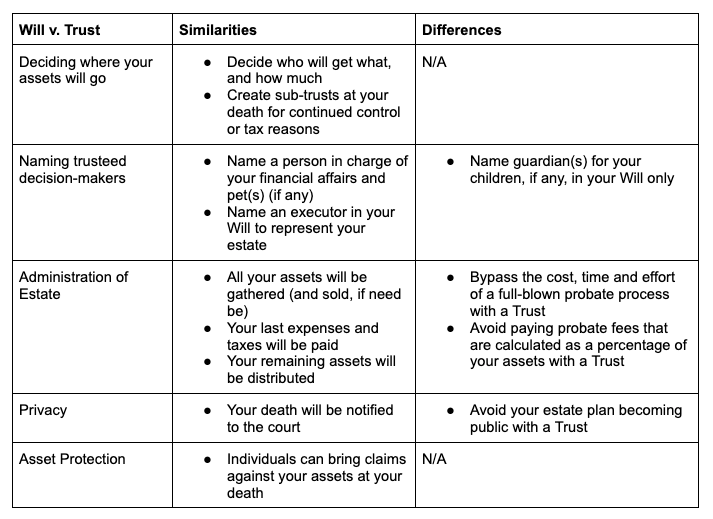
The chart below summarizes the overlap and differences between a Will and a Revocable Trust in most U.S. states.

Trust vs. Will comparison chart

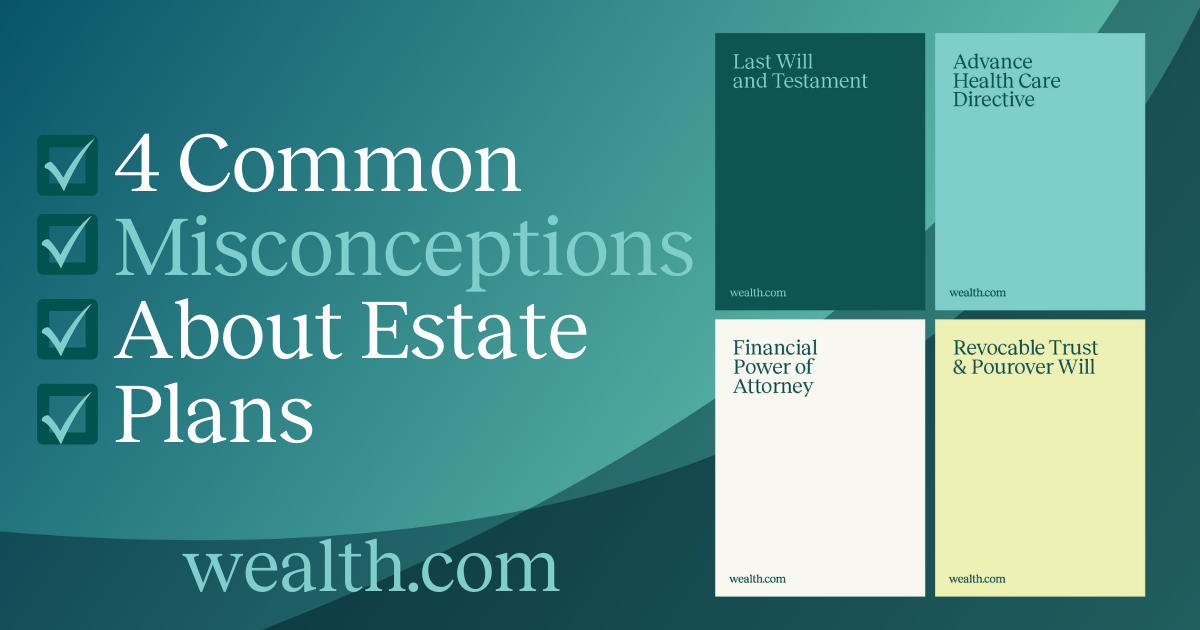
4 Common Misperceptions About Estate Plans

If you don’t have one yet, ask yourself what’s holding you back.

The words most often associated with estate planning are “important” (53%), “responsible” (52%) and “smart” (42%), according to a survey conducted in the U.S. by WALR in partnership with Wealth in December 2021. Yet only 53% of us have an estate plan. What drives this dichotomy?

Put simply: misperceptions.

Here, we examine the top four reasons people aren’t doing the “important, responsible and smart” work of creating an estate plan — and how to get over those hurdles.

Misperception #1: It’s something to do… later.

The survey findings suggest that when it comes to estate planning, people are prone to procrastination. The No. 1 reason respondents gave for not having an estate plan in place is “I just haven’t gotten around to it” (40%), indicating that they don’t consider it something they need to do right now.

But here’s why you should: While nobody likes to think about dying young, if you’re the parent of small children, it behooves you to prepare for the unthinkable. This is where the Will portion of an estate plan comes in. (For the uninitiated, estate plans often include documents such as a Will or a Trust, power of attorney, a health care directive and beneficiary designations, plus regular reviews and revisions.)

To ensure that your children are cared for in the way you want them to be, you’ll need to name who their guardians would be if both parents die before the kids turn 18. Without those arrangements, the courts will intervene and decide who will raise your children.

Even if you don’t have children, there are other people who deserve protection. Surely, you’ve seen this plot on TV: Someone with money dies, and the war between family members begins. It happens IRL, too. One sibling might think they deserve more than another, or one sibling may think they’re well equipped to handle the finances even though they’re drowning in debt. Without a plan in place, you have no control over who settles these debates.

Common Misperceptions About Estate Planning - Wealth.com

Misperception #2: Estate planning is complicated.

You’re not alone in thinking this. For respondents to the survey who didn’t have a plan, 23% said a big reason is that, well, they don’t know where to start—20% said they don’t know anything about what estate planning entails. However, many people find it easy to create the major estate planning documents on their own—as long as clear directions are involved. For example, you can draw up a simple, valid Will using software, online or via an app. (Though you may want to crowdsource to find the most reliable options.)

Of course, if you have questions or need documents that are more specific than what’s offered publicly, you should seek personalized advice from an expert.

Misperception #3: I don’t own much, so I don’t need one.

Remember, an estate plan covers both your finances and your assets. Even if you’re just leaving behind property, if you don’t decide who receives it after you’re gone, you’re relinquishing control of what happens to it.

And even if you think you don’t have much money, when you die, your estate consists of not just the money you use day to day but also your life insurance, the equity in your house, the full value of your retirement plans — and everything else you own. That usually amounts to more than you anticipated.

Misperception #4: It’s too depressing to deal with.

Creating an estate plan forces people to confront both mortality and money, two issues that can be upsetting and tough to talk about. Perhaps reframing the situation can help. According to the WALR-Wealth survey, when people who have an estate plan in place were asked to describe the process of setting up a plan, the most common words they used were helpful, simple, empowering and relieving. But respondents who said they set up an estate plan in response to losing a loved one to COVID-19 were more likely to struggle with the process and describe it as confusing, tedious and, yes, depressing. These findings suggest that when estate planning is done before a stressful life event, it’s just not that bad.

Moreover, life is unpredictable. So why not draw up an estate plan? As Chief Growth Officer of Wealth, Tim White, sums it up, “Creating an estate plan is a genuine act of compassion for your loved ones and your greater community, if part of your plan includes charitable donations. There’s real value in the peace of mind that comes from knowing your legacy — whatever that means to you — will be intact after you die.

Guardianship Explained

Choosing a person to care for your minor children

Nominating a Guardian

To make this safeguard official, name guardians through your Will (or in certain states, a separate Nomination of Guardianship). Your designations will have a lot of weight with the judge who would ultimately decide which guardian would be in the best interest of your children. This is especially important if you suspect that your loved ones might disagree over who should become guardian of your children. Asking the person you choose for this role to be a guardian will not alone show the court your intentions.

You can also make your wishes known through a Nomination of Guardianship, which is a simple document that is separate from your Will and acts as a letter to the judge. However, in most states, the judge may give greater weight to your choice if it is included in your Will because you might have signed your Will before two witnesses and/or a notary.

Picking the right person to be your children’s guardian may be hard. You obviously want someone who knows and loves your children, and most people pick someone within the family. But you also may want someone who lives in the same geographical area, so your children’s lives will not be completely uprooted. Or you might prioritize someone who shares your values or who practices the same religion as you. You also want to consider lifestyle and age. Your brother might be your best friend, but if he’s single and travels extensively, is full-time parenting the right fit for him? Same for your own parents, who might not be able to provide the kind of care your child needs as they age.

You also can name backup guardians in case the person you choose as the primary guardian is unable to take on that role.

Whomever you choose, you should talk through the decision with your children’s other parent and with the potential guardians. Be open to the possibility that the other parent may have different wishes and that  someone you trust so much may not feel up for the responsibility.

Other Considerations

Families and plans change over the years. The best friends you named as guardians when your first child was born may no longer be as close to you, may have moved away or gotten divorced. You may now have four kids instead of one, so it would be overwhelming for the guardians to take care of all of them in addition to their own children. Just as with all parts of your estate plan, you should regularly re-evaluate and updated your guardianship nominations. To name new guardians for your children, update your Will or Nomination of Guardianship in accordance with your state’s estate planning laws. Finally, make sure you coordinate your nominations with your children’s other parent to avoid confusion and conflict.

What Happens to Your Social Profiles When You Die?

Tips on dealing with your digital afterlife in your estate plan

No matter how many fans, followers, or friends we have in this life, at some point we’re all going to die. Here are some of the most common questions people have about what happens to their social media presence after they’re gone.

Q: What happens to my social media accounts when I die?

A: The short answer: Nothing. Not automatically, anyway. Unless you take steps to outline your wishes—or adjust some simple settings on Facebook—your accounts will remain visible and “active.”

Q: How will my loved ones get access to my social media accounts?

A: As with your financial accounts, you’ll want a secure way to provide usernames, passwords, and any multi-factor authentication information to the person you designate. Remember, your Will is not the best place to reveal this information because it can become part of the public record.

There are many options for securely storing your social media access information, but we hope you’ll consider using our bank-level encrypted Vault where you can feel confident filing any important documents you want secure cloud-access to.

Q: How do I designate someone to manage my accounts?

A: Each social media platform has its own policy concerning the accounts of people who have died. They are all likely to evolve over time as this issue becomes more and more relevant. In less than 50 years, Facebook will have more dead members than living ones, so it’s not a problem that can be ignored.

In Facebook’s General Account Settings, under Memorialization settings, you can request to have your Facebook profile permanently deleted after you die or identify a Legacy Contact to look after your account. That person can accept new friend requests, manage tribute posts, delete posts, change the profile picture, and remove you from tags, but they cannot see your messages or add or remove friends.

Instagram, Twitter, and LinkedIn accounts don’t yet have the same “legacy” option. However, those accounts can be deleted by a direct family member or person you’ve designated as your power of attorney by providing proof of your death.

Q: How do I decide if I want someone to delete or deactivate my social media accounts?

A: Figuring out the future of your Facebook page may seem like a slightly silly discussion topic amid all the other important end-of-life decisions you need to talk about with your family. But as with many things concerning your estate, they are the ones who have to live with the decision. Talk with them to see how they feel. A couple things to think about: Some family members might think of your social posts and photos as akin to a diary and would never consider deleting something so priceless. On the flip side, those helpful birthday reminders and “you have memories” notifications that social sites send could be painful, especially while your loved ones are still grieving. Keeping a social media page but having the legacy contact turn off notifications can be a good compromise.

The Most Common Estate Planning Mistakes and How To Avoid Them

With many things in life, when you make a mistake, you fix it, learn from it, and move on. With estate planning, though, your mistakes may not manifest until after you’re gone. No learning, no fixing, no moving on. These mistakes can have lasting effects for your loved ones—from simple to serious—so let’s take a look at how you can avoid the six most common estate planning errors.

1. Not making a plan.

Let’s get the biggest estate planning mistake out of the way first. You need some sort of estate plan in place to ensure your loved ones are taken care of after you die. You can make all the excuses you want—I’m not old enough, or rich enough, or smart enough to make a plan—but we’re here to help make it a simple and smooth process.

2. Not talking about your plan.

Discussing your estate plan with your loved ones and your executor or trustee guarantees that they are clear about your wishes and won’t be confused or surprised regarding anything in your documents. It also provides an opportunity for candid conversations about what your beneficiaries really want. For example, you might think that leaving your house to your daughter is a great gift, but she might be planning to move out of state. Talk through issues like these, because your estate plan is meant to prepare, not burden, your loved ones. While you’re having these discussions, be sure to note where your original, signed estate planning documents are located (in a safe deposit box or file cabinet, or with a lawyer), and if you’re storing any electronic copies on your computer or online (like in the Wealth Vault) and how to access them.

3. Not thinking more broadly about your legacy.

It might seem easiest when you’re creating your estate plan to leave everything to one beneficiary. Don’t forget: your estate plan is your last opportunity to leave something meaningful to your favorite charity or someone who would find the most meaning in a prized possession of yours. Your estate encompasses all your possessions. Perhaps you would like to leave old photographs with your niece, who keeps the family genealogy, or you would like to leave a last cash gift to the animal shelter where you have volunteered for years.

4. Not leaving a full inventory of your assets.

When it comes time to distribute your assets, your executor or trustee will need to gather (marshall) all your assets. Without an up-to-date record of everything you own, some assets can get lost. Retirement accounts, storage units, safe deposit boxes, and cryptocurrency are all commonly forgotten or lost during administration. If these assets are left unclaimed, they may never make it to your chosen beneficiaries. For example, it’s estimated that over 20% of all 401K funds are lost or forgotten.

5. Neglecting your online assets.

Maybe your grandparents didn’t have to worry about digital assets, but nearly everyone today has some sort of online account that will need to be managed after their death. You should think about whether you want your loved ones to take down (or continue to manage) your social media accounts, preserve important files you stored in the cloud, access software for smart systems that run your house, and download your digital photos. Consider leaving the usernames and passwords for your smartphone and most important online accounts with your estate planning documents.

6. Forgetting that your estate plan isn’t just for after you die.

Several important estate planning documents help you manage affairs while you’re still alive. Establishing a financial power of attorney and a health care power of attorney will appoint someone to help with legal, financial, and medical decisions when you’re unable to make them for yourself. For some people, setting up a trust allows a trustee to step into your shoes more easily if you need help managing your affairs during your life.

Whether you’re creating your estate plan from scratch or updating an existing plan, being aware of these common mistakes can help you avoid them.

Having Difficult Conversations About Estate Planning

A How-To Guide for talking to the people you love about what happens when you die:

Most of us have been taught that politics, religion, and money are topics to avoid with family and friends. They are charged with emotion, highlight our differences, and lead to some uncomfortable interactions. Another topic people tend to avoid talking about—especially with our families—is what happens when we die. You know it’s important, but you steer clear of it anyway.

We want to help you to be better prepared to approach these awkward, but necessary, conversations about end-of-life preparations. Whatever your family dynamics look like, there are tips and tools you can use to have more empathetic conversations with your children, siblings, parents, and other loved ones.

Talking With Your Kids

Losing a parent is hard on a child, regardless of the child’s age. But how you prepare your children for when you are gone will change over time as they grow older. School-age kids should be comforted knowing they’ll be taken care of by someone who loves them. As they become older teenagers and adults, it’s time to have more candid conversations about your estate plan, especially if you’ve selected one or more of them to be your:

They don’t have to be privy to every element of your plan, but it can be helpful to keep them in the loop on the location of your estate planning documents and how to access other accounts as needed.

If you’ve selected one of your children over another to be part of managing your estate, you might want to discuss your rationale—one child lives closer, is more organized, or is older—so there are no hard feelings among siblings. If your children will be responsible for your last wishes, outline the details in your estate plan and also discuss what you want to happen to your body (cremation, burial, donating your body to science), as well as specific instructions for your funeral or other type of celebration or ceremony. This also is an opportune time to discuss end-of-life health care decisions. A 2021 study found that although 90% of people think having conversations about their end-of-life healthcare decisions is essential, just over a quarter (27%) have done so. If you have an advance directive or living Will, your wishes should be spelled out, but discussing them out loud ensures there are no surprises.

Talking With Your Parents or Older Relatives

Once you’re an adult, it’s time to discuss with your parents what kind of plan they have in place. If you know they’ve neglected estate planning, you and your siblings or other relatives are going to be the ones trying to clean up the chaos when they die.

At some point, you also may be the person left to care for older aunts, uncles, in-laws, or grandparents. If these individuals have not designated anyone else to manage their affairs, discuss making your role more official, such as naming you as the agent in their powers of attorney, so you’ll be able to take care of financial and healthcare decisions for them.

If you have a good relationship with your siblings, try to get aligned before having a conversation with your parents so everyone is on the same page. And if you can’t seem to make any headway simply talking about the topic, try sharing informational articles, walking them through a digital estate planning site, or scheduling an appointment to meet with an estate planning attorney. You can’t force them to create an estate plan, but you can help to demystify and simplify the process for them.

Having The Talk

You don’t want to ruin a family celebration by talking about death, but if the holidays or birthdays are the only time you get together as a family, set aside a separate chunk of time to have an estate planning discussion. Be prepared for some emotion and be open to questions and differing perspectives. It’s important to be honest but not overwhelming. These are important decisions that need to happen, but they don’t all have to be finalized in one conversation. Focus on the fact that estate planning provides peace of mind for everyone—both the person dying and their loved ones left behind.

Having a loose agenda or checklist of topics can help ensure you cover all the essentials. Be sure to include Wills or Trusts, financial power of attorney, and healthcare power of attorney.

Who Needs an Estate Plan?

Six reasons people think they don’t need one when they really do

TL/DR:

In short, everyone can benefit from having an estate plan. There is no specific income threshold or criteria to meet in order to need an estate plan or gain the benefits from having one in place. Your circumstances and personal wishes are what guides how estate plans are created, but the specifics of your life shouldn’t prevent you from realizing the benefits of having an estate plan.

This article explains under what specific circumstances you might need an estate plan and why the reasons you think you might not need one aren’t always true.

_______________________________________________________________

For many people, the word “estate” in estate planning conjures up images of a mansion with servants and grand staircases and probably a stable out back. Most people don’t see themselves in those images, which means they relegate estate planning to the über-wealthy. The result? You likely have formed a few misconceptions about who needs an estate plan, confident in your belief that it’s simply not for you. But that’s a costly mistake many people make. Here, we bust six of the most common myths about who needs an estate plan.

Myth 1: Not me, I’m not rich enough.

Do you have a savings account? A car? A dog? These are not the trappings of the rich and famous, but they are parts of your estate that will need to be taken care of or find a new home when you die.

Reality: Yes, you have an estate, which is really just a fancy word for all your stuff. There is no minimum net worth that triggers a need to create an estate plan, but rather a series of decisions you can choose to make. Otherwise, you will let laws drafted long ago determine where your stuff should go and a judge who has never met you might decide who should manage your affairs and take care of your kids. You may already have designated a beneficiary for some of your accounts—your 401(k) and life insurance, for example. But that’s just a first step toward a plan; estate planning is the best way to direct how the rest of your property and possessions should be divvied up.

Myth 2: Not me, I’m not old enough.

We get it—lots of people put off estate planning because it makes them confront the idea of death. But guess what? It’s going to happen to all of us, and none of us know when, so it’s better to be prepared, right?

Reality: You can start estate planning as soon as you turn 18 (and in some states, even younger!), but the real trigger is when you start acquiring things—money, real estate, vehicles, collections—that you want to protect after you die. And, of course, having kids is one of the biggest reasons people start thinking about estate planning.

Even in their 20s, most people have possessions they’d like to see passed on to family members or other loved ones. You may be worried that no one in your family would know to give your pets to your neighbor or friend, rather than surrender them to a shelter. Or, if something were to happen to you, you feel strongly that you would want certain family members (but not others) to manage your affairs or make medical care decisions for you.

Group of young people taking a selfie.

Myth 3: Not me, I don’t have any valuable property to pass down.

Just because you don’t own real estate doesn’t mean you don’t need an estate plan.

Reality: Often value is in the eye of the beholder. Maybe you and your favorite nephew have always shared a passion for model trains and you would want him to end up with your train set that he always admired. Or you would like to make a last cash gift to your favorite charity as part of your legacy. You can include instructions in your will about sentimental possessions too, ensuring they are preserved and appreciated by future generations.

Myth 4: Not me, my family knows exactly what I want to happen when I die.

Do they really? Are you sure? Do they know your feelings about organ donation, and would they respect them? If your family situation is calm and uncomplicated, that may be true. But that’s not most of us.

Reality: Making an estate plan is a gift to your loved ones that protects and provides for them while clearing up any confusion about your wishes. If something were to happen to you, it will be an upsetting time for those who step in to make the toughest decisions on your behalf. There could be disagreements about your treatment and care, who should sign paperwork on your behalf, and where your stuff will end up. When you take the time to put instructions into documents like an advance health care directive, a financial power of attorney, and a Will and/or Trust, you eliminate second-guessing and free your loved ones in making those tough decisions.

Myth 5: Not me, I don’t have kids, so I don’t need a Will.

Writing a Will that designates guardians for minor children is a commonly cited objective for estate planning, but it’s not the only one by a long shot.

Reality: If you die intestate (without an estate plan), your possessions and property will pass to your children or spouse in some proportion that varies by state law. But if you’re single and don’t have kids, then it actually makes it more complicated to decide what to do with your stuff. Depending on the state, all of your stuff might go to your parents, otherwise your siblings. If you want anyone else – a nephew, friend or charity – to receive anything from your estate, however small, you need an estate plan.

Myth 6: Not me, I’m not dying anytime soon, so I don’t need to worry about estate planning now.

The COVID-19 pandemic taught us a lot of important lessons about living in the moment, including facing our own mortality. It’s a wake-up call that many of those ages 18 to 34 heard loud and clear. In 2021, 63% more people in that age group created a Will than in 2020.

Reality: In addition to being prepared for the unexpected, there’s a very important part of estate planning that many people forget about because it covers what happens when you’re alive. Signing an advance health care directive and financial power of attorney are two estate planning steps that allow someone else to make decisions on your behalf and grant signature authority over your affairs. The advance health care directive, when it includes a living Will, also clarifies your wishes for the type of medical care you want to receive if you are unable to make decisions for yourself or communicate for yourself.

The bottom line:

Everyone can benefit from an estate plan regardless of circumstance. That doesn’t mean everyone’s estate plan will look the same, it just means that the answer to “who needs an estate plan” is… me.

Ready to get started?

We can help you create, manage, and visualize your estate plan using our comprehensive and secure platform, without needing any outside help.

Announcing Emergency Access

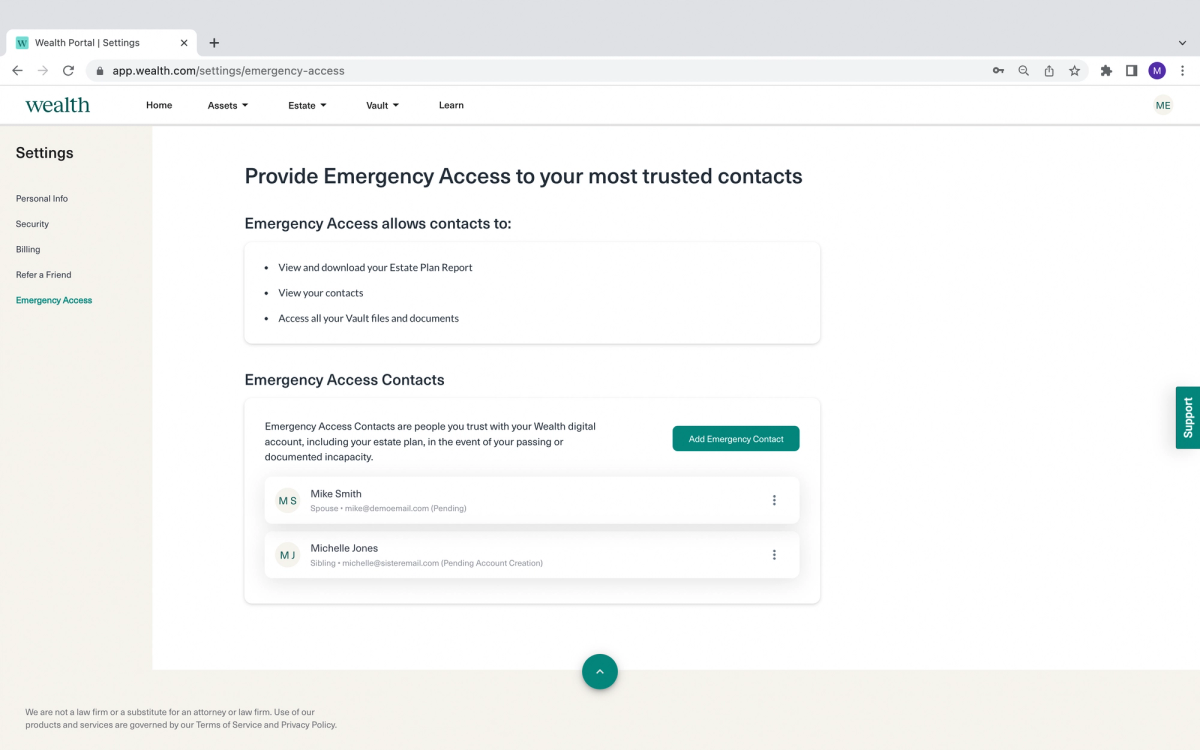
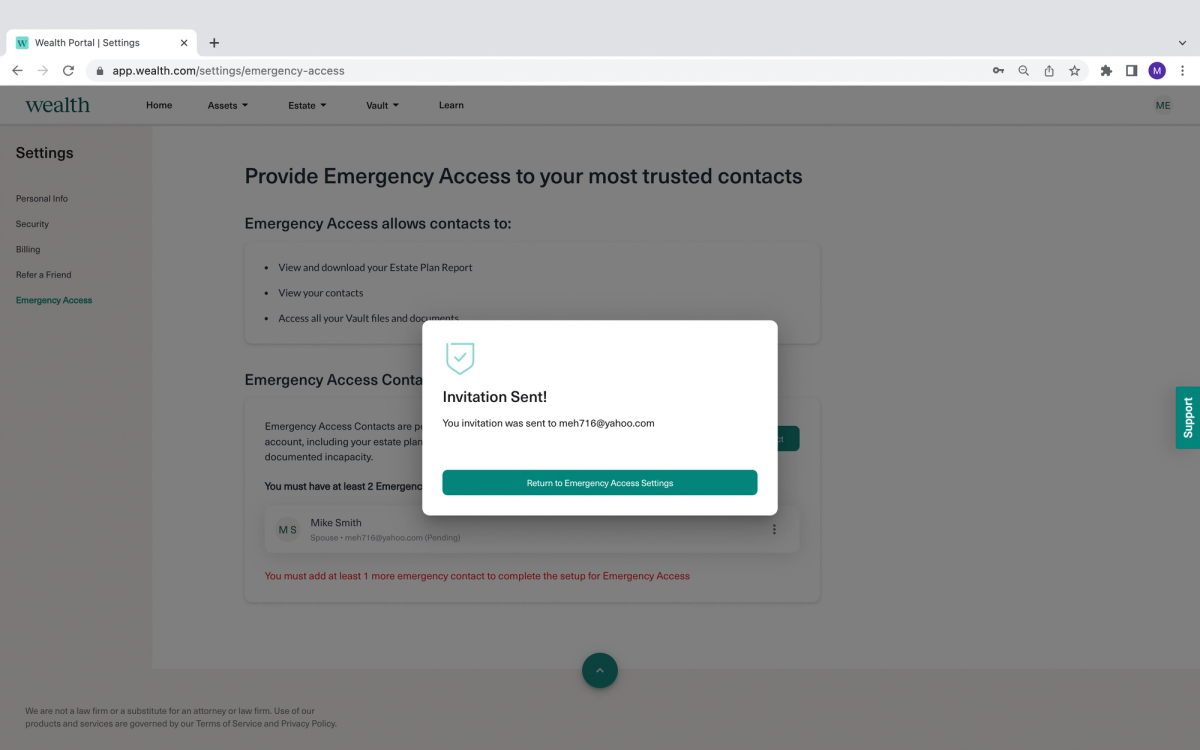
Wealth is pleased to announce our Emergency Access feature is now available. With Emergency Access, you can select at least two trusted individuals who will receive access to your Wealth account, estate plan and other essential documents in the event of an emergency.

To set up your Emergency Access:

  • Go to Settings
  • Select Emergency Access
  • Click “Add Emergency Contact”

2023 IRS Inflation Adjusted Numbers Reference Guide for Estate Planning

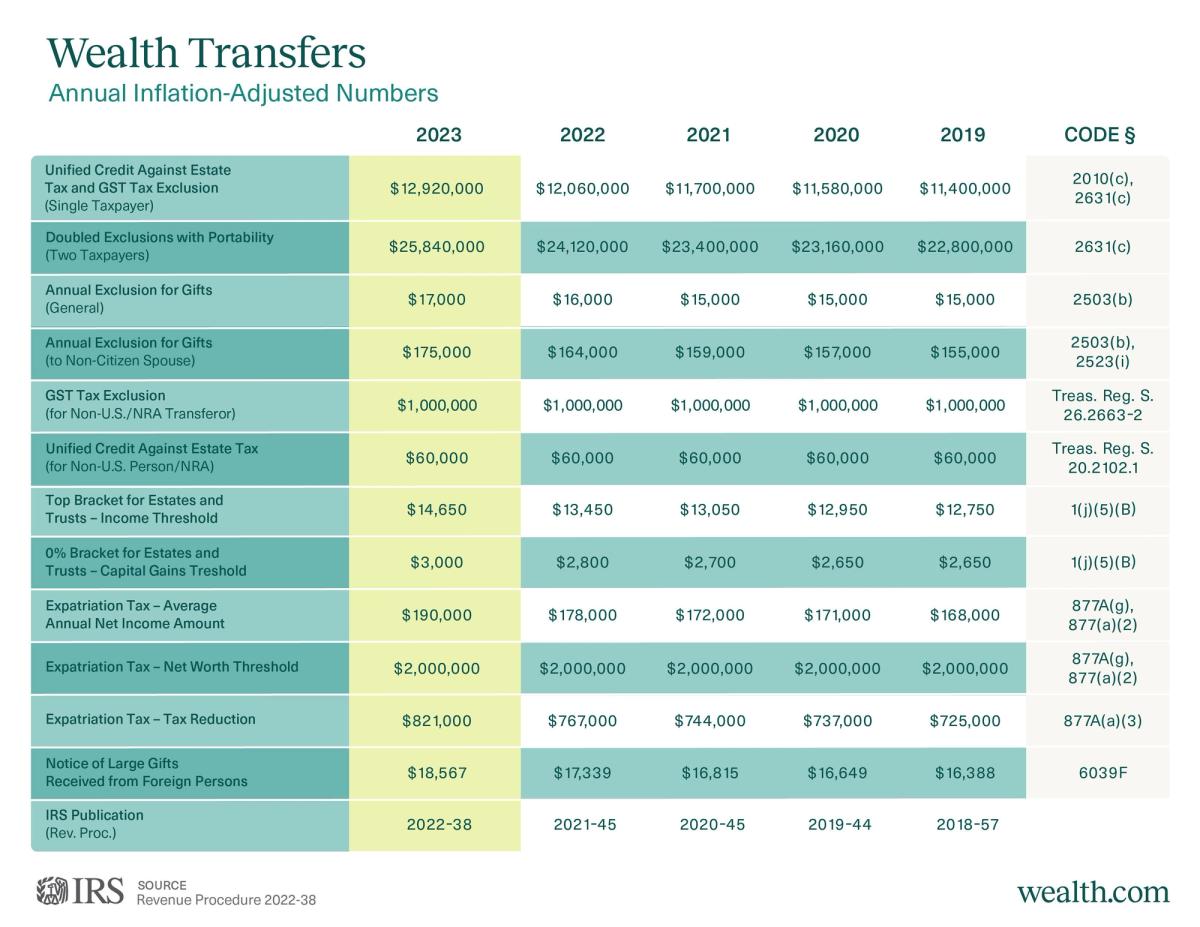
The IRS just released its inflation-adjusted numbers for 2023, which have fairly significant implications for wealth planning.

Our legal team reviewed Revenue Procedure 2022-38 and pulled out only the numbers most relevant for wealth transfer planning into one chart, plus historical information and legal sourcing. It is meant to be your handy, downloadable and printable, one-page reference guide when planning (and reporting) taxable gifts or implementing estate freeze strategies in the coming year.

The chart below is geared toward individual taxpayers, and their advisors, who are thinking about tax planning by leveraging wealth transfer techniques.

Wealth.com Wealth Transfers Annual Inflation-Adjusted Numbers Chart

Use Cases

These are a few examples of how our IRS Inflation Adjusted Numbers Chart might be helpful:

Example 1

If you are an advisor with clients who are married and are wealthy enough to be considering lifetime wealth transfer strategies in the coming year — like setting up an irrevocable trust and gifting significant assets into that trust — you might find it relevant to know the federal estate and gift tax exemption amounts not only for one spouse, but both spouses (taking into account portability), without having to sift through the full IRS publication. Our chart helps calculate adjusted thresholds quickly.

Example 2

To understand whether your clients are making taxable gifts and whether to file a gift tax return (Form 709), you will need to know the annual gift tax exclusion amounts, which can be found in our chart below.

Example 3

If you are working with a donor or gift recipient who is a non-resident alien (i.e., a non-U.S. person for estate and gift tax purposes), these thresholds can be dramatically different from those you are used to working with when advising a U.S. person. These numbers are particularly cumbersome to track down because many of those thresholds are not adjusted for inflation from year to year.

Example 4

When gauging whether to establish the irrevocable trust, you may want to take into account the income tax costs from the compressed tax brackets of a trust compared to those for an individual, and weigh those income tax costs against the estate tax savings.

Example 5

Other specific issues may apply to your clients’ situation in the wealth transfer context. Your client may be considering expatriation or renouncing their green card or citizenship, or may be receiving large gifts from abroad themselves, triggering reporting requirements.

Download the PDF

2023 Chart
1 9 10 11