Individual vs. Joint Trust: How to Decide Which is Right for You

So you and your spouse, or partner, are creating your estate plan for the first time. Early on in the process, you’re likely to be faced with the decision of setting up a single Joint Revocable Trust or separate Individual Revocable Trusts.

Knowing which is best for you both may not be immediately obvious, and you should take the time to understand the differences between the two to come to a decision.

There are a lot of factors you should consider, including:

  • Your estate planning and legacy goals and wishes
  • Your family situation, e.g. if you have previous spouses or a blended family
  • If separation or divorce is a concern
  • If asset protection from creditors or legal issues is a concern
  • If you and your partner are legally married or not

The article below digs into these factors as well as the pros and cons of each type of trust to help you make an informed decision about your estate plan.

First, do you need a trust?

If you’re not sure if you should have a trust in your estate plan—let alone choose which type of trust—here are a few reasons why you should consider having one in place:

  • To avoid probate. Trusts help bypass the probate process, which can be lengthy and costly, so that your assets are distributed quickly and privately.
  • To protect and control asset distribution. Trusts provide a way to protect assets from creditors, lawsuits (like divorce), and even from mismanagement by beneficiaries by providing specific instructions for how assets are distributed to them. The grantor (the person who sets up the trust) can include further instructions for how their assets in the trust should be distributed and to whom.
  • Planning flexibility. Trusts can be tailored to meet a number of goals and wishes, from providing for children or those with special needs to laying out how a business you own should be dealt with after your death.
  • Tax efficiency. Depending on the trust and how it’s structured, you may be able to minimize estate and gift taxes, leaving more of your assets to pass onto your beneficiaries.

It should also be noted that this article is focusing on revocable trusts. As the name suggests, a revocable trust can be “revoked” or updated by the person(s) who set it up. Sometimes referred to as “Living Trusts,” they allow for more flexibility in your estate planning, especially if you expect your situation to change in the future.

An irrevocable trust, on the other hand, cannot be easily revoked or changed. However, an irrevocable trust—and there are multiple types—are often used for greater asset protection and tax strategies, as assets placed in them can be removed from your taxable estate. Though this could often result in the grantor losing control of those assets placed in the trust. Irrevocable trusts are also often used by those with more complicated and/or high-net-worth estates.

That said, revocable trusts are a great vehicle for many people due to their flexibility and ability to both help avoid probate and provide a seamless transfer of assets upon your death.

As a couple, your next decision is whether to create and maintain separate trusts or create one together. Below, we go through some factors that can help you decide what is best for you and your spouse or partner.

What is the difference between an individual trust and a joint trust?

If a couple opts for individual trusts, each person will create their own trust separately. This means both you and your significant other will maintain control over your respective trust, allowing each of you to independently manage your assets. Each person is able to determine how their assets are distributed, name their own beneficiaries, and set specific terms for how their trust is managed.

Alternatively, a joint trust is a single trust set up by both of you together. Assets are combined into one entity and managed jointly by you and your significant other. This represents a unified estate plan for your shared financial goals and intentions.

What are the pros and cons of an individual trust?

Just because you are married, or in a committed relationship, it doesn’t necessarily mean a joint trust is the right, or best, decision for you.

Individual trusts allow each spouse or partner to have control over their assets and their estate plan. Having separate trusts could make sense for couples that may differ in their approach to who should control which assets or how those assets should be distributed after their respective deaths.

You may also want separate trusts if you have concern over how your spouse or partner may handle certain assets after you pass.

Here are some factors that you should consider about an individual trust:

Strengths of an individual trust

1. Simple administration upon death

With an individual trust, asset administration becomes more straightforward upon death. It reduces confusion because the assets are already segregated between you and your deceased spouse. This helps streamline the process of transferring assets to the beneficiaries named in the deceased spouse’s trust.

2. Separate control over your estate plan

If you and your significant other prefer to have separate control over your assets, an individual trust allows for that rather than tying assets together in a single trust. This could be a benefit for those that may have previous marriages or children from a prior relationship and want to manage assets for those beneficiaries separately. It can also be a benefit in case you separate or divorce, since your estate plans are already separated and can help protect assets in any potential legal proceedings.

3. Allows for certain spousal gifting strategies

Individual trusts can simplify certain financial strategies, such as gifting assets to your spouse or significant other. For example, if one spouse needs to qualify for Medicaid, their assets can be moved out of their name and into the other spouse’s name. This allows one spouse to qualify for Medicaid benefits while still protecting the assets of the healthy spouse. It should be noted in the Medicaid example, however, that laws differ by state and you’ll want to understand the laws in your state if this may be a priority for you both when creating your estate plan.

4. Asset protection in certain situations

Individual trusts may protect assets in situations where one partner is exposed to legal or financial risks. By keeping assets separate, this could shield the other spouse from exposure to creditors or lawsuits.

5. Greater flexibility for beneficiaries

Individual trusts create more flexibility for couples that may have blended families or differ in their goals for how their assets should be distributed. Each person can structure their estate plan to suit their individual goal without needing to compromise the other person.

Weaknesses of an individual trust

1. Complexity during life

Having two separate trusts can certainly create complications for you and your partner. Especially if you want to keep the balance between both relatively equal. Doing so requires frequent monitoring and adjusting, which could be more time-consuming compared to a joint trust.

2. Higher administrative costs

Creating two separate trusts could result in higher legal and management costs. Each trust also requires its own documentation and could result in separate tax filings, which could create additional costs over time.

3. Potential for conflicts in decision-making

With each partner or spouse having full control over their own trust, this could lead to conflicts if both of you are not completely aligned on your financial and estate planning goals. This could be about which assets are put into each trust, if the trusts are equally balanced (or not), or if changes should be made to one, or both, of the trusts.

What are the pros and cons of a joint trust?

Creating separate individual trusts could require more oversight and frequent adjusting, but it could also lead to more streamlined decision making and execution upon death.

That said, a joint trust may require less management while you’re alive but it could create more complications at death or if you and your significant other were to separate.

Here are some factors to consider about a joint trust:

Strengths of a joint trust

1. Simplified and convenient asset management

Unlike needing to manage two separate trusts, you and your significant other will have all assets consolidated into a single trust. This helps reduce the paperwork and complexity of managing multiple trusts and also streamlines the process of moving assets into a single trust. If you want to make updates, it’ll be easier to do with a single trust versus separate ones.

2. Reflection of shared goals

A joint trust provides a cohesive estate plan that reflects the financial plan of both you and your spouse. It helps both partners agree on a single approach for how assets are to be distributed and aligns legacy planning.

3. Easier administration upon death

A joint trust creates a smoother transition of assets when one partner dies. With assets already consolidated and clearly designated, it creates even more protection from probate and allows for a smoother transfer process to the living spouse and/or beneficiaries.

4. Fosters clear communication

With a joint trust, both partners need to be on the same page. While that could cause some tough conversations up front, before the trust is created, it helps foster open and clear communication about what your shared goals and wishes are. It also creates transparency in handling shared finances.

Weaknesses of a joint trust

1. Complications in the event of divorce or separation

A joint trust can be problematic if you get a divorce, or decide to separate, since both of your assets are combined in a single legal entity. This can make dividing those assets time-consuming and, potentially, costly due to legal disputes. This can all be compounded if there’s a blended or complicated family situation.

2. Conflict due to differing estate planning goals

While creating a joint trust can help open up communication between you and your spouse, it can also lead to conflicts if you’re unable to resolve differences. For example, you may have a dispute about leaving assets to children from a prior marriage or which of your children should receive a certain family heirloom. Both of you must agree on the terms of the trust and it creates the possibility of opening up disagreements.

Even after a joint trust is established, you must both agree on any updates or changes you’d like to make. If one spouse wants to make an update, but the other disagrees, this can obviously create a conflict.

3. Potential lack of asset protection

Unlike two individual trusts which can help shield assets if one spouse runs into financial or legal issues, a joint trust means your pooled assets are potentially at risk in these situations.

Further factors and considerations when choosing a trust

Beyond these pros and cons for each type of trust, there are other factors that you should consider when deciding which is best for both of you.

These include:

Estate size and complexity: Larger estates or those that may involve more complex needs or distribution rules may benefit from individual trusts while a joint trust may be preferred for simpler estates.

Blended families or previous marriages: If you or your partner have previous spouses or children from a prior relationship, you may opt for individual trusts to separate control over certain assets.

For example, if you and your spouse have a joint trust and after one of you passes, a family member is upset that they are not named as a beneficiary, or are unhappy with the terms of the trust, they could try and contest it in court. If they are successful, that could throw out the entire trust for the spouse that’s still alive.

Your goals for managing your estate and finances: Some couples prefer to manage their finances jointly, while others prefer to do so separately. That doesn’t mean your estate planning needs to match but you should consider if you and your partner prefer to keep things separate or want to manage your estate together.

The state where you live: There may be nuances depending on the state where you live that could affect whether a joint or individual trust is the best choice. For example, if you live in a community property states—meaning assets acquired during marriage are jointly owned by both spouses, regardless of which person actually is named on the title or earned the income—a joint trust may make the most sense.

Currently, there are nine community property states: Arizona, California, Idaho, Louisiana, Nevada, New Mexico, Texas, Washington, and Wisconsin. Alaska is also a community property state but only if both spouses opt in through a community property agreement.

Furthermore, how your state deals with estate tax may impact your decision to have joint or individual trusts. An example would be in a state like New York, which has a state estate tax that’s separate from the federal estate tax. Individual trusts may make sense in this case so that each spouse’s estate is able to use their full estate tax exemption. With a joint trust, you may forfeit some of those tax advantages because assets become blended between you both.

Whether you’re legally married or not: For those that aren’t legally married, a joint trust could complicate issues—especially if you and your partner don’t or can’t file joint tax returns. If you each need to file separate, individual tax returns, you’ll need to keep track of the income generated in the trust separately.

This can lead to tax reporting and accounting complexities, particularly when it comes to dividing trust income, capital gains, or deductions because each person must accurately report their portion of the earnings. Furthermore, having a joint trust can blur the lines of ownership which could complicate the issue even more.

Should you choose individual trusts or a joint trust?

Ultimately, the decision comes down to your goals and wishes each of you have.

If you have a simple estate, have no concerns about divorce or separation, and are in agreement with how your assets should be managed while living and after death, a joint trust is likely a good choice.However, if your estate is complex, your assets are considered high- or ultra-high-net-worth, you prefer to manage assets separately from each other, or have different views on how certain assets should be distributed, creating separate individual trusts may make the most sense.

You and your partner should sit down and discuss these with each other, and understand how you each want to approach legacy planning. It’s always recommended that you also discuss these factors with your financial advisor, CPA and/or an attorney in your state to help weigh the pros and cons against the financial plan you already have.

Also remember, both types of trusts are revocable—meaning they can be undone. While doing so could be messy depending on the terms of the trust, it’s something that can be done if needed.

If you want to learn more about the difference between individual and joint trusts, and how to approach choosing one, listen to this Practical Planner episode.

Ready to deliver the #1 rated digital estate planning platform to your clients? Book a demo to learn more about our comprehensive solution.


What to Know About Naming a Trust as a Beneficiary of Your Retirement Account

A critical part of estate planning is deciding how to distribute your retirement assets, such as IRAs or 401(k)s. You can name either individuals or a trust as beneficiaries of your retirement accounts. This strategy can offer certain benefits, particularly in terms of control and protection, but it also comes with potential tax implications and administrative complexities. That’s why those considering naming a trust as a beneficiary should approach the decision very carefully.

That said, the decision ultimately comes down to what your goals and priorities are. So it’s important to consider the potential benefits and disadvantages of naming a trust, and how that may affect your overall estate plan.

In this article, we explain all you need to know, including pros and cons of naming a trust for your IRA, to make the most informed decision you can.

What are the benefits of naming a trust naming a trust vs. individual as an IRA beneficiary?

There are a number of reasons why you may want to choose a trust as your IRA beneficiary. But, the main reasons are usually about exercising control over how the assets are distributed and to provide potential protection from creditors.

Here are a few reasons why it may make sense for you:

1. Control over the distribution of assets

If you have beneficiaries who are minors, have special needs, or lack financial responsibility, naming a trust provides more control over how retirement account assets are distributed. You can specify conditions in the trust, such as age milestones for access, specific uses for the funds, or annual withdrawal limits.

2. Protection from creditors or divorce

A trust can act as a barrier from potential creditors, lawsuits, or divorce proceedings. Naming a trust as the beneficiary can help prevent the funds being accessed in those types of situations.

3. Multi-generational wealth preservation

A trust can be used to help preserve assets from a retirement account for future generations, such as children or grandchildren, by staggering the distribution over many years.

4. Managing complex family dynamics

If you have a complex family dynamic, such as a previous spouse, children from previous relationships, or estranged family members, naming a trust as the beneficiary can ensure assets are distributed according to your wishes if there are any family disputes, rather than being distributed according to default state laws.

5. Centralizing asset management

Naming a trust can be part of a strategy to consolidate multiple types of assets under a single entity, making it easier for a trustee to distribute according to your wishes, as well as handle any other administrative tasks or investments. This may be particularly relevant for those with larger estates or managing multiple beneficiaries.

Even if any of these reasons are a priority for you, you should still understand the potential disadvantages of naming a trust before following through, if only to make sure you fully understand the decision and you’re not hit with any surprises.

What are the disadvantages of choosing a trust as your retirement account beneficiary?

The primary drawback of naming a trust as a beneficiary of an IRA or 401(k) mainly has to do with taxes. Trusts don’t typically enjoy the same tax advantages of an individual. For instance, it’s much easier for a trust to hit the top tax bracket—37%—than it is for an individual.

Here are some common disadvantages of naming a trust as a beneficiary of your retirement account:

1. Trusts have higher tax rates

Because trusts have more “compressed” tax brackets, they reach higher tax rates at much lower income levels than individuals—hitting the highest rate at just $15,200 of income. This risks reducing the amount passed onto the people named in your trust as beneficiaries.

It’s important to note, however, that there are ways to get around having the trust pay the taxes (more on this below).

2. Less flexibility

Once you name a trust as the beneficiary, changing it later could prove complicated—though not completely undoable. But, remember, trusts are legal entities that include special instructions and may have limited ability to adapt to beneficiary needs, law changes, or just your overall wishes, especially if it’s an Irrevocable Trust.

3. Risk of mismanagement by the trustee

A trust requires you naming a trustee, someone to oversee its management, including the distribution of funds and other administrative tasks. While a trust includes special instructions, some may not be “codified” and may be left as recommendations the trustee should follow but isn’t required to follow.

While the trustee should be someone you trust to manage everything, there is always the possibility that someone that’s inexperienced or has conflicted interests may not do so effectively.

4. It can introduce numerous complications

Naming a trust as a beneficiary, unlike a person, can complicate how funds are withdrawn and taxed. These rules vary by the type of trust, making it difficult for an inexperienced trustee to manage without help from professionals like attorneys, financial advisors, or tax experts..

Again, these are just a few potential drawbacks. It’s also important to dig into a bit more about taxes, withdrawal rules, and the impact of 2019’s SECURE Act.

How the SECURE Act of 2019 impacts naming a trust as a beneficiary

2019’s SECURE Act made major changes to inherited retirement accounts, with the IRS issuing its final regulations in 2024. These had some major implications on how One of the biggest updates is that many who inherit a retirement account would be subject to the 10-Year Rule and required minimum distributions (RMDs). This rule also applies to trusts in most situations. Here’s what you need to know about navigating these changes.

Loss of the “stretch” rule

Previously, most trusts could stretch retirement account distributions over a beneficiary’s life expectancy. However, the SECURE Act now limits this period to 10 years, creating potential tax challenges.

Trustees face a decision: either spread withdrawals over the 10-year period or take smaller required minimum distributions (RMDs) annually and withdraw the bulk in the 10th year. Both strategies risk higher tax brackets because the IRA or 401(k) must be emptied by the end of the 10 year period.

In some cases, a 5-year rule may apply instead of the 10-year rule, which could present even greater tax disadvantages, depending on the type of trust.

When the 5-year withdrawal rule applies

The 5-year rule may apply in the following circumstances:

1. Non-designated beneficiaries. If you name a non-designated beneficiary, such as a charity or estate when the account owner dies before their RMD age, and the beneficiary does not qualify for the 10-year rule.

2. If the trust does not qualify as a “see-through” trust. A trust must meet certain conditions to be considered “see-through.” If not, the 5-year rule may still apply.

How to avoid the 5-year withdrawal rule

To avoid the 5-year withdrawal rule, the trust being named as the beneficiary of an IRA or retirement account must be considered a “see-through” trust. If it is considered a “see-through” trust, then the 10-year rule will apply, per the SECURE Act (again, the “stretch” rule would have applied prior to the SECURE Act).To be considered a “see-through” trust, it must meet four requirements:

1. The trust must be valid under state law.

2. The trust is irrevocable or becomes irrevocable at the death of the grantor (the person who set up the trust).

3. The beneficiaries of the trust are identifiable.

4. The trustee has provided the custodian of the retirement account with the trust document by October 31 of the year that follows the grantor’s death.

Once the trust has been established as the “see-through” trust, it must then be determined what the payout period is for the IRA based on the underlying beneficiaries. This depends on whether the trust is a conduit trust or an accumulation trust.

Here are the differences between the two:

Conduit Trust: This type of trust requires that all IRA distributions are paid directly to the trust beneficiaries. The IRS looks at the life expectancy of the beneficiary to determine RMDs, but under the SECURE Act, these distributions must still follow the 10-year rule in most cases.

Accumulation Trust: This type of trust allows IRA distributions to be retained in the trust for further management and control. However, the IRS considers the age of the oldest trust beneficiary to determine the applicable RMD period, which could also be within the 10-year window.

Why do these withdrawal rules matter?

The major disadvantage of the new 10-year rule is that it can have a significant impact on the trust’s taxable income, thereby risking reaching a higher tax bracket. If the trust is subject to the 5-year rule, it’s an even bigger disadvantage.

These new rules—the 10-year withdrawal period and mandatory RMDs—also apply to some individuals named as beneficiaries. We detailed some potential scenarios in another article.

However, they don’t apply to spouses named as beneficiaries. Another major advantage of naming a spouse is that they are able to roll over any inherited IRAs or 401(k)s into an account in their own name.

Can a person pay the taxes instead of the trust?

Trusts reach the highest marginal tax rate on income much faster than individuals. However, if the trustee distributes income to the trust’s beneficiaries, those individuals can report the income on their personal tax returns, potentially at a lower tax rate.

This approach is often possible with a Grantor Trust. In this context, however, the trust would not be considered a Grantor Trust since the grantor would be deceased. For other types of trusts, avoiding trust tax rates requires specific provisions in the trust agreement. The trustee must have the authority to distribute the trust’s income directly to the beneficiaries and issue a Schedule K-1 (Form 1041).

Trustees might choose this strategy when the beneficiaries’ personal tax brackets are lower than the trust’s tax brackets, optimizing tax efficiency. This decision must be weighed carefully, considering the beneficiaries’ financial circumstances and any potential conflicts.

In such cases, the trustee can issue a Schedule K-1 (Form 1041) to the beneficiaries, allowing them to report the income on their personal tax returns.

These details must be correctly set up in the trust before it is named as a beneficiary to avoid unintended tax consequences.

So while it’s possible to avoid the tougher trust tax rates, doing so still involves nuances and potential complications. That’s not to say that it should deter you from this strategy but it’s important to understand the nuances and that it may be best to consult with an estate attorney when setting up your trust if naming it as an IRA beneficiary is your intention.

So should you name a trust as a beneficiary to your IRA or 401(k) or not?

There isn’t a right or wrong answer. As detailed above, there are valid reasons to name a trust as the beneficiary of your retirement account. And there are reasons you may not want to.

In most circumstances, it may be best to name a spouse as the primary beneficiary because they are not subject to the SECURE Act’s 10-year withdrawal rule or the mandatory RMDs. And they are able to roll over any inherited accounts into an account under their own name—meaning it’s not counted as taxable income.

Ultimately, the decision usually comes down to control versus tax and cost efficiency. If having control over how the retirement assets are distributed is a major concern and you care less about maximizing the amount, then naming a trust may make the most sense. However, if you want to maximize the amount that passes onto your beneficiaries and don’t mind there being less control over how those beneficiaries receive and/or use the funds, naming them directly likely makes the most sense.

Either way, it’s a crucial decision and one that should be made carefully. It’s always recommended that you work with your financial advisor or a tax professional to approach the decision that makes the most sense for you and your situation.

How to Get Estate Planning Documents Notarized

So you’ve created, or updated, your estate planning documents. Congratulations! You’re at the final stretch but there’s one more important step you may need to take: Your documents need to be signed and notarized.

Getting your documents notarized serves a few purposes but the most important one is that without getting notarized, they may not be considered legally valid. That could open your estate up to potential probate proceedings or other court challenges.

We recommend following this process:

  1. Print your documents, or request them to be shipped to you.
  2. Take them to be signed in front of a notary (additional witnesses may be needed).
  3. Scan your notarized documents and upload them into your wealth.com Vault for security and accessibility.

Below we’ll detail more about the process, our recommendations and answers to common questions.

What does it mean to get estate planning documents notarized?

Getting a document notarized is when a notary public certifies the authenticity of signatures on a document. Typically, the process involves:

  • Identity verification. The notary verifies that the person signing is who they claim to be. They typically ask for identification in the form of a driver’s license or passport.
  • Witnessing the signature. A notary also needs to witness first-hand the person signing the documents willingly and not under coercion. Some states may require additional witnesses.
  • Notarial seal and signature. After the notary confirms the above, they include their signature and their official or stamp confirming that the document is now legally valid and credible.

Why is a notary needed?

The primary reason for getting documents notarized is for your protection. First, to ensure that documents aren’t fraudulently signed in your name. For example, somebody signing a will in your name that you did not actually sign—like something out of a movie plot.

Second, to ensure that the documents are recognized by the legal system if, and when, they need to be executed. The last thing you want to happen with your estate plan is for there to be unnecessary legal action because the validity of the documents you signed is questioned. By getting documents notarized, when they need to be executed there is confirmation that you have willingly signed them and they can be legally executed because you followed your state’s regulations for getting them notarized.

How can I get my documents notarized?

Requirements for how to get documents notarized vary by state. Each state has its own laws and regulations governing how notarization works. Differences between states may include identification requirements you can use or if you need additional witnesses as well as training requirements for notaries themselves.

If you need to notarize your documents, you can actually order a mobile notary directly within Wealth.com. We offer a nationwide network across all 50 states of trust-certified notaries who can meet you at a preferred date, time, and location. Your advisor doesn’t need to coordinate this appointment, since our mobile notary preferred provider, Sign Here Ink, manages all orders and scheduling. Our mobile notaries also bring printed copies of your documents to the appointment, so there’s no need to print them yourselves. Once the appointment concludes, the notary will leave the original documents with you to keep and scan a digital version for your advisor same-day to download. It’s that simple! If you’re a Wealth.com user, you can learn more about how to request a mobile notary your Help Center or by asking our AI assistant. 

You can also find a notary at a local UPS or FedEx location. Banks also often have notaries on staff, although you may need to be a customer to use them. You can also search online for local notaries near your home. The benefit of going to a UPS or FedEx location is that you can print your documents there (if you don’t have a printer at home), get them notarized on site and then scan the signed documents and have them emailed to you so you can upload them to your secure Vault.

When you print your wealth.com documents, details for getting them notarized in your state will be included.

Are online notary services also available?

Online notary services are legal to use in some states but you should use caution if you choose to use one. That’s because while they can legally operate in some states, there still may be legal requirements that could conflict or create confusion with the use of an online notary.

For example, New Jersey allows remote ink-signed notarization but doesn’t recognize remote online notarization—the difference being the need for a wet signature. However, that ability to get it remotely can easily cause confusion.

Furthermore, some online notary services may not accurately follow state-specific instructions if they operate in multiple states, opening you up to potential issues in the future.

Legislation in a number of states is likely to continue to be updated, with the hope that remote online notarization becomes a simpler process. We are actively monitoring legislation across the country and will notify you—via instructions when it’s time to sign your documents—if remote online notarization is allowed in your state.

Until then, we do recommend an in-person notary as the best way to ensure that you minimize any potential legal issues if, and when, your documents are executed in the future.

Can I get my documents notarized in another state?

It’s recommended that you follow your state regulations and also discuss with your notary. Technically, a notary can legally notarize documents from any state as long as the notarial act occurs in the state in which they were commissioned because notaries are typically only verifying the signer’s identity and not the document itself.

However, best practice would be to confirm with the notary that they don’t believe this would be an issue. We also recommend extreme caution in this instance that the document is being notarized according to the instructions of the state they were produced in.

What if someone named in my estate plan is also a notary?

It’s not usually recommended that any interested party notarize or witness any estate planning documents.

Certain states will strike the nomination as executor or gift to a beneficiary if a witness is the individual named as either. Even without a specific statutory prohibition in a given state, it opens the door for all kinds of litigation arguments around undue influence and capacity in execution

Wealth.com Announces Family Office Suite™: Cutting-edge estate management for highly complex estates

Today, we’re announcing our Family Office Suite™, our cutting-edge collection of technologies for highly complex estate plans. These new features empower financial advisors to visualize their clients’ estate plans, model out potential scenarios and optimize for tax alpha. This is a major step forward in helping advisors reduce manual efforts and scale their estate planning services while providing greater clarity for their clients.

Family Office Suite™ introduces new features into the wealth.com platform while establishing the connectivity between existing features to seamlessly collect, structure, model and visualize all information in a clients’ estate plan, culminating in an elegant, personalized and co-branded client deliverable.

Over 400+ wealth management institutions already trust Wealth.com to elevate their estate planning services. Now, they can rely on our modern approach to estate planning, built with revolutionary technology, for a better way to manage their clients’ estates, even for the most complex plans, especially high-net-worth (HNW) and ultra-high-net-worth (UHNW) households.

With Family Office Suite™, advisors gain the ability to:

  • Visualize the complex.New capabilities like EstateFlow™, Irrevocable Trust One-Pagers, and the Heritage Map empower advisors to make estate planning tangible and easier to understand. These tools bring clarity to intricate topics such as sub-trust distributions, estate and GST tax exposure, and administrative cost modeling.
  • Quantify tax alpha. Estate tax calculators and scenario analysis capabilities give advisors the ability to quantify tax implications and identify tax optimization opportunities.
  • Organize and collaborate. Advisors can simplify data collection by leveraging the wealth.com Vault and Ester™ AI to instantly extract and centrally store all key information from estate planning documents. Collaboration is further enhanced between advisors, in-house specialists and important intermediaries through in-app tooling and direct API integrations with leading CRM and Portfolio Management systems.
  • Deliver refined reports. Financial advisors can create the ultimate client deliverable, in seconds, using the Report Builder. Wealth.com does the heavy lifting by transforming all underlying client data into ready-made visuals and slides. All reports can be firm-branded, complete with custom colors, fonts and logos.

“As we advance our product roadmap, particularly for advisors serving high-net-worth and ultra-high-net-worth clients, we are committed to transforming all aspects of the estate planning service model to be a more efficient and effective process,” said Danny Lohrfink, chief product offer and co-founder of Wealth.com. “The Family Office Suite not only elevates the client experience but also unlocks greater productivity for advisors—what used to take weeks now takes mere minutes. ”

Ready to provide your clients unparalleled clarity and insight on their estate plans? Get a demo.

How Often Should You Update Your Estate Plan?: A Comprehensive Guide

Nearly 70% of Americans don’t have an estate plan—but if you’re in the minority that do have one, you still need to stay on top of it. Estate plans aren’t “set it and forget it” but often need to be updated to reflect any major changes in your life. This ensures that your wishes will be followed, that your assets are distributed efficiently and that your loved ones are protected from any surprises after your passing.

This guide covers why regular revisions are crucial, how to keep your plan aligned with your goals and how financial advisors can be a critical part of this process for their clients.

Why regular updates are necessary for your estate plan

Estate plans are living documents that must evolve as your life does. Changes in your personal life, financial status or federal and state tax law can significantly impact how your estate is handled.

While having an estate plan—which should include a Will, Trust(s), Power of Attorney and an Advanced Health Care Directive—is better than not having one at all, having an outdated plan can also create unnecessary headaches for you and your loved ones.

An estate plan outlines what you want to happen with your assets after you pass and it also includes your wishes in situations if you become incapacitated or unable to make decisions. If you’ve accumulated more assets, want to leave certain items to new people in your life or you’ve just changed your mind about your legacy, these are all reasons you want to update your estate plan.

Ultimately, regular updates can help prevent unnecessary disputes and inefficient asset distribution.

How often do you need to update your estate plan?

There’s no hard rule about how often you should update your estate plan, though most experts recommend reviewing your plan every two years and doing a more thorough analysis and update every five years. Ideally, your plan should really be updated anytime there’s a material change that would impact it.

With a digital estate planning solution, however, you can update as often as you need to, and each update can be made quickly and easily. You don’t have to wait years to meet with an estate attorney, but can make sure that your documents reflect any changes in your life or how you wish your estate plan to be carried out.

Still, it’s important to understand what life changes may warrant updating your estate plan so you can stay proactive and keep your estate plan up-to-date.

Those triggers can include marriage or divorce, having a child, significant financial gains or losses, or moving across state lines to name a few. Below, we dive into some of the more, and less, common reasons you may need to review and update your estate plan.

12 reasons you may want to update your estate plan

Again, any time anything changes significantly in your life, it’s usually worth revisiting your estate plan. To help clarify what those “significant changes” are, here are ten common reasons you’ll want to consider revising your estate plan:

1. You get married

When you take those vows for better or worse, richer or poorer, you change—legally and philosophically—what happens to your property. In most states, if you die, your spouse will inherit your money and possessions, either before or in combination, with any children you have. But specifically naming your spouse in your estate plan will ensure your spouse is protected when you die. As soon as you get home from the honeymoon, update your estate plan to add your spouse or to create a joint will or trust together.

2. You get divorced

As a married couple, if you’ve created joint assets or property, you’ll want to update your plan if you decide to separate. Also note that if you and your spouse have a separate will or trust, you may want to remove them as a beneficiary and update the information on any joint property that you own.

It’s also important to know that if you are planning a trial separation period—or if your state requires one before your divorce is final—you shouldn’t wait to make changes to your estate plan. If you were to die while separated, your soon-to-be ex-spouse could still be your primary beneficiary in your now-outdated plan.

3. You have or adopt a child

Adding a new family member is a momentous and joyful occasion—and may come with many sleepless nights. But make sure you update your estate plan to reflect the money and property that you want your child or children to inherit. You should also rewrite it to name a guardian who will be responsible for your children until they turn 18. If you haven’t discussed guardianship with the person you’re nominating, you may even want to name a backup in case they don’t agree.

Adopted children are generally treated the same as biological children in intestate succession laws but you’ll still want to update your documents to include them. Foster children and stepchildren whom you don’t formally adopt as your own typically don’t have any legal rights to your estate unless you specifically name them in your will or trust.

4. The death of a beneficiary, executor or named guardian

If anyone named anywhere in your estate plan dies, you’ll want to update it.

Most people leave a large chunk of their estate to a single beneficiary, usually their spouse. If they die before you, you’ll want to update your estate plan to adjust your list of beneficiaries.

In the unfortunate event that one of your children, or another one of our named heirs, passes while you’re still alive you should update your estate plan to redistribute that property to other beneficiaries.

But you’ll also want to update your plan if someone you’ve designated as an executor, beneficiary or even a guardian of your children or pets dies.

5. You’ve had a falling out with someone named in your estate plan

Ruined relationships could affect your estate planning in several ways. If there’s a big family fight and you sever ties with a sibling, you might want to specifically exclude them as a beneficiary.

Another possible reason for a change is if you’ve named someone as your executor or trustee and you no longer feel comfortable entrusting them with that responsibility. You’ll want to identify and document a new person for that role ASAP.

6. Your wealth increases significantly

Maybe you’re the lucky one to win the lottery. Or you hit it big on the stock market. Or maybe you receive a large inheritance from a family member. Whatever the reason is, if your estate suddenly becomes larger than you previously expected, you may need to update your estate plan.

You should reconsider how your wealth should be distributed after your death. That may include how much your beneficiaries are getting or the amount you’re giving to charity. This is also an opportunity to do wealth transfer planning to reduce taxes at your death, like forming special trusts.

7. Your wealth is significantly reduced

If your finances are negatively impacted, you’ll want to revisit your estate plan because the distributions you’ve set up may no longer make sense. For example, if you’ve designated a certain amount to go to charity, that amount may now be the bulk of your estate and there won’t be enough left over for your other beneficiaries.

8. Moving to a new state

The laws that govern wills, trusts, and estate taxes vary by state, as do laws covering inheritance, real estate, and marital property. It’s important to make sure your estate plan is optimized for the state where you legally reside to ensure that you avoid potentially costly legal battles and to ensure that your wishes are still being met.

9. Starting or selling a business

Owning a business can present its own intricacies when it comes to estate planning, but that’s why it’s critical to update your plan. It’s important to create a succession plan for any business assets, including equity and ownership in the company.

Updating your estate plan may require coordination with your company, so it’s important to explore with an estate attorney how to approach those conversations and what needs to be discussed with the other business owners.

10. A child turning 18

Children reaching adulthood is a reason to review your estate plan. It doesn’t necessarily require updating because you may have already set up trusts to distribute assets in a certain way even after they’ve turned 18. At the same time, the need for a trust may recede and you may want to consider tax planning strategies with that adult child.

But there are other considerations for a child reaching adulthood. Perhaps you may now want to name them as a potential guardian for any younger children you have, or you want to entrust them with pets or other non-financial assets you have. And if you do decide those, that may necessitate updating other parts of your estate plan to ensure that they and your other children are set up financially.

11. Changes in federal or state tax law

While this may not happen often, it’s important to be aware of any changes in tax laws that could affect your estate plan. For example, the Tax and Jobs Act of 2017 (TCJA) nearly doubled the estate tax exemption, allowing individuals to leave more of their assets to their heirs without incurring federal estate tax. The exemption increased from about $5.49 million in 2017 to $11.18 million in 2018 for individuals, impacting decisions on asset transfers and trusts. And, currently, that law will sunset in 2025—meaning the exemption amount will be cut in half—so those that have assets over the current exemption limit may want to create strategies now.

12. You change your definition of what you want your legacy to be

It’s not uncommon that someone’s goals and wishes may change. Just as you may have had a falling out with a sibling or family member, you may have developed a closer relationship with an extended family member, like a cousin or nephew that you now want to be a part of your estate plan.

Maybe you’ve designated a portion of your estate to go to charity but your preferred charity has changed. Or you’ve adopted a new pet and want to designate a guardian should you die.

It’s possible that the decisions you laid out in your Advanced Health Care Directive have also changed. If so, you should revisit and update it. Same for any decisions you want changed about potential Power of Attorney scenarios.

People’s wishes change, and that’s OK! Just make sure those changes are reflected in your estate plan.

How digital estate planning simplifies updating estate plans

Traditionally, updating an estate plan isn’t always simple. Normally, they’d have to consult with an estate attorney to make any changes, hence the recommendation by experts to revisit every two to five years. Any updates an attorney makes can be subject to their hourly wages, as well as any discussion about those changes. Any other conversations about what changes to make and how to approach them, can also be subject to their hourly rate. Plus, you may need to wait to find time in your attorney’s schedule to do all of this.

But with a digital estate planning solution, there is no need to wait. You can login at any time and make any edits, as often as you want. If you’re having a child, you don’t need to wait until that child is born to update your beneficiary information. If you’ve moved and need to update your real estate information, you can just go ahead and do it (wealth.com’s Zillow integration will even notify financial advisors when a client has moved so they can proactively let them know to update their plan).

A digital estate planning solution makes it much easier for your estate plan to ebb and flow with the changes in your life. No longer do you have to make a plan that has barrier to revisiting and updating.

How financial advisors can help clients keep their estate plan updated

Financial advisors are uniquely positioned to help their clients ensure their estate plans are kept up-to-date because they’re already involved in overseeing their finances. While clients may not actively offer up that they’ve had a falling out with a sibling or that they’ve adopted a new pet, advisors will likely know if they’ve gained or lost a significant amount of money. But, even for those life changes that are more difficult to talk about, advisors can help uncover reasons their clients’ estate plans should be revisited.

Here are some actionable tips for financial advisors to help keep their clients’ estate plans up-to-date:

  • Schedule regular reviews: This can be as simple as incorporating estate planning into your quarterly or annual client reviews. While some reasons may be obvious, like moving to a new state, some, like family squabbles, may not be. Ask the right questions, like if they’ve had any significant financial changes or if they’ve come into possession of any non-financial assets they want passed down to their children. But it’s also worth doing a thorough review of their estate plan at certain points. This doesn’t have to happen at every review, but going through the details of the estate plan may help the client to offer up information they may not otherwise, like the person they named as executor has died or that they want to add a new family member as a beneficiary. Often, it’s not that your client doesn’t want to share this information, it’s just that they don’t think to share it. With regular reviews, you can help them stay on top of their legacy.
  • Keep documentation updated: Documentation is paramount! So make sure that you help your clients maintain all necessary records that could impact their estate plans, like deeds for properties and financial statements. Also make sure to keep all information about beneficiaries, trustees and executors up-to-date.
  • Stay informed about law changes: Keep yourself informed about changes in laws that could impact your client’s estate plan. Subscribe to newsletters or podcasts—wealth.com’s The Practical Planner podcast is certainly one we recommend. However you prefer to stay on top of legal and tax news, your clients are looking to you to be informed. Doing so will only strengthen the relationship you have with your clients.

If you want to dive deeper into when an estate plan should be updated, check out The Practical Planner podcast episode, “When to Update an Estate Plan hosted by Anne Rhodes, wealth.com’s Chief Legal Officer, and Thomas Kopelman, wealth.com’s Head of Community and Co-founder of AllStreet Wealth.

Ready to deliver modern estate planning to your clients? Book a demo to learn more about our comprehensive platform.

2023 Year in Review

2023 was a transformative year for wealth.com.

We want to thank you for being an integral part to our continued success as our accomplishments happen in partnership with you and your clients.

We’re even more excited about what 2024 has in store, but before we look ahead, we’re thrilled to share some of our key accomplishments from 2023.

Major Product Features

We take a proactive approach to product innovation, continuously expanding our offering and improving the experience for both advisors and members. Here are some highlights of what we launched last year:

Visualize Client wealth.com Estate Plans

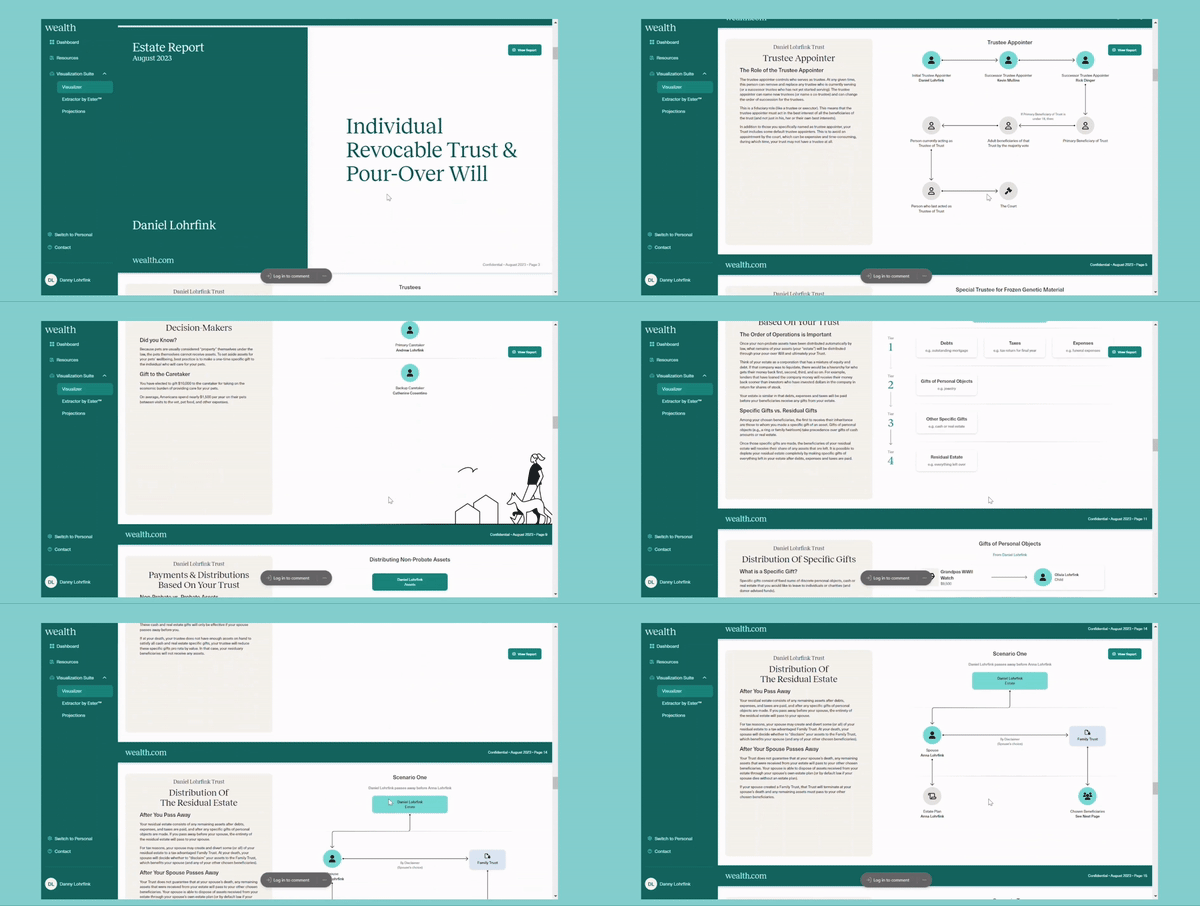
Whenever your client creates an Estate Plan through wealth.com, we automatically generate a visualization of their documents to simplify their decisions into real terms and help facilitate conversations around how their assets will be distributed based on different scenarios.

wealth.com Visualizer
Extractor by Ester™

We built a first-of-its-kind artificial intelligence model that saves advisors hours of reviewing clients’ existing estate plans by extracting key information from estate planning documents in a matter of minutes to be saved in a summary report to review with clients.

Projections Calculator

Strengthen estate planning conversations with your clients by using our proprietary projections calculator to estimate their net worth growth over time and understand how the future value of their estate might be impacted by estate taxes.

Enhanced Guidance for Document Creation

We expanded our embedded intelligence layer to better support members along their estate planning journey, including improved document matching for members who are recommended Couples Trust Plans to draft a Joint Trust or 2 Individual Trusts, as well as tips and checks within the document creation workflows that are triggered based on client’s actions.

Advisor Activity Feed and Wealth Insights

Check on all your clients’ activity and progress through the advisor activity feed. Learn as you go with wealth insights that help you understand how each of your client’s changing circumstances impacts their plan recommendation. We also added the ability for you to add notes to client activity updates.

Advisor/client collaboration features
  • Pre-Fill Client Onboarding: Facilitate client onboarding and document drafting process with pre-filled basic information to help your client get started.
  • Contact Card Creation: Set up the key people in their lives to help clients have a starting point for document creation.
  • Store files in your client’s Vault: Upload files directly to your client’s vault, a central file repository within wealth.com, and accessible to their designated emergency contact in the case of a life-changing event.
  • Print & Ship on Behalf of Your Client: Help your client sign their documents. You can also request a shipment of their documents.
Integrations

Our mission is to fit seamlessly into the rest of your business operations, giving you the information you need, where you need it. We enhanced our integrations to allow advisors to access clients’ estate planning information directly from Wealthbox and Redtail.

New Podcast

The Practical Planner | wealth.com

We introduced our podcast, “The Practical Planner,” hosted by Anne Rhodes, our Chief Legal Officer, and Thomas Kopelman, our Head of Community, who has also been recognized as a Top 100 Advisor by Investopedia. The podcast details everything advisors need for effective estate planning and more.

Wealth.com on the Road

wealth.com team

In 2023, wealth.com participated in over a dozen events across the United States including Future Proof, Schwab IMPACT and MarketCounsel Summit to showcase why we are the leading estate planning platform tailored for advisors.

And look out for us in 2024! We’re wasting no time in getting back on the road and we hope to see as many of our clients, partners, and friends as possible.

Wealth.com in the Media

Maybe you saw us in the news last year? We secured nearly 100 media placements, including features in renowned publications like WealthManagement.com, Fortune, ThinkAdvisor, Wealth Solutions and many more to spread the word about the impact of estate planning, and how to make it an integral part of advisor and client relationships.

wealth.com team


As we look forward to the opportunities that 2024 holds, we remain dedicated to providing our advisor partners and your clients with industry-leading tools to create, manage and visualize their estate plans continuously.

Trust for Descendant Explained

What is a Trust for Descendant?

A Trust for Descendant is a type of sub-trust that specifically benefits a child (or a more remote descendant), who is called the “primary beneficiary.”

More generally, a sub-trust is a type of trust that is “created under” another main document, which is usually a Revocable Trust or a Will. A sub-trust continues beyond the period of time that is required for estate or trust administration after your passing; the sub-trust ensures your wishes and objectives are met even long after you are gone.

How does a Trust for Descendant work?

This type of sub-trust allows you to pass assets to specific beneficiaries under conditions you stipulate, so that the beneficiary is protected and your wishes for how those assets are used cannot be altered.

For example, if you create an Individual Revocable Trust, you can direct that all assets passing to your minor child be held in a sub-trust trust — i.e., a Trust for Descendant — until the child reaches age 25.

Trusts for Descendant are set up for three primary reasons:

1. Control over assets.

2. Tax planning (keeping assets outside your beneficiary’s taxable estate at their death).

3. Asset protection (from the beneficiary’s creditors and divorce, for example).

Even if you trust your children to manage their own financial affairs, the last two reasons may still apply to your situation.

NOTE: You can name someone to help the primary beneficiary manage their inheritance until the primary beneficiary reaches a specific age or passes away, or the Trust is too small to make it worthwhile to keep.

Key Benefits

Customize Beneficiaries

You can choose which descendants will receive their inheritance from you in trust. The primary beneficiary’s own living descendants are also beneficiaries of the trust, but the trustee is directed to prioritize the primary beneficiary’s interests.

Power of Appointment

You can choose to provide the primary beneficiary with the ability to redistribute the trust assets. This power is often included if controlling how the primary beneficiary spends their inheritance is less important to you. This power allows the primary beneficiary to account for a large difference in financial resources among your descendants, to provide for a beloved spouse after their own death, or to reduce income or estate taxes.

Determine the Termination Event

You have the ability to decide when the trust should end. You are also able to grant the primary beneficiary an earlier withdrawal right; the beneficiary can demand from the trustee a fraction of the trust at an interim age before the trust ends.

Who is a Trust for Descendant for?

This type of sub-trust is useful for someone who worries that their child needs help managing their inheritance, is concerned about family assets being gifted away or taken away by individuals outside the family, or worries about estate and generation-skipping transfer taxes.

What happens when the Trust ends?

When the Trust ends, the trustee will distribute the remaining assets in accordance with the terms of the trust agreement, subject to any powers of appointment you have given to the primary beneficiary of the terminating Trust. If the Trust ended because the primary beneficiary attained the milestone birthday you chose, any assets remaining in the trust will be transferred to the primary beneficiary.

If the Trust ended because the primary beneficiary passed away, the trust assets will be distributed to the primary beneficiary’s own descendants, otherwise to your other descendants, following a default hierarchy that prioritizes individuals who are more closely related to the primary beneficiary in your family tree. These distributions can be made directly to these individuals, or in further trust following your wishes for when all Trusts for Descendants will end.

Can I change my mind and add or remove a Trust for Descendant at a later date?

If you decide to create a Trust for your descendant, that Trust will be drafted into your documents. As long as you have at least a child or grandchild, it is possible for you to have a descendant who is a minor at the time you pass away. For this reason, consider including a Trust for Descendant as a default. You should always plan using the most accurate information you have, both currently and in the future. If your family situation changes in the future, update your estate plan to match your current needs.

Save this Trust for Descendant Explainer in PDF form

Download PDF

*Disclaimer: wealth.com is not a law firm and is not practicing law. That said, our platform is maintained with care by attorneys who used to practice at the top trust & estate law firms in the U.S. so you can be sure each legal document created with Wealth.com is of the highest quality and is legally valid and optimized for its state, covering all 50 of the United States and Washington D.C.

Marital Trust: A Practical Explainer

What is a Marital Trust?

The common name for a trust that benefits the trust creator’s spouse. A sub-trust is a type of trust that is “created under” another Trust (or a “trust within a trust”).

Who Typically Uses a Marital Trust?

  • Blended families.
  • High net worth families (i.e., estate and generation-skipping transfer taxes).
  • Families with assets to be kept within the family (e.g., family business).

A Marital Trust is useful for someone who has children from a previous relationship, worries about someone influencing their spouse to disinherit their beneficiaries, or is wealthy enough to worry about the estate and generation-skipping transfer taxes.

How Does a Marital Trust Work?

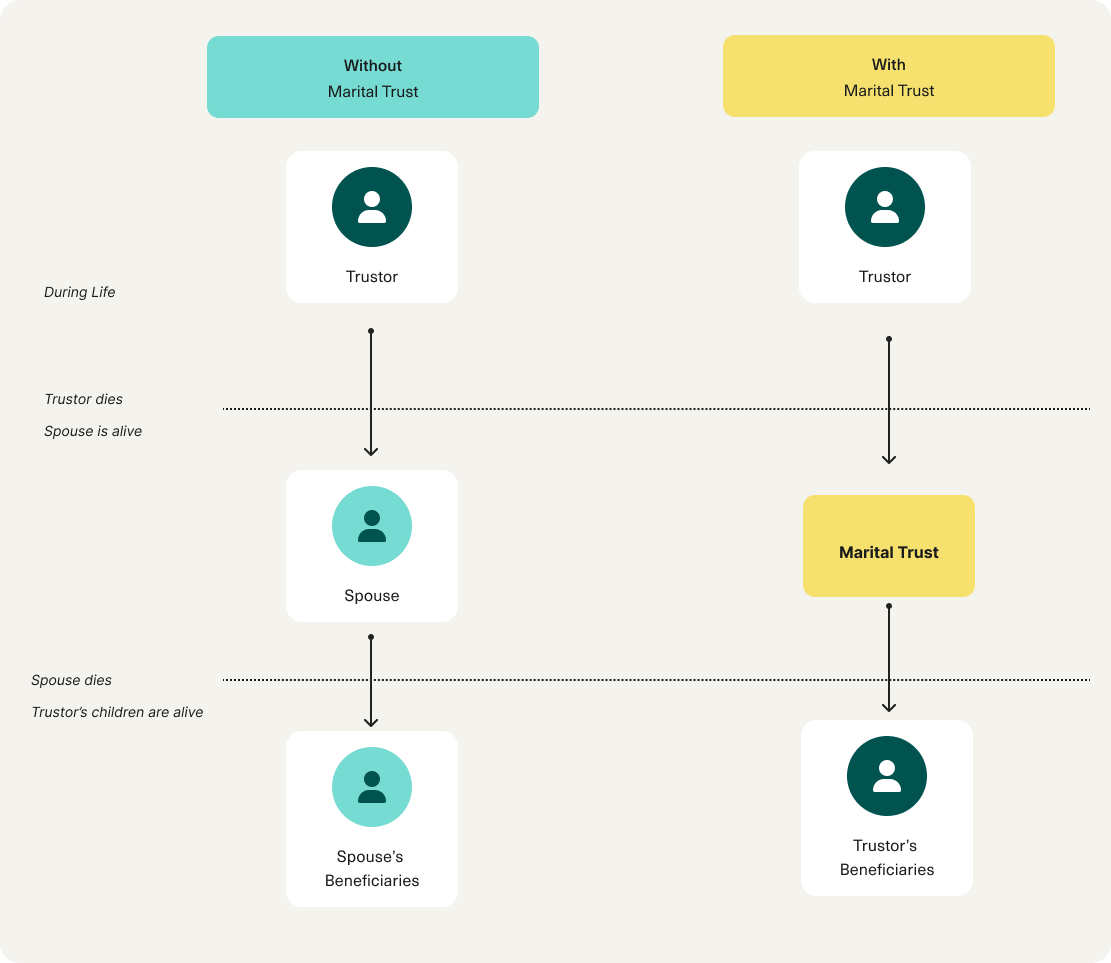
They receive a deceased spouse’s assets for the benefit of the surviving spouse. They generally protect assets from creditors while preserving the deceased spouse’s wishes for how their assets will be distributed and used, including at the surviving spouse’s death. When properly structured for tax planning purposes, they can preserve the deceased spouse’s generation-skipping transfer tax exemption amount without jeopardizing the unlimited marital deduction.

A diagram showing how assets are distributed when a marital trust is used, and when one is not.

5 Key Features of the wealth.com Marital Trust

There are many ways to design a Marital Trust. If you want your spouse’s inheritance to qualify for a benefit called the “unlimited marital deduction” (i.e., passing an unlimited amount of property at your death to your spouse completely free of estate tax and without using your estate tax exemption), the Tax Code has stringent requirements for the design of this Trust. The Trust must qualify as a “qualified terminable interest property” (or QTIP) Trust. The wealth.com Marital Trust is this type of Trust.

  1. Only your spouse can be the beneficiary of the Marital Trust.
  2. The Trustee must distribute any “income” generated inside the Marital Trust (e.g., rent if the Marital Trust owns a rental unit) at least once a year, but can do so more frequently if desired.
  3. The Trustee can make distributions for your spouse’s health, education, maintenance, or support. If the distribution is for any other reason, an independent trustee (who cannot be your spouse) should be appointed to provide checks and balances.
  4. You can choose whether your spouse may serve as trustee. If you are concerned about your spouse serving as trustee (e.g., because your spouse will be unable to manage the inherited assets or you would like checks and balances on your spouse’s ability to spend the inheritance), you will be able to prohibit your spouse from serving as the trustee and appoint someone else as the trustee.
  5. You can always change your mind about including the Marital Trust. This flexibility is built into the wealth.com platform for maximum personalization as your life circumstances change.

Download A Printable Version of this Marital Trust Guide

Download PDF

*Disclaimer: wealth.com is not a law firm and is not practicing law. That said, our platform is maintained with care by attorneys who used to practice at the top trust & estate law firms in the U.S. so you can be sure each legal document created with Wealth.com is of the highest quality and is legally valid and optimized for its state, covering all 50 of the United States and Washington D.C.

Beneficiary Designation Explained

How This Crucial Aspect of Estate Planning Works

A good estate plan allows you to understand what happens to your assets when you pass away.

Generally speaking, there are three factors that can impact what happens to your assets at death:

  1. How your asset is owned.
  2. Your estate planning documents.
  3. Whether or not you have designated beneficiaries.

It is not commonly understood that there are certain assets, such as a 401k, with beneficiary distribution rules that can override what is outlined in a Will or Trust.

This means that understanding the totality of various beneficiary designations is crucial to your estate plan functioning as you intend.

If that seems daunting, you’re not wrong. Trying to consolidate and manage everything that requires beneficiary designation manually can be tricky, especially as your life circumstances change over time. Fortunately, the wealth.com platform makes all of this easier to manage.

More on that in a bit — first we further explain how beneficiary designations function within optimized estate planning.

Beneficiary Designations

Many types of assets allow for a formal “beneficiary designation,” which directs where that asset will go upon your death regardless of the terms of a Will or Trust. Common examples of such assets include retirement accounts and life insurance policies. .

A closely related cousin of the beneficiary designation is a “pay on death” (POD) or “transfer on death” (TOD) designation. The same idea applies: if you pass away, your designation will bypass your Will or your Trust. Some states allow vehicles, personal objects, and real estate to pass through TOD, but the documentation must be carefully prepared to meet the legal requirements. Bank and brokerage accounts, closely-held stock and other securities may also pass by POD or TOD depending on the bank or custodian that maintains the account for you.

Typically, beneficiary designations are made through the institution where the asset is held (a custodian or administrator). Once a beneficiary designation has been made through the institution, it is important to keep track of who you designated as beneficiary for each asset so it aligns with and does not contradict how you want asset distribution to go in your estate planning documents.

Not all assets are eligible to have a designated, POD or TOD beneficiary. For example, there is currently no cryptocurrency exchange or investment platform that will allow you to designate a beneficiary for your crypto assets. It turns out a Will or Trust is one of the best ways to make sure your crypto will go where you want them to at your death.

Type of Ownership

Your assets can be owned in different ways. You can own them jointly with others and the titling carries implications for the designation upon death, or through an entity like a trust or corporation.

Certain ownership types, like “With Right of Survivorship,” “Joint Tenancy” or “Tenancy by the Entirety,” legally indicate that at one of the joint owner’s death, the other surviving joint owner(s) will automatically inherit the asset. In that case, the last survivor takes the entire asset and will be able to pass the asset to their beneficiaries through their Will or Trust. These forms of titling are especially common when you purchase real property with someone else.

The automatic transfer on death processes supersede any beneficiary designation or terms in your Will or Trust.

If you own an asset through an entity or arrangement governed by an agreement, the agreement may specify what your rights and restrictions are upon death. For example, you may own real property through an LLC.

The operating agreement for the LLC may contain provisions restricting your ability to transfer your LLC interests to your own beneficiaries upon your death, or give a right of first refusal to the other LLC members to purchase your interests.

If post-death rights are not spelled out, those LLC interests would likely default into your estate and pass to your beneficiaries through your Will or Trust.

Estate Plan Documents

Finally, many assets do not transfer to someone else automatically upon your death, as outlined in the two categories above.

These assets typically pass pursuant to your Will or Trust.

Conclusion

These three methods of asset distribution can work together as part of your overall estate plan to dictate where your assets will go upon your death.

However, understanding which assets have beneficiary designations and whether how you have titled the asset affects the default rights upon your death can be difficult because they are often disaggregated.

This is where the wealth.com platform comes in: our Asset Aggregation and Ownership Balance Sheet tools help record how you own your assets and what their various beneficiary designations are all in one place.

This information at the asset by asset level can be seamlessly paired with your estate planning documents to give you an understanding of how your assets will be distributed and with whom they will end up after your death.

Wealth.com helps you create and maintain a cohesive estate plan — providing the peace of mind that comes from knowing the friction your heirs will experience is minimized and your estate will be administered correctly when the time comes.

Note: Recording or updating beneficiary designations in the wealth.com platform does not alter your beneficiary designations; instead, we make recording all of your externally designated beneficiaries simple which helps maintain updated records and aids in the estate administration process.

Estate Administration Checklist

The Checklist available for download below is designed to help people understand their responsibilities and organize tasks following the death of an individual who asked them to administer an estate.

Advisors can use this as a general guide to help clients navigate the administration of an estate through to its conclusion.

Estate Administration Checklist Download PDF

Estate and Wealth Planning Checklist

Adding value to a client doesn’t have to be complicated; sometimes, it’s as simple as making sure your client’s loved ones are taken care of if something were to happen to your client.

The checklists available to download below can be used to help clients optimize their planning — wherever they are in their estate planning journey.

But first, what is estate planning?

Estate planning encompasses two types of planning:

  1. Foundational estate planning, which is a “starter pack” of legal documents in case the client is incapacitated, unavailable, or has passed away.
  2. Wealth or tax planning, which is tax- or control-driven transfers into trusts, entities or accounts.

Every single one of your clients needs a foundational estate plan – and knows it. You can deliver massive value just by helping them check that box off. Then, you can graduate your client into the more complex transfers if they need it.

What Comprises the Foundational Estate Plan?

  1. Will
  2. Revocable or Living Trust
  3. Advance Directive Over Health Care Matters
  4. Durable Power of Attorney Over Financial Matters

Review the legal documents alongside all beneficiary designations (e.g., IRAs, 401 (k)s and life insurance) and right of survivorship designations (e.g., WROS on financial accounts and real estate). These designations override the Will or Trust, which may come as a surprise to your client. Designations are often used as stop gap solutions until someone has a proper Will or Trust, at which point the designations may be removed in favor of the estate or be “funded” (i.e., transferred) into the Trust.

*An attorney or digital estate planning platform like wealth.com can help your client determine if a Trust is more appropriate than a standalone Will. The key consideration is whether avoiding a full-blown probate process, including privacy, is important to your client.

Case Study

How often do you find wrong or missing beneficiaries when you go over the Will or Trust of a client (or potential client)?

Our partner Retirement Tax Services found that over 60% of prospective clients have wrong or missing beneficiaries, when they have an estate plan at all. That means the prospective client would be leaving assets to someone they didn’t expect at all. This is when the client has that “aha” or “I can’t believe this” moment.

Using the checklists included in the PDF below can help advisors create these “aha” moments and improve their clients overall financial wellbeing with better estate planning.

Estate Planning Checklist

Download PDF

Is Digital Estate Planning Safe and Practical?

TL/DR: Digital online estate planning can be safe, easy, and practical. Common questions about the process are discussed below.

_______________________________________________________________

Online options for things we once did in person are on the rise, and estate planning is no exception. Inexpensive and easy-to-use digital planning tools now allow you to create your Will, Advance Health Care Directive, and other estate planning documents at a fraction of the cost of hiring an attorney. But how do you know if digital estate planning is the right choice for you?

Below we answer common questions regarding ease of use, privacy, and security considerations when selecting a digital estate planning platform.

Q: Does the digital estate planning platform keep my information secure?

A: An online estate planning service should maintain rigorous security standards to protect user privacy. Wealth uses multi-factor authentication and bank-level encryption to secure all data from any potential breach.

Q: Is my situation too complicated for online estate planning?

A: Most online estate planning platforms work well for uncomplicated family and financial situations. The Wealth platform provides for unique situations, including blended families, gifts of specific items, creation of estate tax-exempt Trusts (e.g., the credit shelter or bypass Trust), and family-owned businesses. If you have any questions regarding your estate, you should consult a qualified attorney. Even if you’ve already created a Will or Trust with an attorney, you can still use online estate planning to modify those documents and manage your estate plan and keep track of your Trust assets.

Q: What are the pros and cons of digital estate planning?

A: Online digital estate planning can be much less expensive than meeting with an estate attorney in person. Additionally, you can revise your estate documents if you change your mind about gifts, agents, or if your life circumstances change. Digital estate documents do not include legal advice specific to your situation. If you have any questions about your estate documents, you should speak to a qualified attorney.

Q: What information do I need to get started with my digital estate plan?

A: You can start your digital estate plan by simply providing your contact information and creating an online account. Once your account has been set up, Wealth will guide you step by step through the process of adding family members, beneficiaries, assets, gifts you would like to give, etc. Wealth provides guidance on how to select trusted agents, validate documents, and alerts you when issues might arise when transferring property or giving gifts.

Q: How do I know my digital estate planning documents are valid?

A: Each state has its own laws about signing, witnessing, and notarizing estate planning documents. Wealth provides signature pages that are valid in your state of residence. Additionally, your Wealth documents will include detailed signing instructions and will alert you if a notary and/or witness(es) is required at the time of signing.

Q: I’m ready to begin my online estate plan. Why should I choose Wealth?

A: Wealth estate planning documents have been customized for the laws of your state and have been reviewed by a licensed attorney in your state.  Wealth uses multi-factor authentication and bank-level encryption to secure your data from any potential breach. You can revise your documents at any time on your Wealth Portal online account. For an additional fee, an attorney licensed in your state is available to answer questions specific to your estate needs.

Ready to begin creating your estate plan? Click here to get started.

Start My Plan
1 4 5 6 7