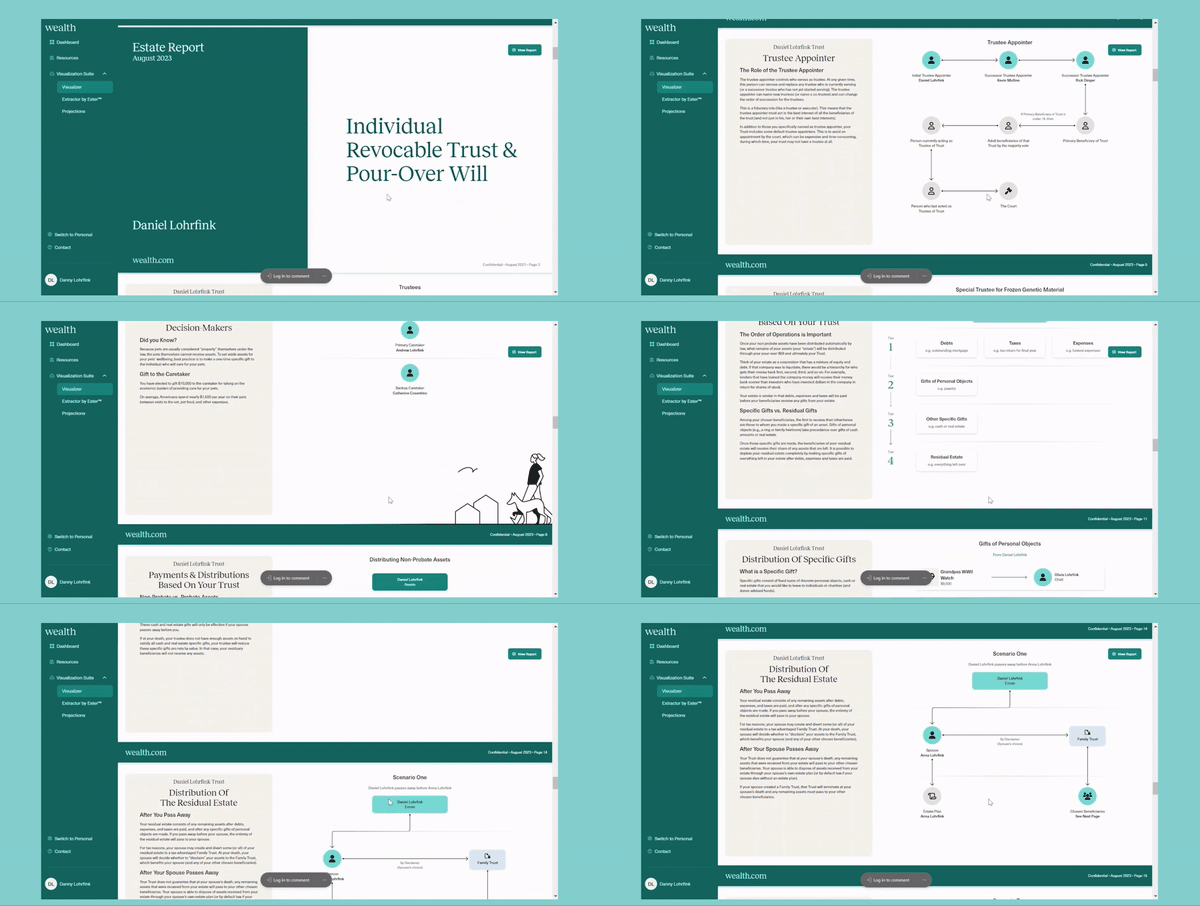
Today, we’re announcing our Family Office Suite™, our cutting-edge collection of technologies for highly complex estate plans. These new features empower financial advisors to visualize their clients’ estate plans, model out potential scenarios and optimize for tax alpha. This is a major step forward in helping advisors reduce manual efforts and scale their estate planning services while providing greater clarity for their clients.
Family Office Suite™ introduces new features into the wealth.com platform while establishing the connectivity between existing features to seamlessly collect, structure, model and visualize all information in a clients’ estate plan, culminating in an elegant, personalized and co-branded client deliverable.
Over 400+ wealth management institutions already trust Wealth.com to elevate their estate planning services. Now, they can rely on our modern approach to estate planning, built with revolutionary technology, for a better way to manage their clients’ estates, even for the most complex plans, especially high-net-worth (HNW) and ultra-high-net-worth (UHNW) households.
With Family Office Suite™, advisors gain the ability to:
Visualize the complex.New capabilities like EstateFlow™,Irrevocable Trust One-Pagers, and the Heritage Map empower advisors to make estate planning tangible and easier to understand. These tools bring clarity to intricate topics such as sub-trust distributions, estate and GST tax exposure, and administrative cost modeling.
Quantify tax alpha. Estate tax calculators and scenario analysis capabilities give advisors the ability to quantify tax implications and identify tax optimization opportunities.
Organize and collaborate. Advisors can simplify data collection by leveraging the wealth.com Vault and Ester™ AI to instantly extract and centrally store all key information from estate planning documents. Collaboration is further enhanced between advisors, in-house specialists and important intermediaries through in-app tooling and direct API integrations with leading CRM and Portfolio Management systems.
Deliver refined reports. Financial advisors can create the ultimate client deliverable, in seconds, using the Report Builder. Wealth.com does the heavy lifting by transforming all underlying client data into ready-made visuals and slides. All reports can be firm-branded, complete with custom colors, fonts and logos.
“As we advance our product roadmap, particularly for advisors serving high-net-worth and ultra-high-net-worth clients, we are committed to transforming all aspects of the estate planning service model to be a more efficient and effective process,” said Danny Lohrfink, chief product offer and co-founder of Wealth.com. “The Family Office Suite not only elevates the client experience but also unlocks greater productivity for advisors—what used to take weeks now takes mere minutes. ”
Nearly 70% of Americans don’t have an estate plan—but if you’re in the minority that do have one, you still need to stay on top of it. Estate plans aren’t “set it and forget it” but often need to be updated to reflect any major changes in your life. This ensures that your wishes will be followed, that your assets are distributed efficiently and that your loved ones are protected from any surprises after your passing.
This guide covers why regular revisions are crucial, how to keep your plan aligned with your goals and how financial advisors can be a critical part of this process for their clients.
Why regular updates are necessary for your estate plan
Estate plans are living documents that must evolve as your life does. Changes in your personal life, financial status or federal and state tax law can significantly impact how your estate is handled.
While having an estate plan—which should include a Will, Trust(s), Power of Attorney and an Advanced Health Care Directive—is better than not having one at all, having an outdated plan can also create unnecessary headaches for you and your loved ones.
An estate plan outlines what you want to happen with your assets after you pass and it also includes your wishes in situations if you become incapacitated or unable to make decisions. If you’ve accumulated more assets, want to leave certain items to new people in your life or you’ve just changed your mind about your legacy, these are all reasons you want to update your estate plan.
Ultimately, regular updates can help prevent unnecessary disputes and inefficient asset distribution.
How often do you need to update your estate plan?
There’s no hard rule about how often you should update your estate plan, though most experts recommend reviewing your plan every two years and doing a more thorough analysis and update every five years. Ideally, your plan should really be updated anytime there’s a material change that would impact it.
With a digital estate planning solution, however, you can update as often as you need to, and each update can be made quickly and easily. You don’t have to wait years to meet with an estate attorney, but can make sure that your documents reflect any changes in your life or how you wish your estate plan to be carried out.
Still, it’s important to understand what life changes may warrant updating your estate plan so you can stay proactive and keep your estate plan up-to-date.
Those triggers can include marriage or divorce, having a child, significant financial gains or losses, or moving across state lines to name a few. Below, we dive into some of the more, and less, common reasons you may need to review and update your estate plan.
12 reasons you may want to update your estate plan
Again, any time anything changes significantly in your life, it’s usually worth revisiting your estate plan. To help clarify what those “significant changes” are, here are ten common reasons you’ll want to consider revising your estate plan:
1. You get married
When you take those vows for better or worse, richer or poorer, you change—legally and philosophically—what happens to your property. In most states, if you die, your spouse will inherit your money and possessions, either before or in combination, with any children you have. But specifically naming your spouse in your estate plan will ensure your spouse is protected when you die. As soon as you get home from the honeymoon, update your estate plan to add your spouse or to create a joint will or trust together.
2. You get divorced
As a married couple, if you’ve created joint assets or property, you’ll want to update your plan if you decide to separate. Also note that if you and your spouse have a separate will or trust, you may want to remove them as a beneficiary and update the information on any joint property that you own.
It’s also important to know that if you are planning a trial separation period—or if your state requires one before your divorce is final—you shouldn’t wait to make changes to your estate plan. If you were to die while separated, your soon-to-be ex-spouse could still be your primary beneficiary in your now-outdated plan.
3. You have or adopt a child
Adding a new family member is a momentous and joyful occasion—and may come with many sleepless nights. But make sure you update your estate plan to reflect the money and property that you want your child or children to inherit. You should also rewrite it to name a guardian who will be responsible for your children until they turn 18. If you haven’t discussed guardianship with the person you’re nominating, you may even want to name a backup in case they don’t agree.
Adopted children are generally treated the same as biological children in intestate succession laws but you’ll still want to update your documents to include them. Foster children and stepchildren whom you don’t formally adopt as your own typically don’t have any legal rights to your estate unless you specifically name them in your will or trust.
4. The death of a beneficiary, executor or named guardian
If anyone named anywhere in your estate plan dies, you’ll want to update it.
Most people leave a large chunk of their estate to a single beneficiary, usually their spouse. If they die before you, you’ll want to update your estate plan to adjust your list of beneficiaries.
In the unfortunate event that one of your children, or another one of our named heirs, passes while you’re still alive you should update your estate plan to redistribute that property to other beneficiaries.
But you’ll also want to update your plan if someone you’ve designated as an executor, beneficiary or even a guardian of your children or pets dies.
5. You’ve had a falling out with someone named in your estate plan
Ruined relationships could affect your estate planning in several ways. If there’s a big family fight and you sever ties with a sibling, you might want to specifically exclude them as a beneficiary.
Another possible reason for a change is if you’ve named someone as your executor or trustee and you no longer feel comfortable entrusting them with that responsibility. You’ll want to identify and document a new person for that role ASAP.
6. Your wealth increases significantly
Maybe you’re the lucky one to win the lottery. Or you hit it big on the stock market. Or maybe you receive a large inheritance from a family member. Whatever the reason is, if your estate suddenly becomes larger than you previously expected, you may need to update your estate plan.
You should reconsider how your wealth should be distributed after your death. That may include how much your beneficiaries are getting or the amount you’re giving to charity. This is also an opportunity to do wealth transfer planning to reduce taxes at your death, like forming special trusts.
7. Your wealth is significantly reduced
If your finances are negatively impacted, you’ll want to revisit your estate plan because the distributions you’ve set up may no longer make sense. For example, if you’ve designated a certain amount to go to charity, that amount may now be the bulk of your estate and there won’t be enough left over for your other beneficiaries.
8. Moving to a new state
The laws that govern wills, trusts, and estate taxes vary by state, as do laws covering inheritance, real estate, and marital property. It’s important to make sure your estate plan is optimized for the state where you legally reside to ensure that you avoid potentially costly legal battles and to ensure that your wishes are still being met.
9. Starting or selling a business
Owning a business can present its own intricacies when it comes to estate planning, but that’s why it’s critical to update your plan. It’s important to create a succession plan for any business assets, including equity and ownership in the company.
Updating your estate plan may require coordination with your company, so it’s important to explore with an estate attorney how to approach those conversations and what needs to be discussed with the other business owners.
10. A child turning 18
Children reaching adulthood is a reason to review your estate plan. It doesn’t necessarily require updating because you may have already set up trusts to distribute assets in a certain way even after they’ve turned 18. At the same time, the need for a trust may recede and you may want to consider tax planning strategies with that adult child.
But there are other considerations for a child reaching adulthood. Perhaps you may now want to name them as a potential guardian for any younger children you have, or you want to entrust them with pets or other non-financial assets you have. And if you do decide those, that may necessitate updating other parts of your estate plan to ensure that they and your other children are set up financially.
11. Changes in federal or state tax law
While this may not happen often, it’s important to be aware of any changes in tax laws that could affect your estate plan. For example, the Tax and Jobs Act of 2017 (TCJA) nearly doubled the estate tax exemption, allowing individuals to leave more of their assets to their heirs without incurring federal estate tax. The exemption increased from about $5.49 million in 2017 to $11.18 million in 2018 for individuals, impacting decisions on asset transfers and trusts. And, currently, that law will sunset in 2025—meaning the exemption amount will be cut in half—so those that have assets over the current exemption limit may want to create strategies now.
12. You change your definition of what you want your legacy to be
It’s not uncommon that someone’s goals and wishes may change. Just as you may have had a falling out with a sibling or family member, you may have developed a closer relationship with an extended family member, like a cousin or nephew that you now want to be a part of your estate plan.
Maybe you’ve designated a portion of your estate to go to charity but your preferred charity has changed. Or you’ve adopted a new pet and want to designate a guardian should you die.
It’s possible that the decisions you laid out in your Advanced Health Care Directive have also changed. If so, you should revisit and update it. Same for any decisions you want changed about potential Power of Attorney scenarios.
People’s wishes change, and that’s OK! Just make sure those changes are reflected in your estate plan.
How digital estate planning simplifies updating estate plans
Traditionally, updating an estate plan isn’t always simple. Normally, they’d have to consult with an estate attorney to make any changes, hence the recommendation by experts to revisit every two to five years. Any updates an attorney makes can be subject to their hourly wages, as well as any discussion about those changes. Any other conversations about what changes to make and how to approach them, can also be subject to their hourly rate. Plus, you may need to wait to find time in your attorney’s schedule to do all of this.
But with a digital estate planning solution, there is no need to wait. You can login at any time and make any edits, as often as you want. If you’re having a child, you don’t need to wait until that child is born to update your beneficiary information. If you’ve moved and need to update your real estate information, you can just go ahead and do it (wealth.com’s Zillow integration will even notify financial advisors when a client has moved so they can proactively let them know to update their plan).
A digital estate planning solution makes it much easier for your estate plan to ebb and flow with the changes in your life. No longer do you have to make a plan that has barrier to revisiting and updating.
How financial advisors can help clients keep their estate plan updated
Financial advisors are uniquely positioned to help their clients ensure their estate plans are kept up-to-date because they’re already involved in overseeing their finances. While clients may not actively offer up that they’ve had a falling out with a sibling or that they’ve adopted a new pet, advisors will likely know if they’ve gained or lost a significant amount of money. But, even for those life changes that are more difficult to talk about, advisors can help uncover reasons their clients’ estate plans should be revisited.
Here are some actionable tips for financial advisors to help keep their clients’ estate plans up-to-date:
Schedule regular reviews: This can be as simple as incorporating estate planning into your quarterly or annual client reviews. While some reasons may be obvious, like moving to a new state, some, like family squabbles, may not be. Ask the right questions, like if they’ve had any significant financial changes or if they’ve come into possession of any non-financial assets they want passed down to their children. But it’s also worth doing a thorough review of their estate plan at certain points. This doesn’t have to happen at every review, but going through the details of the estate plan may help the client to offer up information they may not otherwise, like the person they named as executor has died or that they want to add a new family member as a beneficiary. Often, it’s not that your client doesn’t want to share this information, it’s just that they don’t think to share it. With regular reviews, you can help them stay on top of their legacy.
Keep documentation updated: Documentation is paramount! So make sure that you help your clients maintain all necessary records that could impact their estate plans, like deeds for properties and financial statements. Also make sure to keep all information about beneficiaries, trustees and executors up-to-date.
Stay informed about law changes: Keep yourself informed about changes in laws that could impact your client’s estate plan. Subscribe to newsletters or podcasts—wealth.com’s The Practical Planner podcast is certainly one we recommend. However you prefer to stay on top of legal and tax news, your clients are looking to you to be informed. Doing so will only strengthen the relationship you have with your clients.
If you want to dive deeper into when an estate plan should be updated, check out The Practical Planner podcast episode, “When to Update an Estate Plan“ hosted by Anne Rhodes, wealth.com’s Chief Legal Officer, and Thomas Kopelman, wealth.com’s Head of Community and Co-founder of AllStreet Wealth.
Ready to deliver modern estate planning to your clients? Book a demo to learn more about our comprehensive platform.
We want to thank you for being an integral part to our continued success as our accomplishments happen in partnership with you and your clients.
We’re even more excited about what 2024 has in store, but before we look ahead, we’re thrilled to share some of our key accomplishments from 2023.
Major Product Features
We take a proactive approach to product innovation, continuously expanding our offering and improving the experience for both advisors and members. Here are some highlights of what we launched last year:
Visualize Client wealth.com Estate Plans
Whenever your client creates an Estate Plan through wealth.com, we automatically generate a visualization of their documents to simplify their decisions into real terms and help facilitate conversations around how their assets will be distributed based on different scenarios.
Extractor by Ester™
We built a first-of-its-kind artificial intelligence model that saves advisors hours of reviewing clients’ existing estate plans by extracting key information from estate planning documents in a matter of minutes to be saved in a summary report to review with clients.
Enhanced Guidance for Document Creation
We expanded our embedded intelligence layer to better support members along their estate planning journey, including improved document matching for members who are recommended Couples Trust Plans to draft a Joint Trust or 2 Individual Trusts, as well as tips and checks within the document creation workflows that are triggered based on client’s actions.
Advisor Activity Feed and Wealth Insights
Check on all your clients’ activity and progress through the advisor activity feed. Learn as you go with wealth insights that help you understand how each of your client’s changing circumstances impacts their plan recommendation. We also added the ability for you to add notes to client activity updates.
Advisor/client collaboration features
Pre-Fill Client Onboarding: Facilitate client onboarding and document drafting process with pre-filled basic information to help your client get started.
Contact Card Creation: Set up the key people in their lives to help clients have a starting point for document creation.
Store files in your client’s Vault: Upload files directly to your client’s vault, a central file repository within wealth.com, and accessible to their designated emergency contact in the case of a life-changing event.
Print & Ship on Behalf of Your Client: Help your client sign their documents. You can also request a shipment of their documents.
Integrations
Our mission is to fit seamlessly into the rest of your business operations, giving you the information you need, where you need it. We enhanced our integrations to allow advisors to access clients’ estate planning information directly from Wealthbox and Redtail.
New Podcast
We introduced our podcast, “The Practical Planner,” hosted by Anne Rhodes, our Chief Legal Officer, and Thomas Kopelman, our Head of Community, who has also been recognized as a Top 100 Advisor by Investopedia. The podcast details everything advisors need for effective estate planning and more.
Wealth.com on the Road
In 2023, wealth.com participated in over a dozen events across the United States including Future Proof, Schwab IMPACT and MarketCounsel Summit to showcase why we are the leading estate planning platform tailored for advisors.
And look out for us in 2024! We’re wasting no time in getting back on the road and we hope to see as many of our clients, partners, and friends as possible.
Wealth.com in the Media
Maybe you saw us in the news last year? We secured nearly 100 media placements, including features in renowned publications like WealthManagement.com, Fortune, ThinkAdvisor, Wealth Solutionsand many more to spread the word about the impact of estate planning, and how to make it an integral part of advisor and client relationships.
As we look forward to the opportunities that 2024 holds, we remain dedicated to providing our advisor partners and your clients with industry-leading tools to create, manage and visualize their estate plans continuously.
A Trust for Descendant is a type of sub-trust that specifically benefits a child (or a more remote descendant), who is called the “primary beneficiary.”
More generally, a sub-trust is a type of trust that is “created under” another main document, which is usually a Revocable Trust or a Will. A sub-trust continues beyond the period of time that is required for estate or trust administration after your passing; the sub-trust ensures your wishes and objectives are met even long after you are gone.
How does a Trust for Descendant work?
This type of sub-trust allows you to pass assets to specific beneficiaries under conditions you stipulate, so that the beneficiary is protected and your wishes for how those assets are used cannot be altered.
For example, if you create an Individual Revocable Trust, you can direct that all assets passing to your minor child be held in a sub-trust trust — i.e., a Trust for Descendant — until the child reaches age 25.
Trusts for Descendant are set up for three primary reasons:
1. Control over assets.
2. Tax planning (keeping assets outside your beneficiary’s taxable estate at their death).
3. Asset protection (from the beneficiary’s creditors and divorce, for example).
Even if you trust your children to manage their own financial affairs, the last two reasons may still apply to your situation.
NOTE: You can name someone to help the primary beneficiary manage their inheritance until the primary beneficiary reaches a specific age or passes away, or the Trust is too small to make it worthwhile to keep.
Key Benefits
Customize Beneficiaries
You can choose which descendants will receive their inheritance from you in trust. The primary beneficiary’s own living descendants are also beneficiaries of the trust, but the trustee is directed to prioritize the primary beneficiary’s interests.
Power of Appointment
You can choose to provide the primary beneficiary with the ability to redistribute the trust assets. This power is often included if controlling how the primary beneficiary spends their inheritance is less important to you. This power allows the primary beneficiary to account for a large difference in financial resources among your descendants, to provide for a beloved spouse after their own death, or to reduce income or estate taxes.
Determine the Termination Event
You have the ability to decide when the trust should end. You are also able to grant the primary beneficiary an earlier withdrawal right; the beneficiary can demand from the trustee a fraction of the trust at an interim age before the trust ends.
Who is a Trust for Descendant for?
This type of sub-trust is useful for someone who worries that their child needs help managing their inheritance, is concerned about family assets being gifted away or taken away by individuals outside the family, or worries about estate and generation-skipping transfer taxes.
What happens when the Trust ends?
When the Trust ends, the trustee will distribute the remaining assets in accordance with the terms of the trust agreement, subject to any powers of appointment you have given to the primary beneficiary of the terminating Trust. If the Trust ended because the primary beneficiary attained the milestone birthday you chose, any assets remaining in the trust will be transferred to the primary beneficiary.
If the Trust ended because the primary beneficiary passed away, the trust assets will be distributed to the primary beneficiary’s own descendants, otherwise to your other descendants, following a default hierarchy that prioritizes individuals who are more closely related to the primary beneficiary in your family tree. These distributions can be made directly to these individuals, or in further trust following your wishes for when all Trusts for Descendants will end.
Can I change my mind and add or remove a Trust for Descendant at a later date?
If you decide to create a Trust for your descendant, that Trust will be drafted into your documents. As long as you have at least a child or grandchild, it is possible for you to have a descendant who is a minor at the time you pass away. For this reason, consider including a Trust for Descendant as a default. You should always plan using the most accurate information you have, both currently and in the future. If your family situation changes in the future, update your estate plan to match your current needs.
Save this Trust for Descendant Explainer in PDF form
*Disclaimer: wealth.com is not a law firm and is not practicing law. That said, our platform is maintained with care by attorneys who used to practice at the top trust & estate law firms in the U.S. so you can be sure each legal document created with Wealth.com is of the highest quality and is legally valid and optimized for its state, covering all 50 of the United States and Washington D.C.
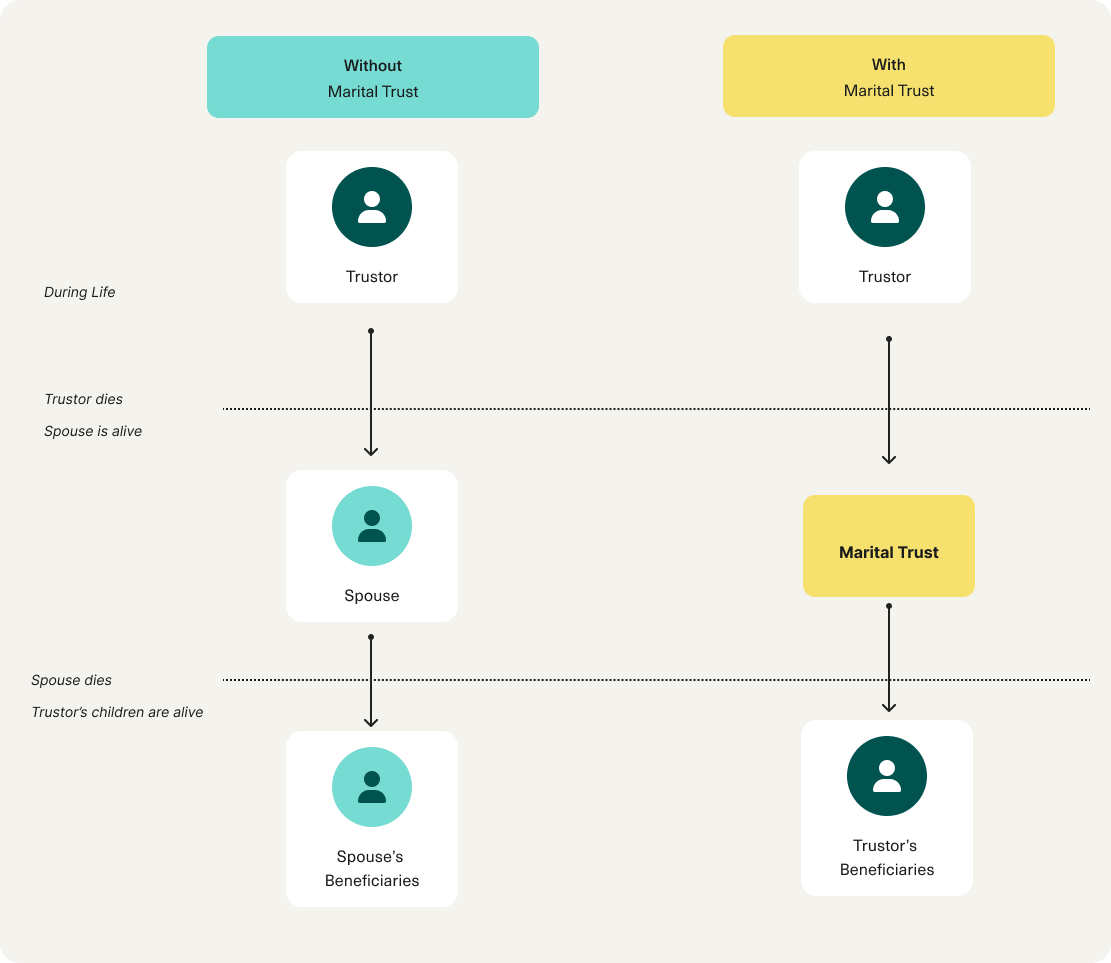
The common name for a trust that benefits the trust creator’s spouse. A sub-trust is a type of trust that is “created under” another Trust (or a “trust within a trust”).
Who Typically Uses a Marital Trust?
Blended families.
High net worth families (i.e., estate and generation-skipping transfer taxes).
Families with assets to be kept within the family (e.g., family business).
A Marital Trust is useful for someone who has children from a previous relationship, worries about someone influencing their spouse to disinherit their beneficiaries, or is wealthy enough to worry about the estate and generation-skipping transfer taxes.
How Does a Marital Trust Work?
They receive a deceased spouse’s assets for the benefit of the surviving spouse. They generally protect assets from creditors while preserving the deceased spouse’s wishes for how their assets will be distributed and used, including at the surviving spouse’s death. When properly structured for tax planning purposes, they can preserve the deceased spouse’s generation-skipping transfer tax exemption amount without jeopardizing the unlimited marital deduction.
5 Key Features of the wealth.com Marital Trust
There are many ways to design a Marital Trust. If you want your spouse’s inheritance to qualify for a benefit called the “unlimited marital deduction” (i.e., passing an unlimited amount of property at your death to your spouse completely free of estate tax and without using your estate tax exemption), the Tax Code has stringent requirements for the design of this Trust. The Trust must qualify as a “qualified terminable interest property” (or QTIP) Trust. The wealth.com Marital Trust is this type of Trust.
Only your spouse can be the beneficiary of the Marital Trust.
The Trustee must distribute any “income” generated inside the Marital Trust (e.g., rent if the Marital Trust owns a rental unit) at least once a year, but can do so more frequently if desired.
The Trustee can make distributions for your spouse’s health, education, maintenance, or support. If the distribution is for any other reason, an independent trustee (who cannot be your spouse) should be appointed to provide checks and balances.
You can choose whether your spouse may serve as trustee. If you are concerned about your spouse serving as trustee (e.g., because your spouse will be unable to manage the inherited assets or you would like checks and balances on your spouse’s ability to spend the inheritance), you will be able to prohibit your spouse from serving as the trustee and appoint someone else as the trustee.
You can always change your mind about including the Marital Trust. This flexibility is built into the wealth.com platform for maximum personalization as your life circumstances change.
Download A Printable Version of this Marital Trust Guide
*Disclaimer: wealth.com is not a law firm and is not practicing law. That said, our platform is maintained with care by attorneys who used to practice at the top trust & estate law firms in the U.S. so you can be sure each legal document created with Wealth.com is of the highest quality and is legally valid and optimized for its state, covering all 50 of the United States and Washington D.C.
A good estate plan allows you to understand what happens to your assets when you pass away.
Generally speaking, there are three factors that can impact what happens to your assets at death:
How your asset is owned.
Your estate planning documents.
Whether or not you have designated beneficiaries.
It is not commonly understood that there are certain assets, such as a 401k, with beneficiary distribution rules that can override what is outlined in a Will or Trust.
This means that understanding the totality of various beneficiary designations is crucial to your estate plan functioning as you intend.
If that seems daunting, you’re not wrong. Trying to consolidate and manage everything that requires beneficiary designation manually can be tricky, especially as your life circumstances change over time. Fortunately, the wealth.com platform makes all of this easier to manage.
More on that in a bit — first we further explain how beneficiary designations function within optimized estate planning.
Beneficiary Designations
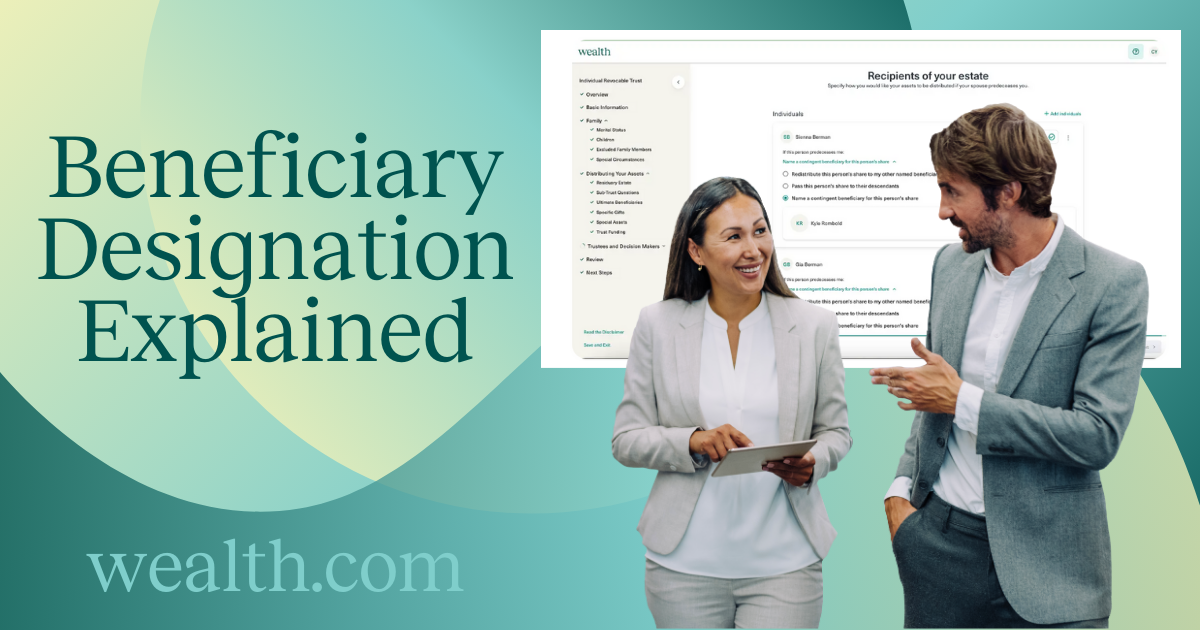
Many types of assets allow for a formal “beneficiary designation,” which directs where that asset will go upon your death regardless of the terms of a Will or Trust. Common examples of such assets include retirement accounts and life insurance policies. .
A closely related cousin of the beneficiary designation is a “pay on death” (POD) or “transfer on death” (TOD) designation. The same idea applies: if you pass away, your designation will bypass your Will or your Trust. Some states allow vehicles, personal objects, and real estate to pass through TOD, but the documentation must be carefully prepared to meet the legal requirements. Bank and brokerage accounts, closely-held stock and other securities may also pass by POD or TOD depending on the bank or custodian that maintains the account for you.
Typically, beneficiary designations are made through the institution where the asset is held (a custodian or administrator). Once a beneficiary designation has been made through the institution, it is important to keep track of who you designated as beneficiary for each asset so it aligns with and does not contradict how you want asset distribution to go in your estate planning documents.
Not all assets are eligible to have a designated, POD or TOD beneficiary. For example, there is currently no cryptocurrency exchange or investment platform that will allow you to designate a beneficiary for your crypto assets. It turns out a Will or Trust is one of the best ways to make sure your crypto will go where you want them to at your death.
Type of Ownership
Your assets can be owned in different ways. You can own them jointly with others and the titling carries implications for the designation upon death, or through an entity like a trust or corporation.
Certain ownership types, like “With Right of Survivorship,” “Joint Tenancy” or “Tenancy by the Entirety,” legally indicate that at one of the joint owner’s death, the other surviving joint owner(s) will automatically inherit the asset. In that case, the last survivor takes the entire asset and will be able to pass the asset to their beneficiaries through their Will or Trust. These forms of titling are especially common when you purchase real property with someone else.
The automatic transfer on death processes supersede any beneficiary designation or terms in your Will or Trust.
If you own an asset through an entity or arrangement governed by an agreement, the agreement may specify what your rights and restrictions are upon death. For example, you may own real property through an LLC.
The operating agreement for the LLC may contain provisions restricting your ability to transfer your LLC interests to your own beneficiaries upon your death, or give a right of first refusal to the other LLC members to purchase your interests.
If post-death rights are not spelled out, those LLC interests would likely default into your estate and pass to your beneficiaries through your Will or Trust.
Estate Plan Documents
Finally, many assets do not transfer to someone else automatically upon your death, as outlined in the two categories above.
These assets typically pass pursuant to your Will or Trust.
Conclusion
These three methods of asset distribution can work together as part of your overall estate plan to dictate where your assets will go upon your death.
However, understanding which assets have beneficiary designations and whether how you have titled the asset affects the default rights upon your death can be difficult because they are often disaggregated.
This is where the wealth.com platform comes in: our Asset Aggregation and Ownership Balance Sheet tools help record how you own your assets and what their various beneficiary designations are all in one place.
This information at the asset by asset level can be seamlessly paired with your estate planning documents to give you an understanding of how your assets will be distributed and with whom they will end up after your death.
Wealth.com helps you create and maintain a cohesive estate plan — providing the peace of mind that comes from knowing the friction your heirs will experience is minimized and your estate will be administered correctly when the time comes.
Note: Recording or updating beneficiary designations in the wealth.com platform does not alter your beneficiary designations; instead, we make recording all of your externally designated beneficiaries simple which helps maintain updated records and aids in the estate administration process.
The Checklist available for download below is designed to help people understand their responsibilities and organize tasks following the death of an individual who asked them to administer an estate.
Advisors can use this as a general guide to help clients navigate the administration of an estate through to its conclusion.
Adding value to a client doesn’t have to be complicated; sometimes, it’s as simple as making sure your client’s loved ones are taken care of if something were to happen to your client.
The checklists available to download below can be used to help clients optimize their planning — wherever they are in their estate planning journey.
But first, what is estate planning?
Estate planning encompasses two types of planning:
Foundational estate planning, which is a “starter pack” of legal documents in case the client is incapacitated, unavailable, or has passed away.
Wealth or tax planning, which is tax- or control-driven transfers into trusts, entities or accounts.
Every single one of your clients needs a foundational estate plan – and knows it. You can deliver massive value just by helping them check that box off. Then, you can graduate your client into the more complex transfers if they need it.
What Comprises the Foundational Estate Plan?
Will
Revocable or Living Trust
Advance Directive Over Health Care Matters
Durable Power of Attorney Over Financial Matters
Review the legal documents alongside all beneficiary designations (e.g., IRAs, 401 (k)s and life insurance) and right of survivorship designations (e.g., WROS on financial accounts and real estate). These designations override the Will or Trust, which may come as a surprise to your client. Designations are often used as stop gap solutions until someone has a proper Will or Trust, at which point the designations may be removed in favor of the estate or be “funded” (i.e., transferred) into the Trust.
*An attorney or digital estate planning platform like wealth.com can help your client determine if a Trust is more appropriate than a standalone Will. The key consideration is whether avoiding a full-blown probate process, including privacy, is important to your client.
Case Study
How often do you find wrong or missing beneficiaries when you go over the Will or Trust of a client (or potential client)?
Our partner Retirement Tax Services found that over 60% of prospective clients have wrong or missing beneficiaries, when they have an estate plan at all. That means the prospective client would be leaving assets to someone they didn’t expect at all. This is when the client has that “aha” or “I can’t believe this” moment.
Using the checklists included in the PDF below can help advisors create these “aha” moments and improve their clients overall financial wellbeing with better estate planning.
TL/DR: Estate planning isn’t as complex as it may seem and you don’t need a legal degree to create one. In short, estate planning is simply recording your wishes for what happens if you’re unable to manage your own affairs. This quick and comprehensive overview will give you a working understanding of the estate planning basics.
No one likes to think about death, especially their own. But think about this: What will happen to your stuff—money, family heirlooms, even a pet—if something happens to you? If you haven’t created a document that tells your loved ones who should get what, and who should sign off on those decisions and do all the paperwork, your loved ones will have to decide for (and potentially argue among) themselves. You can provide for your family’s needs, ensure your wishes are honored, and save your loved ones a lot of anguish during an already stressful time by creating an estate plan.
Although estate planning is essential for ensuring your money and property are distributed in exactly the way you want, only one-third of adults in the U.S. have a Will. That overall number has fallen steadily over the past five years, but the COVID-19 pandemic did inspire those ages 18 to 34 to write a Will—63% more people in that age group created a Will in 2021 than in 2020.
So why don’t more people do it? The five main reasons are:
I just haven’t gotten around to it.
I don’t have enough money saved.
I don’t know how to begin.
I don’t know anything about it.
I don’t own anything valuable.
Unfortunately, these misconceptions are preventing people from putting even a basic plan in place. People perceive estate planning to be complicated, scary, or simply not relevant to them. The reality is, you don’t have to be a millionaire or own multiple homes to benefit from an estate plan.
You need an estate plan if:
You worry that your pet(s) could be given to a shelter
You want to make a final gift to a grandchild, niece, or nephew, or a friend or charity at your death
You have specific wishes about your health care and end-of-life care
You feel strongly about who should manage your affairs if you were unable to do so yourself
You really want your children to end up with your assets, if there is anything left after your spouse passes away
Some of your family members don’t get along and might disagree about who gets what or who should manage your affairs
You do not want a certain family member to receive your assets, to make health care decisions for you, or to manage your affairs
You own a significant amount of cryptocurrency
Do any of these sound like you? Because most everyone can benefit from the peace of mind an estate plan brings, we want to demystify the process so everyone—yes, even those without a law degree—can see that it’s simpler and more accessible than they think. And, hopefully, the information in this guide will equip you with enough information to quit putting off this important task.
Getting Started: Estate Planning Documents
At its most basic level, estate planning is making preparations for when you’re no longer able to make decisions for yourself. It requires creating and signing a few legal documents; but more importantly, it requires thoughtful decisions so that the money and possessions you have earned and accumulated can be passed down to your family or whomever you choose.
Let’s talk about what you’ll put in place as part of a basic estate plan. The legal documents are:
Last Will and testament: This document, which becomes active after you die, expresses your wishes for how to divide up your property and possessions and names the people you prefer to manage your financial affairs (the “executor”) and take care for your children who are minors or have special needs (the “guardian”). A revocable Trust can offer some advantages over a Will (more on Trusts vs. Wills here). However, you can only designate an executor or a guardian through a Will, not a Trust. For this reason, you still need a short Will (called a “pourover Will”), even if the centerpiece of your estate plan is a Trust.
Financial power of attorney: Think of this document as a permission slip that gives the person you name (the “agent”) the ability to conduct financial transactions, sign documents, and make other legal decisions as if they were you. In most states, you can choose if your agent has this permission immediately after you sign or only once you are incapacitated. This document terminates at your death.
Advance health care directive: This document empowers the person you name to make decisions about your medical treatment, symptom management, and end-of-life care. Depending on your home state, this document may go by a variety of different names, including a health care power of attorney or proxy. The document usually includes or is paired with a living will, which are your written instructions for health care providers about the type of life-prolonging medical care you want to receive if you are unable to make decisions for yourself.
Trust: A Trust is created by a contract or agreement and acts like a bucket of “stuff.” The Trust agreement is the set of rules that the creator of the Trust puts in place for the trustee who oversees the Trust. The rules include what powers the trustee has over the Trust, to whom and under what circumstances the trustee can give assets out of the Trust. After you create a Trust, you can transfer your assets into the Trust right away, before you die. There are many types of Trusts that accomplish different goals. If you create a Trust as the centerpiece of your estate plan instead of a Will (more on Trusts vs. Wills here), you will set up a type of Trust called a “revocable Trust” or “living Trust.” You will be the trustee of your revocable Trust in the beginning. You can also designate the person who will step in for you as trustee so that when you are unable to manage your own affairs eventually, that successor trustee can distribute your stuff according to your instructions. Unlike a Will, a Trust is active the day it is created, which means that your successor trustee can also help you manage the stuff inside of your Trust in case you are incapacitated.
There are two types of Trusts.
Revocable or living Trusts can be altered at any time by the creator of the Trust (you). These Trusts are often used as a substitute for a Will in estate planning.
Irrevocable Trusts are difficult and expensive to alter once created. They can be used to achieve many types of goals, including minimizing taxes protecting assets from creditors, naming an adult to manage property for children before they reach a certain age, and ensuring that assets stay within the same family. In your Will or your revocable Trust, you can instruct your executor or trustee to create an irrevocable Trust to take advantage of the benefits of irrevocable Trusts.
Why Do I Need an Estate Plan?
No one needs an estate plan. That is, unless you want to avoid confusion, chaos, hurt feelings, family drama, and delayed distribution due to probate. So, maybe you do need one?
An estate plan lets you give the gift of clarity to your loved ones—and does all the legal heavy lifting so they don’t have to. When you spell out your wishes in the legal documents listed above, there’s less second-guessing about your intentions for how your stuff should be distributed.
The opposite is true if you die without a Will or Trust in place. Legally, you are dying intestate, and your home state’s succession laws will determine how your assets will be distributed and to whom. These succession laws differ from state to state, but were likely drafted a long time ago, based on the most common wishes of a typical, American nuclear family, and likely do not reflect the complexities of your family and cultural heritage.
By not creating an estate plan, you are just letting the state legislature from decades ago take a guess as to what your wishes are. This is especially true if you’re single and don’t have dependents.
You may own assets that will not pass through your estate, either because of the title on the asset or because you designated a beneficiary. For example, jointly owned property–real estate, a car, or bank account–will automatically pass to the survivor, or you may have designated a beneficiary for a life insurance policy or retirement account. However, it is still important to have a Will or a Trust for several reasons. Certain assets must pass through your estate (for example, personal objects or cryptocurrency), so the only way to direct where they go at your death is through a legal document. Having no assets in your estate will make it difficult to pay for your last expenses, including funeral costs, legal fees, and any taxes.
Who’s Involved in an Estate Plan?
Now that we’ve looked at the important reasons why to have an estate plan, it’s time to turn to the who in an estate plan.
The most important person is you, the creator of the Will (testator) or Trust (called grantor, settlor, or trustor–not to be confused with the trustee!). By taking the time for careful consideration and creating various legal documents, you are establishing clear expectations for how you want your money and property to be handled upon your death.
The other essential players involved in estate planning include:
Beneficiaries: These are family members, loved ones, or charitable organizations—anyone who receives an asset of yours in your Will or Trust. Assets can include cash, real estate, or that piano you inherited from your grandparents.
Heirs: If you die without an estate plan (or all the beneficiaries you listed in your estate plan have passed away or otherwise do not qualify to receive your assets), the people who will receive your assets are known as your heirs. Your heirs are determined under default succession laws. They are not necessarily the people you would have named as your beneficiaries.
Executor: If you create a Will, you will name an executor (sometimes called an administrator or personal representative) to manage your affairs after you die. This person will collect your property, pay any debts and taxes, and distribute the remaining property according to the terms of your Will. This often takes a bit of legwork, including contacting banks, investment and insurance companies, and appraisers.
Trustee: When the centerpiece of your estate plan is a Trust rather than a Will, this person manages your affairs just like an executor would. Because the roles are so similar, generally the same person is named in the role of successor trustee and executor. Moreover, if you put assets into your Trust during life, the trustee can manage them during your incapacity, instead of relying on a financial power of attorney.
Agent or attorney-in-fact: Not to be confused with an actual lawyer, this is the person you named in your financial or health care power of attorney to act or make decisions on your behalf.
Guardian: If you have children who are minors or have special needs, this is the person you name to care for the wellbeing in case both you and the other parent are unable to care for those children.
If you’re wondering whether a lawyer is also part of this list, it depends. Most people can set up and manage their estate plan on their own using online tools, like Wealth, which are backed by extensive legal expertise.
When you put together the what, why, and who behind estate planning, you can see it really boils down to thinking about and documenting your final wishes, then appointing someone you trust to be in charge of executing those wishes after you die. It’s a simple, thoughtful act that protects your family and your legacy.
We hope these explanations have shown that estate planning is important but not impossible. Like death itself, it’s not something people talk about much, which has led to a myth that it’s too complicated for the average person to tackle. The reality is, estate planning takes time and consideration, but it’s time well spent to safeguard your loved ones’ wellbeing.
Online options for things we once did in person are on the rise, and estate planning is no exception. Inexpensive and easy-to-use digital planning tools now allow you to create your Will, Advance Health Care Directive, and other estate planning documents at a fraction of the cost of hiring an attorney. But how do you know if digital estate planning is the right choice for you?
Below we answer common questions regarding ease of use, privacy, and security considerations when selecting a digital estate planning platform.
Q: Does the digital estate planning platform keep my information secure?
A: An online estate planning service should maintain rigorous security standards to protect user privacy. Wealth uses multi-factor authentication and bank-level encryption to secure all data from any potential breach.
Q: Is my situation too complicated for online estate planning?
A: Most online estate planning platforms work well for uncomplicated family and financial situations. The Wealth platform provides for unique situations, including blended families, gifts of specific items, creation of estate tax-exempt Trusts (e.g., the credit shelter or bypass Trust), and family-owned businesses. If you have any questions regarding your estate, you should consult a qualified attorney. Even if you’ve already created a Will or Trust with an attorney, you can still use online estate planning to modify those documents and manage your estate plan and keep track of your Trust assets.
Q: What are the pros and cons of digital estate planning?
A: Online digital estate planning can be much less expensive than meeting with an estate attorney in person. Additionally, you can revise your estate documents if you change your mind about gifts, agents, or if your life circumstances change. Digital estate documents do not include legal advice specific to your situation. If you have any questions about your estate documents, you should speak to a qualified attorney.
Q: What information do I need to get started with my digital estate plan?
A: You can start your digital estate plan by simply providing your contact information and creating an online account. Once your account has been set up, Wealth will guide you step by step through the process of adding family members, beneficiaries, assets, gifts you would like to give, etc. Wealth provides guidance on how to select trusted agents, validate documents, and alerts you when issues might arise when transferring property or giving gifts.
Q: How do I know my digital estate planning documents are valid?
A: Each state has its own laws about signing, witnessing, and notarizing estate planning documents. Wealth provides signature pages that are valid in your state of residence. Additionally, your Wealth documents will include detailed signing instructions and will alert you if a notary and/or witness(es) is required at the time of signing.
Q: I’m ready to begin my online estate plan. Why should I choose Wealth?
A: Wealth estate planning documents have been customized for the laws of your state and have been reviewed by a licensed attorney in your state.Wealth uses multi-factor authentication and bank-level encryption to secure your data from any potential breach. You can revise your documents at any time on your Wealth Portal online account. For an additional fee, an attorney licensed in your state is available to answer questions specific to your estate needs.
Ready to begin creating your estate plan? Click here to get started.
So much of estate planning is thinking through how you want things handled after you die, before you start actually making a documented plan. The idea of a financial power of attorney (FPoA) flips that a bit, because it’s about appointing someone to handle your affairs in case you become incapacitated and can’t make your own decisions. The process seems complex, but we’ll simplify it so you can make sense of the basics you need to know to include this important element in your estate plan.
What Role Does a FPoA Play in Estate Planning?
In a nutshell, a financial power of attorney is a document in which you appoint a trusted person to act on your behalf to make financial decisions. In establishing a FPoA, you hand over the legal reins to another person to conduct financial transactions, sign documents, or make other legal decisions as if they were you. This might happen for only a limited period of time (during a serious illness or after an accident, for example), or it can take effect immediately upon signing and last up to your end of life. Once your FPoA is completed, your trusted person, the agent, sometimes called an attorney-in-fact or fiduciary, can be responsible for managing your financial affairs. You will need to use a second document, called an Advance Health Care Directive (sometimes known as health care proxy or health care power of attorney), to designate who should handle all of your medical decisions. There are several types of FPoA, so consider the specific needs of your estate before selecting one.
Durable Power of Attorney
The type of FPoA most commonly used in estate planning is a durable power of attorney. “Durable” indicates that your agent has your permission to act on your behalf even though you are incapacitated or disabled. In other words, the FPoA is effective until you either revoke the document or have passed away.
You can spell out your agent’s powers, responsibilities and restrictions in the FPoA. The powers vary from state to state but usually include the ability to:
Sell or manage property and real estate
Sign legal documents and checks
Manage personal and business-related financial accounts
Pay medical bills (but not make healthcare decisions)
File taxes and settle claims on your behalf
Hire professional assistance, such as a lawyer or advisor
Non-Durable Financial Power of Attorney
When an FPoA is not “durable,” your agent’s powers end when you become incapacitated or disabled. In other words, you want to supervise your agent’s use of the FPoA powers. This can be a good option for transactions that are not driven by estate planning needs. For example, you might grant your advisor a non-durable FPoA to conduct time-sensitive trades on your behalf.
In addition, you may be comfortable allowing your agent to change your estate plan or the rights of your beneficiaries; because these are such sensitive powers, in most states, you must affirmatively grant each estate planning power.
Why Include a Durable Power of Attorney in Your Estate Plan?
A complete estate plan should provide not only for death, but incapacity and unavailability. Putting a FPoA in place allows someone to continue managing your financial affairs if you cannot sign important documents yourself in case of emergency, a routine surgery, or even travel abroad.
Keep in mind that to complete your FPoA, it must be signed in accordance with your specific state’s requirements, which might mean signing before a notary public or witness(es).
The wealth.com platform makes it straightforward to get your Financial Power of Attorney drafted and securely stored in our Vault, and provides state-specific guidance on how to fill out and sign your FPoA.
Get this guide to Financial Power of Attorney as a printable PDF
What’s the Difference and Which One Is Right for Me?
TL/DR: In simple terms, a Will is a legal instruction to the court about what should happen to what you own after you have passed away. A Trust is a contract you make with someone whom you trust about what you own, regardless of whether you have passed away. There are many types of Trusts, but the Revocable Trust (or Living Trust) is most commonly used as a substitute for a Will. The Revocable Trust may offer you some advantages that a Will doesn’t, as this article will explain.
In climactic movie scenes and music videos when a family gathers to hear how the dead person’s fortune will be split up, it’s always the deceased’s Will being read out loud for the big reveal. In real life, however, a Will doesn’t get read out loud; instead, the executor sends a copy to all known beneficiaries.
Even without a dramatic reading, you might still have concerns about keeping your last wishes private. A Will becomes a publicly available document on the probate court’s docket. Probate is often how the press learns the details of a celebrity’s assets and who the heirs are after the celebrity has died.
If maintaining your privacy is important to you, consider making a Trust – and not a Will – the centerpiece of your estate plan.
A Revocable Trust (or Living Trust)* can be a great alternative for many reasons, beyond privacy. These fall into four main categories:
Avoiding the court process at death
Keeping your wishes private
Planning for your incapacity
Learning a new set of words
Note that just because most Americans have a Will* and not a Trust does not mean that you should have a Will. Depending on your situation and wishes, a Revocable Trust may be the best option for you.
If, after we dig deeper into each of the differences, you’re still not sure, take our quiz here.
_____
*1 The rest of this article may refer to this type of Trust as simply “Trust.” A Revocable Trust (or Living Trust) is not to be confused with an Irrevocable Trust. Learn more about this topic here.
*2 A lot more people have a will (60% of the people we surveyed in our estate-planning research who have an estate plan) vs. a trust (38% have a living or revocable trust, and just 19% have an irrevocable trust).
Avoiding the Court Process at Death
The main reason people choose a Trust is to simplify the court process that happens at death, which is called “probate.” If you die with a Will that distributes your assets (or without an estate plan at all), a probate judge will oversee how your assets will be distributed.
This process can be difficult and expensive and take a long time. If one or more factors indicate that probate will be more onerous for your estate, you should consider putting in place a Trust to avoid probate. These factors are:
(a) You live in a state that tends to have a complicated or expensive probate process.
(b) You own real estate (or tangible objects of significant value) that is located in a state other than your home state.
(c) You own assets that are complex and may require more active court supervision, like stock that is not publicly traded.
Unpacking each of these factors:
(A) Some states charge probate or court fees based on the size of your estate (i.e., how much you owned in your name at death). Attorneys may charge up to tens of thousands of dollars to help your executor navigate probate. All those fees are first paid from your assets, so there will be less left to distribute among your loved ones. And even when your assets are not particularly complex, probate in your home state could tie up your assets for up to two years. If you live in a state like this, a revocable trust will allow you to put more control in the hands of your trustee and “bypass” much of the probate process.
(B) If you own real estate or personal property in another state, dying with only a Will means that your executor must start probate processes not only in your home state, but in all the other states as well. By putting the property located in other states in your revocable trust,* your trustee will be able to avoid these “offshoot” probate proceedings.
(C) If you own assets that are a little more complex, such as stock that is not publicly traded, your executor will have to coordinate more closely with the probate court to make sure the stock is properly transferred to the appropriate beneficiaries. This can lengthen the time for probate.
If you anticipate that probate would be costly and time-consuming for your loved ones, a Revocable Trust might be the best option for you.
____
*If you place the real estate or personal property in an entity like a limited liability company (LLC), you may also be able to avoid probate, but that analysis must be done by an attorney licensed to practice law in the state where your real estate or personal property is located.
Keeping Your Wishes Private
As part of the probate process, a Will becomes part of the public record. Revocable Trusts typically avoid probate (unless there is an issue like an angry family member who brings a legal claim against your Trust). With a Revocable Trust, your estate plan is more likely to remain private.
Information that will become public if part of your Will include:
(a) Who you consider to be your family members.
(b) Who you want to exclude from receiving your assets or having a trusted role in your estate plan.
(c) Who will receive your assets, and how much of your assets they will receive.
(d) How you would like your last remains to be handled.
If you would prefer to keep these details private, a Revocable Trust might be the best option for you.
When They Become Effective
A Will does not become effective until you die, whereas a Trust is effective immediately on the day you create it. As a result, a trust has legal effect before your death – i.e., while you are alive but either incapacitated or unavailable. If it is important for you that someone take over responsibility for your financial affairs immediately if something were to happen to you, then a Revocable Trust gives you a more powerful vehicle compared to a Will or a financial power of attorney.
Ensuring that “it’s business as usual,” can be especially important if you own a closely-held business and you are expected to be involved in the day-to-day operations or in making high-level decisions by voting your shares. Your succession planning for your business should include transferring your shares into a Trust so that your trustee can step into your shoes if something happens to you.
Learning a New Set of Words
A Trust can be used as an alternative to a Will, but the vocabulary will be different and less familiar to most people, which contributes to the feeling that Trusts are more complicated than Wills. For example, instead of referring to an “executor” or “personal representative,” the trusted individual who will manage your affairs is called a “trustee.”
That being said, if there are factors indicating that you should have a Revocable Trust, you should not let legal terms discourage you from using a Trust as the centerpiece of your estate plan.
What Are Common Misconceptions about What a Trust Can Do For Me That a Will Can’t?
1. If you have a Revocable Trust, you won’t need a Will.
Even if you have a Revocable Trust, you will still need a Will. If you pass away with any assets in your own name, you need a Will to make sure all of those assets go into your Trust, where the Trust will instruct where those assets will go. This type of Will, which accompanies a Revocable Trust, is much shorter than a standalone Will and is commonly known as a “pour-over Will.” This is important because some assets must be owned in your own name while you’re alive, like a retirement account, and you may not get around to putting all your assets in the name of your Trust before you pass away.
You will also need a pour-over Will to name an executor and guardian(s) for your children, if any.
2. As long as I have a Revocable Trust, my loved ones will definitely avoid probate.
A Will must go through probate, whereas a Revocable Trust has the opportunity to avoid probate.
First, you will need to “fund” your Trust, which means transferring as much of your assets as possible into your Revocable Trust. Some courts, like in California, may allow you to avoid a full-blown probate if you show that you intended to fund your trust by signing a general assignment of all your assets into the trust. Other states will instead require that you actually re-title any real estate and change the owner on your bank accounts and other assets.
Lastly, the probate court may become involved to resolve any issues among your beneficiaries or trustees. For example, someone may call into question whether your Will and Trust are not valid.
3. A Revocable Trust will make it harder for someone to sue my estate.
We all fear that someone will be unhappy with the wishes of the decedent or how the estate administration is being handled and bring a lawsuit against the estate. Having a Revocable Trust instead of a Will will not deter a motivated person from suing against your assets at your death.*
Note that a Revocable Trust should not be confused with an Irrevocable Trust, which may offer some level of asset protection. Asset protection means that a creditor (for example, someone to whom the Trust beneficiary owes money for an accident) may not be able to reach the Trust assets because the assets are considered to be separate from the beneficiary and cannot be used to fulfill the beneficiary’s debt.
4. If I anticipate that my estate will owe death taxes, I must have a Revocable Trust.
Tax planning for estate and generation-skipping transfer taxes can be accomplished with either a Will or a Revocable Trust as the centerpiece of your estate plan. You do not need a Revocable Trust just because you may have a death tax issue. The important thing is to make sure your Will or Trust has the proper provisions to meet your tax planning goals. Your Will or Trust must create Trusts after you’ve passed away (a testamentary sub-Trust) that comply with the Tax Code and direct your assets into those sub-Trusts using rules or formulas that will minimize taxes in the long term.
Sub-Trusts are Irrevocable Trusts created at your death and are not to be confused with Revocable Trusts that you create while you are alive as an alternative to writing a Will.
5. If I would like more control over how my assets are used after my death or keeping my assets within my family across generations, I must have a Revocable Trust.
If you would like to maintain some control over how your assets are used or gifted away after your death, you should make sure sub-Trusts (see 4 above) are created after your death. To create this type of sub-Trust, you can use either a Will or a Revocable Trust as the centerpiece of your estate plan.
Sub-Trusts are Irrevocable Trusts created at your death and are not to be confused with Revocable Trusts that you create while you are alive as an alternative to writing a Will.
____
*Certain estate planning tools exist to deter someone from suing your assets, including “no contest” or “in terrorem” clauses. These tools can be implemented in a Will or a Trust with the advice of an attorney.
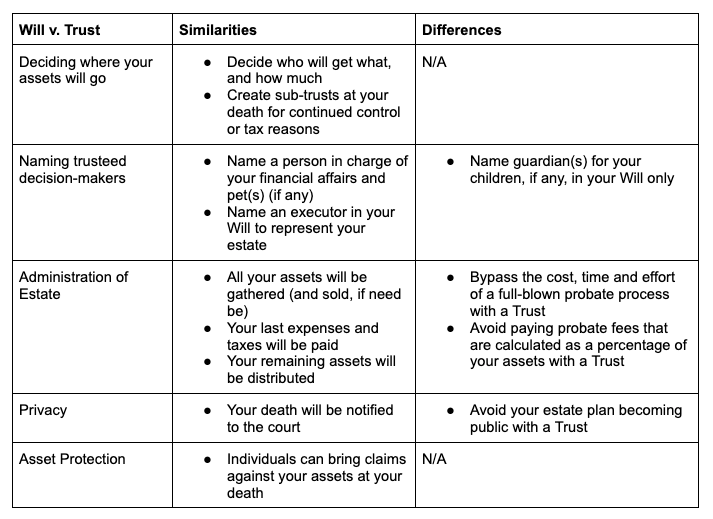
The chart below summarizes the overlap and differences between a Will and a Revocable Trust in most U.S. states.