



Reflection & Momentum: 2024 in Review and What’s Ahead for 2025

2024 was a groundbreaking year for wealth.com, revolutionizing how wealth managers and estate planning come together through innovative technology. As the Great Wealth Transfer continues, estate planning has become essential for advisors aiming to elevate client satisfaction and engage the next generation.

Our success is thanks to our growing network of wealth management and advisor partners who trust in the power of estate planning and wealth.com’s ability to deliver for them and their clients.

To our clients, partners, and the wealth management community we connected with: thank you for making 2024 unforgettable. The entire wealth.com team is dedicated to continually innovating and improving the estate planning experience, and we can’t wait to show you what we’re working on in 2025.

First, here’s a look back at our highlights and accomplishments from the past year:

2024 was a year of innovation, recognition and growth

The wealth.com team hit the ground running in 2024. We doubled down on innovation, consistently releasing product features to improve the estate planning process for advisors and having life-changing impacts for their clients.

Our hard work was rewarded with recognition from industry leaders and wealth.com was firmly established as the leading digital estate planning platform.

We also attended and spoke at events across the country, worked closely with fantastic partners within the industry, grew our Practical Planner podcast and more—culminating in a Series A led by Google Ventures and other leading tech investors.

wealth.com team at Charles Schwab conference in San Francisco

Top product announcements

Family Office Suite™

Our Family Office Suite™introduced the industry’s first collection of estate management of technologies for highly complex estates. Since released, it has enabled advisors to streamline estate management by seamlessly collecting, structuring and visualizing data from a client’s estate plan—and delivering it in all in elegant, customizable reports to enhance wealth transfer conversations.

Ester™ AI enhancements

We invested heavily in Ester™, our AI legal assistant tool, that enables advisors to work smarter by automating manual processes, namely reviewing estate planning documents. This year we launched:

  • Executive Summaries: Single-page, client-ready summaries of documents.
  • Automatic Contact Card creation for key decision makers and others named in documents, such as trustees and family members.
  • Expanded extraction capabilities to new document types, including Irrevocable Trusts (GRATs, ILITs and SLATs), Advanced Health Care Directives and Financial Powers of Attorney.

Document Creation improvements

We furthered our industry-leading document creation capabilities last year. This included allowing for greater customizations in our Revocable Trusts and Last Wills & Testaments, such as the ability to add Marital Trusts, Trust for Descendants, name contingent and ultimate beneficiaries in the event no primary beneficiaries are named (also known as a “disaster” clause).

We also refined the client onboarding experience to help them confidently navigate their estate planning journey by simplifying questions asked, providing more educational materials and allowing them to review and confirm their document recommendations.

Awards, announcements & media

Wealth.com founders at GV (Google Ventures) office in the Ferry Building in San Francisco after Series A announcement

Last year, wealth.com made waves in the industry with exciting awards, big partnership announcements and plenty of media buzz.

Announcements

It goes without saying, the most exciting announcement last year was our $30M Series A. The round was led by GV (Google Ventures), along with Citi Ventures, Outpost Ventures, Fifty Three Stations and Firebolt Ventures. It was a pivotal moment for wealth.com and our journey to reimagine estate planning, as well as setting the stage to even bigger in 2025.

We also announced a number of exciting partnerships, including:

Awards

We’re thrilled and grateful for the recognition our product and leadership team received last year. It’s exciting to see industry leaders and peers acknowledge our achievements and the hard work the entire wealth.com team puts in every day to build the best solution.

Here are some highlights from 2024:

In the media

Wealth.com was featured in nearly two hundred media mentions in 2024, including nationally recognized and industry-leading publications such as WealthManagement.com, CityWire RIA, ThinkAdvisor, Axios, Financial Planning, InvestmentNews, Barron’s and more.

We’re continuously engaging reporters to provide education on how advisors can best serve their clients through estate planning strategies. You can find all our latest news on our Press Page.

On the road

Wealth.com at FutureProof in 2024

If you ran into a wealth.com team member in 2024, it’s no surprise—we were everywhere! From speaking on stages to building connections and handing out fan-favorite swag (shoutout to the lucky surfboard winner at FutureProof 2024), we made the most of nearly two dozen events.

And we’re just getting started. In 2025, we’ll be hitting the road even more, so keep an eye out. We can’t wait to reconnect and meet new faces along the way!

What we’re focused on in 2025

2024 was just the start for wealth.com and we’re building on the momentum for 2025. This year, we’re raising the bar with exciting announcements, feature updates, and more. While we can’t reveal everything just yet, here’s a what you can expect from us:

Continuing to lead the industry in innovation

With the Family Office Suite™, the industry leading AI, and unmatched document creation capabilities, wealth.com stands as the only true end-to-end estate planning solution. This year, we’re doubling down our focus on rolling out features designed to serve all clients, from the UHNW to the mass affluent, helping advisors streamline their businesses and achieve true scale.

This year, you can expect to see us:

  • Introducing greater flexibility to customize your clients’ use cases, from document creation to reporting.
  • Expanding your strategic capabilities for estate and tax planning in the platform.
  • Adding more integrations to streamline your planning and collaboration processes.
  • These are only the tip of the iceberg. We’re making bold moves to innovate and solidify wealth.com as the ultimate estate planning platform for advisors and their clients.
  • Empowering advisors with unmatched support and resources

At wealth.com, we’re passionate about helping our advisor partners excel to both maximize the value of our platform and deliver an exceptional client experience. In 2025, we’re focused on expanding educational resources by launching Wealth.com Workshops—an exclusive series of virtual events designed to unlock the full potential of estate planning.

Early pilot sessions showed incredible engagement, and we’re excited to make this a cornerstone of the advisor experience.

We’re committed to making every wealth.com interaction seamless and rewarding. Stay tuned for more exciting updates as we continue to improve the advisor experience.

Harnessing AI to transform estate planning

Ester™ isn’t going anywhere—in fact, it’s just getting started. We believe AI is key to enhancing the wealth.com experience for advisors and the value they bring to their clients. This year, our AI team will be working hard to expand Ester™’s capabilities and integrate AI more deeply across the platform.

Events, events & even more events

It’s a good thing the wealth.com team can’t sit still because they’ll be criss-crossing the country attending all of the hottest wealth management events.

Here’s where we’ll be in the next few months—if you’re there, come say hi!

The best is yet to come

2024 just set the stage for wealth.com, and the importance of estate planning in holistic wealth management. But our focus continues to be on you—the advisor, the wealth manager and your clients. Your success is our reward and we couldn’t have achieved the amazing things in 2024 without our amazing clients and partners. We can’t wait to show you what we’re working on this year and to help you achieve even better results for your clients and your business.

How to Manage Real Estate and Property Assets in an Estate Plan

Real estate is often one of the most valuable assets in a person’s estate. Whether it’s your primary residence, a vacation home or an investment property, it’s important that your real estate is properly accounted for in your estate plan. Failing to do so could lead to a lengthy probate process, unexpected taxes for your heirs or even the loss of a family property.

For many people, placing real estate into a trust can be the best solution. Doing so allows the property to avoid the time-consuming and public probate process. It also ensures the real estate will seamlessly pass on to your beneficiaries according to the terms you’ve outlined in your trust.

This article will detail what to consider about properties and real estate, and the potential options for incorporating those assets into an estate plan.

Why planning ahead for property in estate planning matters

Real estate is not like other assets. It can’t be easily divided up and distributed to heirs like cash in a bank account.

Real property must go through a legal transfer of title to pass ownership to the next generation. Without proper planning, this transfer process can become complicated and complex for beneficiaries.

Here’s why you want to have a process in place:

1. Avoid probate: Any assets that are not in a trust when you pass will likely have to go through probate. This is true of any real estate or properties too. During probate, your beneficiaries will not have access to the property, including rental properties. Your estate will still go through probate even with a will in place, though it should make the process smoother.

2. Minimize taxes: Without proper preparation, your heirs could be hit with a hefty tax bill when they inherit your real estate. While the federal estate tax exemption is high ($13.99 million per individual in 2025), several states may have their own estate or inheritance taxes with much lower thresholds. Proper estate tax strategies for your real estate can help minimize or, potentially, eliminate this.

3. Clarify your wishes: Real estate often has sentimental value in addition to monetary value. Perhaps it’s the home where your children grew up or a lakeside house where extended family has gathered for summer vacations. Putting your wishes in writing can prevent arguments between family members, specifying whether it should remain in the family or if sale proceeds are to be split among beneficiaries.

4. Plan for incapacity: An estate plan doesn’t just address what happens after you die. It should also protect you and your assets during your lifetime, in the event you become incapacitated by illness or injury. Let’s say you own a rental property that provides a stream of income. If you were to suddenly become unable to manage the property, who would handle tasks like collecting rent, paying property taxes and coordinating repairs? Without a Financial Power of Attorney in Place, your family would have to petition the court to appoint a guardian—an expensive and stressful process.

How to pass real estate to your beneficiaries

Let’s look at some of the different ways you can pass property to your heirs.

Leave it in your will

The most basic option is to name the beneficiary for each piece of real estate in your will. Upon your death, the executor of your estate will be responsible for ensuring the property is formally transferred to the new owner.

The downside of using a will is that the property will have to go through probate before your beneficiary can take ownership.This can be a time-consuming process, and your heirs will likely need to hire an attorney to navigate the legal complexities, resulting in additional costs and delays

Form a limited liability company (LLC)

If you own rental properties or real estate used for a business, you might consider transferring those properties into a limited liability company (LLC). An LLC provides liability protection, shielding your personal assets if someone were to sue over something that occurred on the property. An LLC may also provide tax benefits.

Once the LLC is created and funded with your real estate, you can leave the corporate shares to your beneficiaries in your will or trust. Upon your death, they will inherit ownership of the LLC and the real estate it holds.

Placing rental properties into an LLC also allows your beneficiaries to easily split ownership of the real estate after your passing. Rather than arguing over who gets which property, they will each own a percentage of the LLC. If one heir wants to be bought out, the others can purchase their corporate shares.

Put it in a trust

A Revocable Trust is often the preferred method for leaving real estate to your beneficiaries. Here’s how it works: You create the trust and name yourself as the trustee. Then you transfer ownership of your real estate into the trust by filing a new deed.

The core action involved in transferring real estate into a trust is to change the title of the property. Currently, you likely hold the title to your real estate holdings in your own name (or jointly with a spouse). To place it in a trust, you’ll need to retitle it in the name of the trust itself.

This retitling keeps the property out of probate upon your death. Instead of going through the probate process, the real estate will immediately pass on to your beneficiaries and be handled according to the instructions you’ve laid out in your trust documents. The trustee you’ve appointed will be responsible for managing the property and transferring it to your heirs as specified.

Trusts provide a great deal of flexibility and control over how your real estate is managed and distributed. You can specify that a property be sold immediately, held for a certain number of years or kept in the family for generations. You might stipulate that a beneficiary can live in a home rent-free or that rental income be used to pay for a grandchild’s college education.

It’s important to note that transferring real estate into a Revocable Trust does not remove it from your taxable estate. However, an Irrevocable Trust can be used to minimize estate taxes for high net worth individuals. Since irrevocable trusts cannot be easily changed once they are funded, they are usually used in conjunction with, not as a substitute for, a Revocable Trust.

Common concerns

Many people worry that retitling property into a trust will impact things like property taxes, insurance coverage or mortgage terms. Fortunately, in most cases, this is not an issue. The transfer does not constitute a sale or change in ownership, so property tax assessments and exclusions like Proposition 13 in California remain unaffected.

Similarly, your existing homeowners insurance policy and mortgage should remain valid and unchanged, although it’s prudent to notify your insurance provider and mortgage lender of the title change so they can update their records. At most, they may have you sign a trust rider agreement.

What married couples should consider

For married couples, there are two common options when it comes to placing real estate in a trust:

  1. Retitle the property to be owned 50% by each spouse’s individual trust. This allows each person to specify their own beneficiaries and terms for their half of the property.
  2. Create a joint trust and place full ownership of the property into that single trust. The couple will need to agree on beneficiaries and terms in the joint trust.

There are pros and cons to each approach that are worth discussing with an estate planning professional. If a couple opts for a joint trust, they should consider what will happen to the property if they divorce in the future.

What happens to real estate not placed in a trust?

Any real estate that you opt not to retitle—or simply forget to retitle—into your trust will have to go through the probate process before it can pass on to your heirs. Probate can be a lengthy and expensive process, and it makes the transfer of the property a matter of public record.

There are some alternatives to trusts that may still allow you to avoid probate for certain property (more on that below), but in general, if you do nothing, your real estate holdings will be subject to probate.

Recording the retitling with a deed

To officially transfer your real estate into a trust, you’ll record a new deed with your county recorder’s office showing the trust as the owner.

Typical deeds used for this purpose include grant deeds, warranty deeds or quitclaim deeds, depending on your location and situation. Your financial advisor or estate attorney can advise on the proper format. The deed will include a detailed legal description of the property being transferred.

Most counties no longer require you to obtain a physical copy of the new deed. Digital recordings are sufficient—you can typically complete the whole process online through your county recorder’s website.

Regional variances in requirements may apply. For instance, Massachusetts does not require you to provide a full copy of your trust agreement when transferring property. Instead, you record a separate trustee certificate along with the new deed.

Alternatives to trusts for passing on real estate

While placing real estate in a trust is an effective way to efficiently transfer it to heirs outside of probate, there are some alternative methods options.

Transfer on Death deeds

Some states allow you to set up a “Transfer on Death” (TOD) deed that automatically transfers ownership of a property to your designated beneficiary upon your death, without the need for a trust or probate.

The TOD deed lists your chosen beneficiary but doesn’t give them any ownership rights until your death. You can change the beneficiary at any time.

This can be a good option for people who only want to specify what happens to their property after death and aren’t concerned about the other benefits trusts provide during their lifetime. But if this is appealing, look into whether TOD deeds are valid in your state.

Life Estate deeds

With a life estate deed (sometimes called a “ladybird deed”), you grant yourself ownership of a property for the rest of your life, and then specify the person you want to inherit the property after you pass away.

This gives you the right to continue living in or renting out the property for your lifetime. Your named beneficiary (legally known as the “remainderman”) automatically inherits the property upon your death without the need for probate.

However, life estate deeds can create complications if you want to sell the property, since the remainderman also has an ownership interest and would need to agree to the sale. Additionally, depending on how long you live, it could impact the capital gains tax your heirs will owe when they eventually sell the property.

Making a property your primary residence for at least two out of five years prior to selling provides a significant capital gains tax exclusion—an advantage your heirs may not qualify for if they inherit through a life estate deed

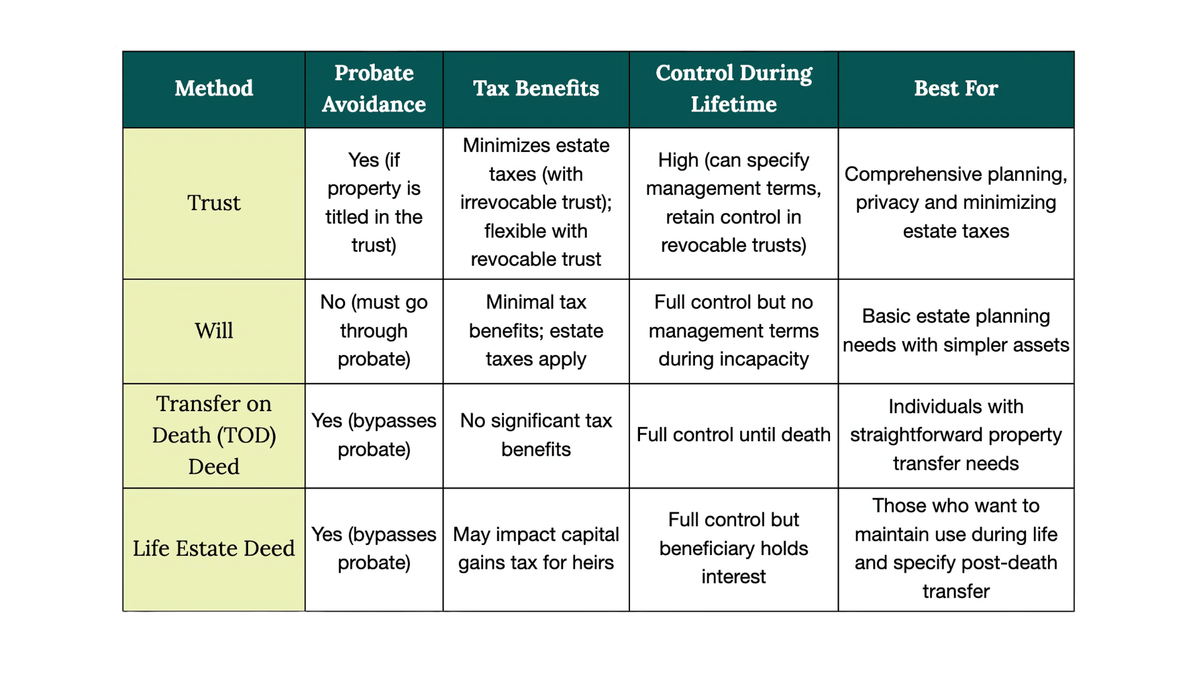
Here’s a simple chart to help understand these different options:

Chart that details the different ways to manage real estate in an estate plan, including potential tax benefits and if it avoids probate

Advanced strategies for estate tax planning

While trusts and careful planning can help minimize taxes for most estates, individuals with large estates, valuable properties, or unique circumstances may benefit from advanced strategies. One such option is the Qualified Personal Residence Trust (QPRT), which offers specific tax advantages.

With a QPRT, you place your property into an Irrevocable Trust for a set length of time, while continuing to live in it. Once the term ends, the property transfers to your beneficiaries (usually your children).

The advantage is that the property is valued for gift tax purposes at the time it’s placed into the trust, not at its value when it eventually transfers. So a $2 million property placed in a 10-year QPRT might only count as a $1.2 million gift, reducing your taxable estate.

The catch is that if you die before the QPRT term ends, the property will revert back to your taxable estate. Planning based on your age, life expectancy, and desired length of stay is required. QPRTs also cannot be revoked if your circumstances change.

Especially for high net worth estates, it’s worth consulting with an experienced estate planning attorney to determine if a QPRT or similar advanced strategy might be advantageous for your situation.

Why financial advisors are key to estate planning

Real estate and taxation issues are complex, but financial advisors have the expertise to guide clients through the nuances of incorporating real estate into estate plans. By offering informed, actionable advice, they help clients clarify their goals, navigate options and achieve peace of mind.

Advisors can assist clients by:

  • Understanding their goals: Who should inherit their properties? Are there specific conditions or sentimental attachments to certain real estate?
  • Assessing their portfolio: What is the value of their real estate holdings? How do these assets fit into their broader financial and estate planning objectives?

With this clarity, advisors can recommend tailored strategies, such as creating a trust, forming an LLC for rental properties or how to approach advanced tax planning techniques like a Qualified Personal Residence Trust (QPRT).

Are you a wealth manager? See how you can start helping their clients with their estate plans and property assets. Book a demo today.

New to Ester® Estate Extraction: Executive Summaries & Expansion to Irrevocable Trusts

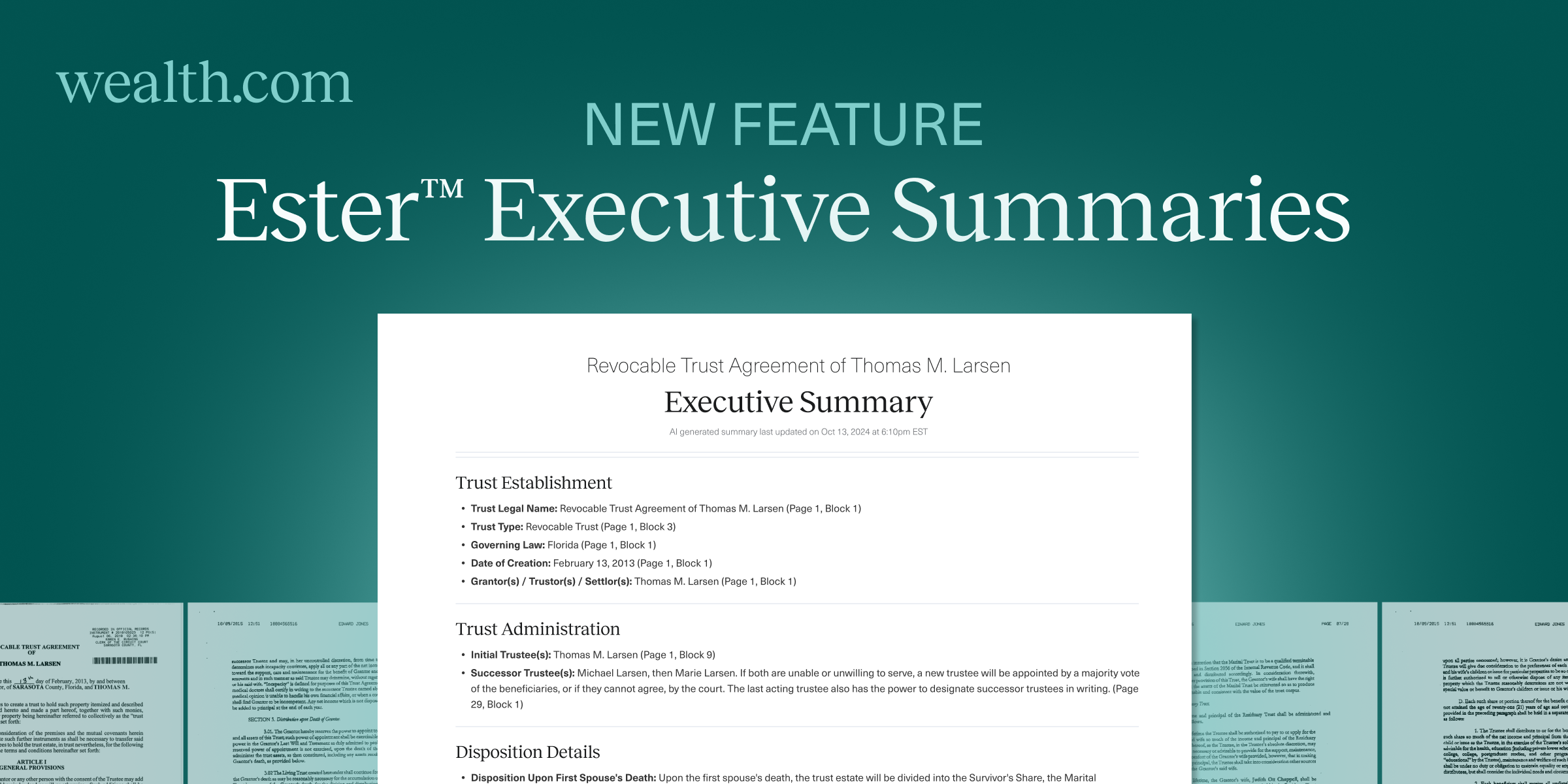
Wealth.com is excited to announce major enhancements coming to Ester®, our proprietary AI legal assistant tool. These updates include a brand new Executive Summary, which is optimized to recognize the decisions made in even the most complex estate planning documents and displayed in a concise, easy-to-read summary.

Executive Summaries for estate documents

Ester®, Wealth.com’s industry leading AI legal assistant, is already solving a critical bottleneck for advisors when it comes to helping clients with their estate plans. Reviewing existing estate plan documents to pull out relevant information—which can often be upwards of 60 or 70 pages—can take hours, if not days of manual work. But with Ester, advisors are able to upload their clients’ documents and, within seconds, get a summary of all the key information.

Now, advisors can also access an Executive Summary of clients’ estate planning documents that includes a link to the exact page where information was identified. This Executive Summary automatically provides built-in talking points to facilitate the conversation with clients and review key decisions.

The Executive Summary will be available for:

  • NEW: Irrevocable Trusts (including GRATs, SLATs, ILITs, Dynasty Trusts, among others)
  • NEW: Advance Health Care Directives
  • NEW: Financial Powers of Attorney
  • Revocable Trusts
  • Last Will & Testaments (including Pour-Over Wills)

Redesigned Ester Visualizer Report

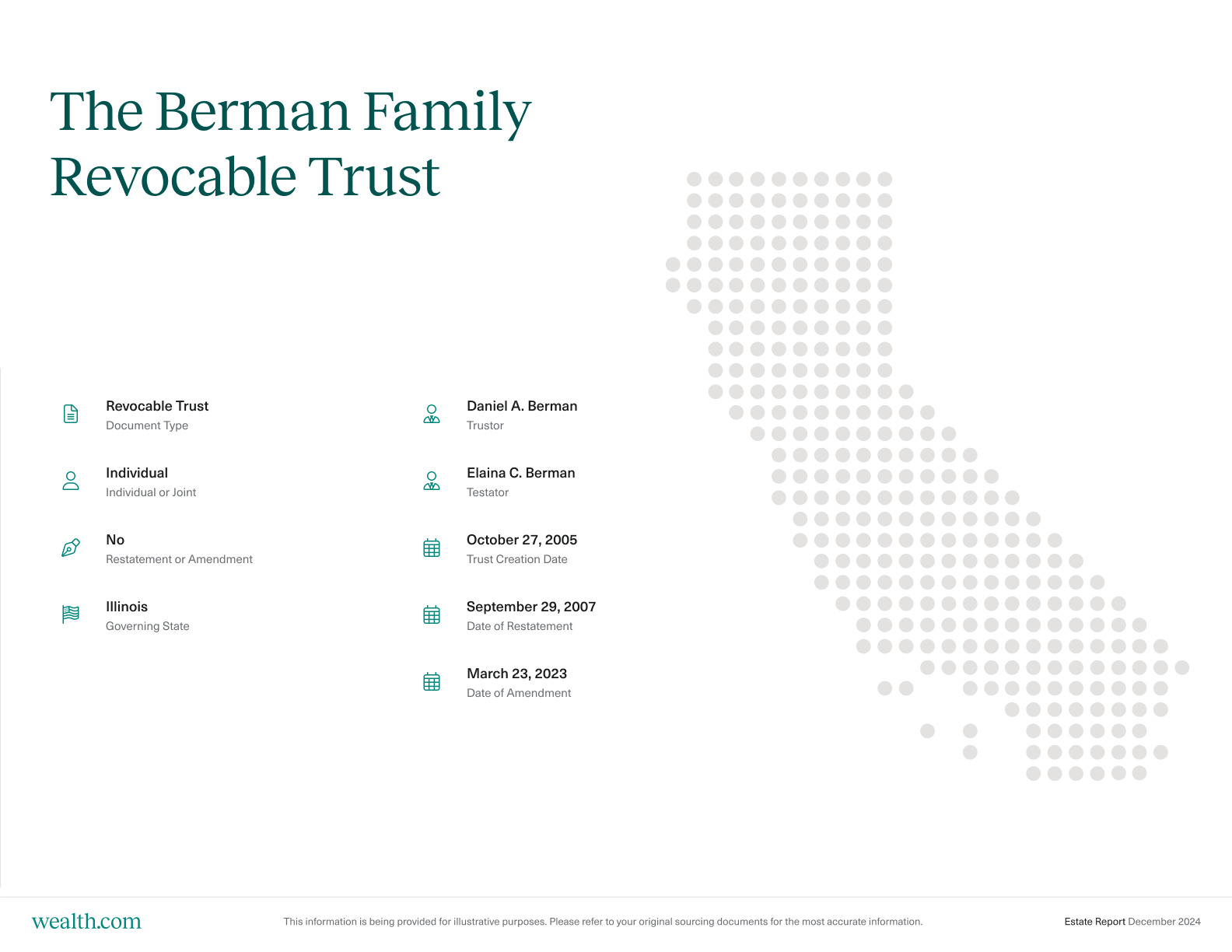
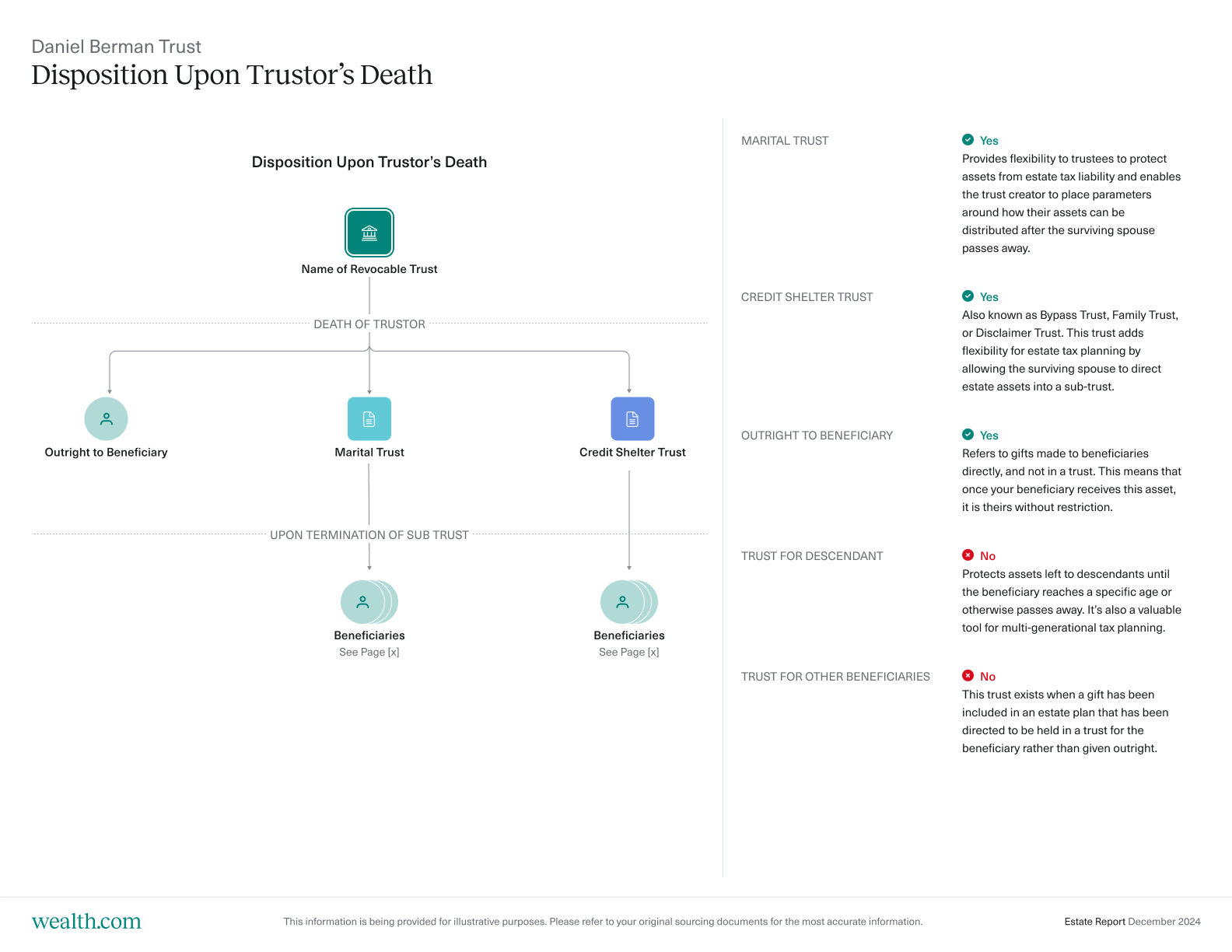
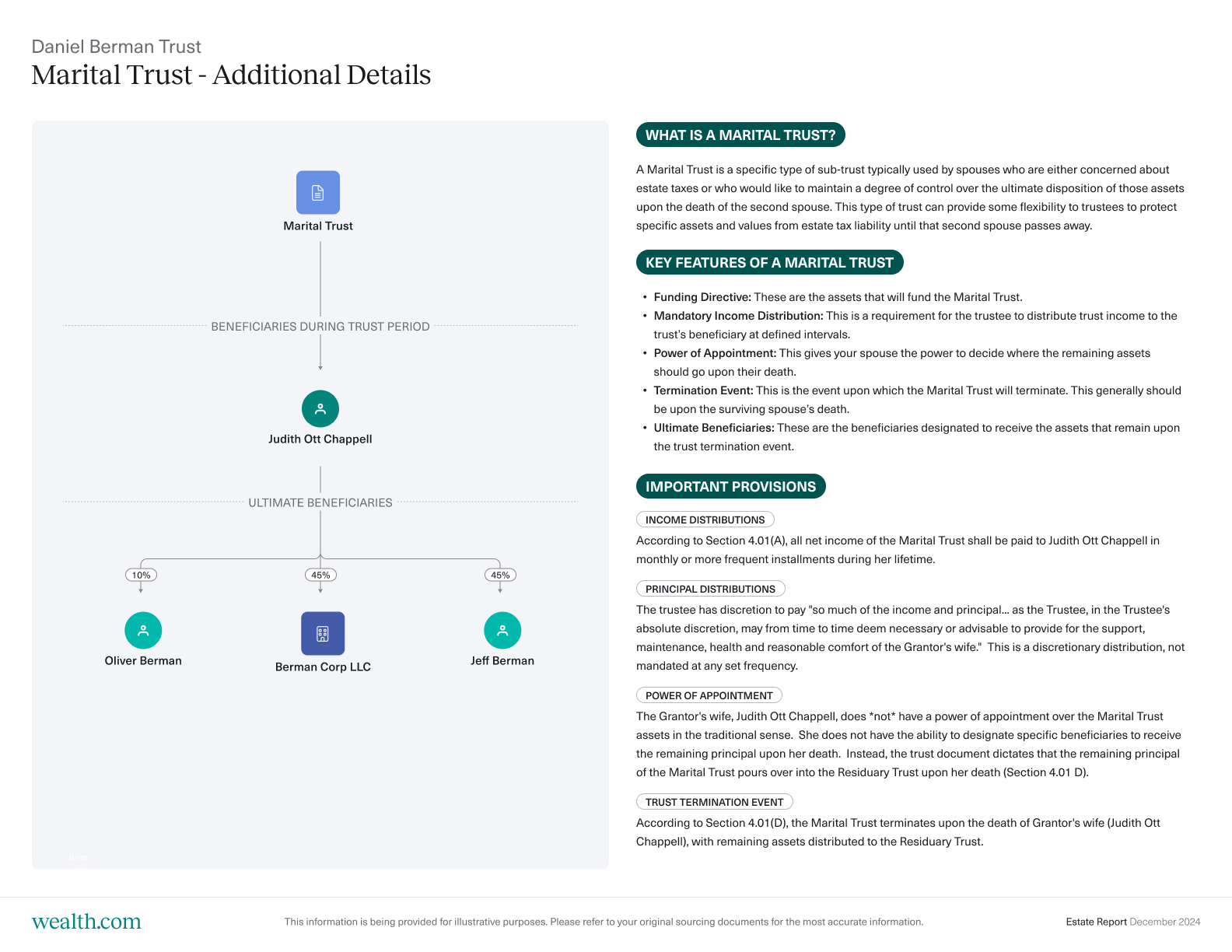
For Revocable Trusts and Last Will & Testament documents, the information that is pulled into the new Ester Executive Summary view is also fed instantaneously into a visualizer report. These distill the details of the extracted documents into visuals that clarify the complex details of the document. The new reports break down key people and entities identified in the client’s document, including grantors, trustees, executors and guardians, alongside how assets will be distributed and to whom, including recognizing income, principal and trust distributions.

Sample report pages: 


Providing clarity on the complex for advisors and clients

Ester acts as your AI legal assistant, helping you to reduce hours of manual effort to deliver clients with clarity about their estate plans and unlock additional planning opportunities to progress forward with your client.

These new updates are currently being rolled out to new and existing Wealth.com customers over the coming weeks. To learn more about how Ester and Wealth.com can reimagine estate planning for your firm, book a personalized demo today.

What to Know About Putting Your Business in a Trust

As a business owner, you’ve poured your heart, soul, and countless hours into building your company. But have you taken the time to consider what will happen to your business if you become incapacitated or pass away? While it’s not the most comfortable topic to think about, properly planning future business ownership can help protect both your company’s future and your family’s financial security.

Whether you’re running a startup, managing a family business or hold equity in a private company, trusts can protect and transfer business interests that could be vital for their long-term success. Here’s how they work and what you need to know.

Why consider trust ownership for your business?

Many business owners default to keeping their business interests in their personal name, assuming they’ll deal with succession planning “later.”

But think about this scenario: You get sick, or have an accident, and are unable to continue to run your company. Who would make business decisions? While you might think a power of attorney would be enough, many financial institutions and business partners can reject or delay accepting power of attorney documents, especially if they don’t meet specific requirements.

A properly structured trust can create a more seamless transition of control, allowing your chosen trustee to step in and manage business affairs without disruption. This can be especially important if you are the sole owner or a key decision-maker.

Other reasons to consider a trust include:

  • Avoiding probate: When you pass away, assets held in your individual name typically must go through the probate process. This means your business details become public record, operations may face delays waiting for court approval and your estate could incur additional costs and administrative burdens. By transferring your business interests to a trust, you can bypass probate and ensure a smoother transition for your successors.
  • Succession planning: A trust allows you to specify exactly how you want your business to be managed and distributed upon your incapacity or death. You can name a successor trustee to oversee operations and provide detailed instructions for the eventual transfer of ownership to your chosen beneficiaries.
  • Asset protection: Depending on the type of trust and how it’s structured, placing your business in one may offer some degree of protection from creditors and lawsuits. This can be especially valuable if your company operates in a high-risk industry.
  • Estate tax planning: If your estate is likely to be subject to estate taxes, certain types of irrevocable trusts can be used to remove business assets from your taxable estate, potentially saving your heirs a significant tax bill.

Trusts can offer control and flexibility over your assets

One common misconception is that putting business interests in a trust means giving up control. In reality, trusts offer a way to maintain control while protecting assets and planning for succession.

For example, you might want your spouse to benefit financially from your business but prefer that operational decisions stay with your business partner. A trust can separate these economic and control rights, ensuring both goals are met.

Revocable vs. Irrevocable Trusts: What’s the difference?

When it comes to trust ownership of your business, you have two main options: Revocable Trusts and Irrevocable Trusts. Understanding the key differences can help you decide which type best serves your needs.

Revocable trusts

Also known as living trusts, revocable trusts can be modified or terminated by the grantor (the person who creates the trust) at any time. Here are the main features:

  • Flexibility: With a revocable trust, you maintain complete control over the assets and can change the trust terms, beneficiaries, or trustees whenever you wish. This can be ideal if your business is still in the early stages or you anticipate needing to adjust your plan over time.
  • Incapacity protection: If you become unable to manage your business due to illness or injury, your chosen successor trustee can seamlessly step in to handle day-to-day operations and major decisions per your instructions.
  • Probate avoidance: Assets held in a revocable trust bypass the probate process, allowing for a faster, private transfer of your business to your beneficiaries.

However, revocable trusts have some limitations. Because you retain control over the assets, a revocable trust does not provide any meaningful protection from creditors or lawsuits. Plus, assets in a revocable trust are still part of your taxable estate, so there are no estate tax advantages.

Irrevocable trusts

As the name suggests, an irrevocable trust is one that generally cannot be modified or revoked once it’s established. The grantor essentially relinquishes control of the assets to the trust. Key features include:

  • Asset protection: Since the assets are no longer under your ownership or control, an irrevocable trust can provide a barrier against creditors and litigation (assuming it’s properly structured and funded in advance of any claims).
  • Potential estate tax savings: Business interests placed in an irrevocable trust are generally removed from your taxable estate, which can be a powerful tool for reducing your estate tax liability.
  • Succession planning: Like a revocable trust, an irrevocable trust allows you to specify how your business should be managed and distributed to beneficiaries. The trustee is legally bound to follow these instructions.

The main drawbacks of irrevocable trusts are their inflexibility and loss of control. Once an irrevocable trust is set up and funded, you typically can’t modify the terms or take back control of the assets without beneficiary approval (and sometimes court approval). Additionally, placing a business in an irrevocable trust can result in the potential loss of a step-up basis at your death, which could result in higher capital gains taxes for your beneficiaries if, and when, they sell the business.

Transferring your business to an irrevocable trust also means giving up direct ownership and control, which can be a psychological hurdle for many entrepreneurs.

Key trust provisions business owners should consider

Regardless of whether you opt for a revocable or irrevocable trust, there are several key aspects your trust document should include if you’re a business owner:

Specific powers for managing the business

Your trust should explicitly authorize your trustee to continue operating the business, making investment decisions, hiring and firing employees, and taking other necessary actions to manage the company effectively. This helps ensure a smooth transition and continuity of operations.

Trustee succession plan

Name not only your initial successor trustee but also alternates in case your first choice is unable or unwilling to serve. Better yet, discuss the decision with your preferred trustee first to ensure they’re already willing and able to serve. You can also cConsider naming a professional fiduciary, such as a bank or trust company, if you’re not comfortable naming someone you know. Or you can name them as a backup to ensure there’s always someone qualified to manage the trust.

Beneficiary distribution instructions

Clearly outline how and when your business interests should be distributed to your beneficiaries. You might include provisions for the trustee to maintain ownership until certain milestones are reached, such as beneficiaries reaching a certain age or the business achieving specific goals.

Asset protection language

If creditor protection is a goal, your trust should include strong spendthrift provisions that restrict beneficiaries from pledging or encumbering their trust interests. This can help shield the business from beneficiaries’ personal liabilities.

Overriding the prudent investor rule

One often overlooked issue is the “prudent investor rule” that applies to trustees. This rule typically requires trustees to diversify investments and avoid concentrated positions. This could directly conflict with holding a controlling interest in a private business.

To address this, you may want to consider explicitly overriding the prudent investor rule in your trust document and grant the trustee power to maintain business interests. Without this provision, your trustee could actually be legally obligated to sell or diversify business holdings.

Dispute resolution procedures

Consider including mediation or arbitration clauses to resolve any disputes between trustees and beneficiaries outside of court, which can be costly and time-consuming.

One common challenge is balancing business operations with family financial needs, especially when family members aren’t involved in the business. One solution to this could be bifurcating trustee roles. Appoint one trustee (perhaps a business partner) to handle business operations and another (often a family member) to manage family financial matters.

Coordination with buy-sell agreement

If your business has multiple owners, ensure that your trust provisions align with any existing buy-sell agreements. Your trust should direct the trustee to carry out the terms of the buy-sell if triggered by your incapacity or death.

Considerations for specific business structures

The type of entity your business operates as can impact trust planning:

  • Corporations: If you own shares in a C-corporation or S-corporation, you’ll need to review the company’s bylaws and any shareholder agreements to ensure they permit trust ownership. S-corporation stock can only be held by certain types of trusts, so it’s a good idea to work with an attorney to structure your trust the right way.
  • Partnerships and LLCs: Review your partnership agreement or LLC operating agreement to see if it allows for trust ownership of shares. You may need to amend the agreement to accommodate your trust. Also, consider any restrictions on transfers of ownership and how they might impact your succession plan.
  • Sole proprietorships: While a sole proprietorship is not a separate legal entity, you can still use a trust to hold and transfer business assets like real estate, equipment, and intellectual property.

The advisor’s role in trust planning

If you’re considering trust ownership for your business, your financial advisor can be a valuable resource throughout the planning process. They can help you clarify your objectives for the business, both during your lifetime and after you’re gone. They can also guide you in prioritizing competing goals like maintaining control, minimizing taxes, and protecting assets.

With a deep understanding of your financial situation and estate planning needs, your advisor can help you weigh the pros and cons of different trust structures and determine whether a revocable or irrevocable trust (or a combination) is best suited for your circumstances.

Your advisor is often just one tool to have in your financial toolbox. They can serve as a point person to coordinate the work of your estate planning attorney, CPA, and other professionals involved in the planning process.

As your business and personal circumstances change over time, your advisor can help you review your trust plan to ensure it remains aligned with your goals.

Is a business trust right for you?

Placing your business interests in a trust can protect your company’s future, streamline your estate plan, and potentially minimize taxes. But it’s not a one-size-fits-all solution. The right approach depends on your specific goals, family situation, and business structure.

If you’re considering trust ownership for your business, start by meeting with your financial advisor. They can help you review your options and develop a plan that safeguards your legacy and ensures a smooth transition for your company when you’re no longer at the helm.

What To Know About The Tax Cuts & Jobs Act Sunset, and How to Prepare Clients

As a financial advisor, helping your clients navigate the ever-changing tax landscape is a critical part of providing comprehensive wealth management services.

One major change on the horizon is the looming sunset of many provisions in the Tax Cuts & Jobs Act (TCJA) at the end of 2025, which could have significant implications for estate planning.

With trillions of dollars expected to pass between generations in the coming years as part of the “Great Wealth Transfer,” it’s imperative that advisors understand the potential impacts of the TCJA sunset and help clients plan accordingly, especially as it relates to their taxable estates.

In this post, we’ll dive into the key aspects of the TCJA sunset, explore who’s likely to be most impacted and outline estate planning strategies advisors can explore to ensure a smooth transition for their clients.

Understanding the potential Tax Cuts & Jobs Act sunset

The Tax Cut & Jobs Act, passed in December 2017, made sweeping changes to the U.S. tax code. However, many of the provisions affecting individuals and their estates are temporary, scheduled to expire on December 31, 2025 due to the budget reconciliation process used to pass the law.

Some of the most significant provisions set to expire include:

  • Estate and gift tax exemption amounts reverting to pre-TCJA levels
  • Individual income tax rate increases
  • Reduction of the qualified business income (QBI) deduction for pass-through entities
  • Lowering of the alternative minimum tax (AMT) exemption amounts

Unless Congress takes action to extend these provisions, the tax code will revert to its pre-2018 state, which could have major ramifications for high-net-worth individuals and families and their estate plans.

Who will be affected?

The TCJA sunset will primarily impact high-net-worth individuals and families—those with assets exceeding the post-sunset exemption amounts. This may include clients who hadn’t previously needed to worry about estate taxes but have seen their wealth grow in recent years and are now in danger of surpassing the lifetime exemption amount.

Certain individuals, like business owners or those with highly-appreciated assets, may be particularly susceptible to the impacts of the reduced exemptions. Blended families and unmarried couples could also face unique challenges and may require more complex planning.

That said, even clients below the exemption thresholds should review their financial plans, as there could be state-level tax consequences to consider. Plus, life circumstances change—what may not be an issue today could become one down the road.

The biggest potential changes of the TCJA sunset

Here’s a look at some of the biggest pending changes and how advisors can prepare.

Estate & gift tax exemption: Use it before you lose it

Perhaps the most talked-about aspect of the TCJA sunset is the impending reduction in the lifetime estate and gift tax exemption. Currently, individuals can transfer up to $13.99 million ($27.98 million for married couples) in their lifetime without incurring federal estate or gift taxes due to the TCJA. It’s important to clarify that this lifetime exemption amount is separate from the annual gift tax exclusion, which allows individuals to gift up to $19,000 per recipient in 2025 without counting towards their lifetime exemption.

But this historically high lifetime exemption means that currently, only a small amount of estates are subject to federal estate tax.

That could change dramatically in 2026, when the exemption is set to drop back down to around $7 million per individual, adjusted for inflation. Suddenly, many individuals who didn’t have taxable estates will be at risk of owing substantial estate taxes, ranging from 18% to 40% on the value exceeding the exemption amount.

This potential change is most relevant to clients who have been relying on ‌elevated exemptions for their estate plans—those with substantial wealth and assets to pass down. Advisors need to be proactive in developing strategies to minimize estate tax exposure, which could include:

  • Gifting appreciating assets: Clients can take advantage of the current exemption by gifting appreciating assets, like stocks or real estate, to irrevocable trusts or directly to beneficiaries. The IRS has confirmed there will be no clawback for gifts made under the current exemption, even if the exemption is lower at the time of the donor’s death. This allows clients to remove asset appreciation from their taxable estates.
  • Spousal Lifetime Access Trusts (SLATs): For married clients hesitant about giving up access to gifted assets, SLATs can provide a solution. One spouse funds an irrevocable trust for the benefit of the other, using their gift tax exemption. The beneficiary’s spouse can still access the funds if needed, offering flexibility and peace of mind.
  • Grantor Retained Annuity Trusts (GRATs): GRATs allow clients to transfer assets to an irrevocable trust while retaining the right to receive annuity payments for a set term. If structured properly, appreciation beyond the IRS Section 7520 rate passes to beneficiaries tax-free at the end of the term.
  • Charitable giving: The TCJA also raised the charitable deduction limit. Taxpayers who itemize can deduct up to 60% of their adjusted gross income—previously they could only deduct up to 50%. Clients who are considering a large charitable donation as part of their estate plan may want to act now before the limit reverts.

It’s important to weigh the trade-offs of these strategies. Gifting to irrevocable trusts can create long-term estate tax benefits, but advisors must carefully evaluate potential drawbacks. Relinquishing control and losing the step-up in basis at death could result in a substantial capital gains tax burden for heirs if the exemption doesn’t ultimately drop as expected or the client’s wealth ends up below the threshold.

Changing income tax rates could impact estate planning decisions

In addition to estate planning considerations, the TCJA sunset will impact clients’ income tax pictures. Tax rates are scheduled to increase across the board, with the top marginal rate rising from 37% to 39.6% and most brackets seeing a lowering of their income thresholds.

Here’s a closer look at how ‌individual tax brackets will change:

After the TCJA sunset, more individuals and married couples will find themselves in higher tax brackets. Depending on their overall financial picture, it might make sense for certain clients to incur taxes at today’s lower rates for the later benefit of their beneficiaries.

For clients in these affected brackets, advisors may want to explore strategies to accelerate income recognition while rates remain relatively low. Options to consider include:

  1. Roth conversions: With tax rates poised to rise, Roth conversions become increasingly attractive. By converting pre-tax retirement accounts to Roth IRAs, clients pay tax on the converted amount now in exchange for tax-free withdrawals later. This can be especially smart for clients who expect to be in a higher bracket in retirement.
  2. Harvesting capital gains: Clients sitting on highly appreciated assets may benefit from selling and recognizing gains before rates increase. Advisors can help clients identify opportunities to strategically offset realized gains with available losses.
  3. Accelerating business income: Business owners expecting strong profits in the coming years might consider shifting income recognition forward to take advantage of current rates. Advisors can collaborate with CPAs to develop timing strategies around invoicing, collections and expenses.

Phaseouts of business income deduction and AMT exemption may increase taxable estates

Two other notable provisions sunsetting in 2025 are the 20% qualified business income (QBI) deduction and the expanded alternative minimum tax (AMT) exemption amounts. While these changes have broad financial planning implications, they can also impact estate planning by potentially increasing a client’s taxable estate.

With the loss of the qualified business income (QBI) deduction, affected business owners could see a jump in their taxable income, which may push them into a higher bracket and over the estate tax exemption. Advisors should work with these clients’ CPAs to explore entity restructuring to manage income tax liability and potentially preserve estate tax exemptions.

Similarly, the AMT may ensnare many more taxpayers post-2025, as the exemption amounts will revert to their much lower pre-TCJA levels. Common AMT triggers like high state and local taxes, significant capital gains, and incentive stock option exercises could inflate a client’s taxable estate. Advisors may want to encourage clients to accelerate income and exercise ISOs while the expanded AMT exemption remains.

Flexibility is key in an uncertain future

With any planning around future tax changes, the only certainty is uncertainty. It’s impossible to predict exactly what the legislative landscape will look like in 2026 and beyond.

It’s possible that many parts of the TCJA could be extended by Congress before the 2025 sunset. However, given the current political landscape and growing national debt, many experts view this as unlikely.

Even if an extension does occur, it may not be permanent. This creates an environment of uncertainty that makes long-term planning difficult—the approach for advisors and clients should be to hope for the best but plan for the worst.

That’s why, above all, advisors should prioritize flexibility in their clients’ estate and tax planning. Rigid strategies based on current law could backfire if the rules change unexpectedly. Instead, focus on crafting nimble plans that can be easily adjusted as circumstances change.

Some key ways to build flexibility into client plans include:

  1. Revocable trusts: Unlike irrevocable trusts, revocable living trusts can be freely amended or revoked by the grantor during their lifetime. This allows clients to modify their plans as needed without losing control of trust assets.
  2. Disclaimers & powers of appointment: Including disclaimer provisions and powers of appointment in estate planning documents gives beneficiaries the ability to adjust inheritances based on the prevailing tax environment. This can help optimize tax outcomes without locking clients into an inflexible structure.
  3. Regular plan reviews: Advisors should commit to meeting with clients at least annually to review estate plans and tax strategies. Regular check-ins provide opportunities to assess how changing laws and circumstances may impact clients’ plans and make proactive adjustments.

Ultimately, the key to navigating the TCJA sunset successfully is to stay informed, start planning conversations early and remain adaptable. By taking a proactive approach, advisors can strengthen client relationships and cement their value as trusted guides through an uncertain tax landscape.

See why advisors and clients love Wealth.com

Get a Demo

Reference Guide: 2025 IRS Inflation Adjusted Numbers for Estate Planning

The IRS just released its 2025 numbers adjusted for inflation. These can have a significant impact on wealth and estate planning.

For many people, the major take away is that the annual gift exemption is increasing to $19,000. For those that already have a gifting strategy or plan significant gifts in 2025—such as contributing to tuition or a down payment for a family member—this increase can help with certain tax strategies.

The other takeaway is the lifetime estate and gift tax exclusion is increasing to $13.99 million for individuals and $27.98 million for married couples, which applies to clients that have high-net worth estates. In 2025, this is even more significant because the Tax Cuts & Jobs Act (TCJA) is set to sunset at the end of the year. Unless Congress extends the provisions in the TCJA, the estate and gift tax exclusion will return to pre-2018 numbers—adjusted for inflation, it would likely be at just under $7 million for individuals.

That’s why it’s for critical for financial advisors to review these 2025 numbers alongside your clients’ plans to understand if there is any impact or opportunities for new estate tax strategies next year.

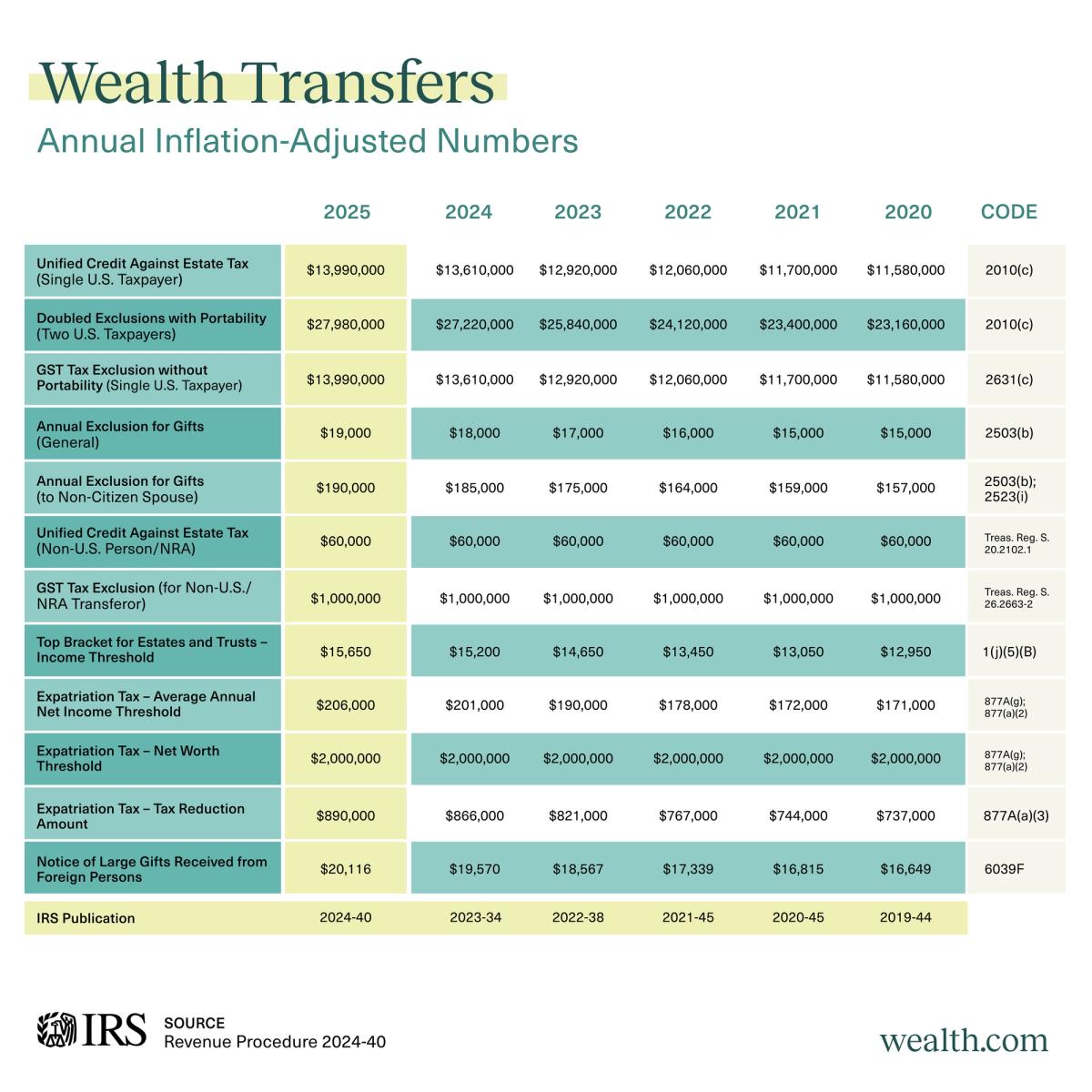
We reviewed Revenue Procedure 2024-40 and pulled out only the relevant numbers for wealth planning to provide advisors, and their clients, a simple reference chart. View it below or download a version that you can keep handy.

IRS Reference guide chart for 2025 inflation-adjusted tax numbers related to estate planning

Actionable takeaways & impacts

While the impact of these wealth transfer-relevant numbers on your clients’ estate plans will depend on their financial situation—for example, individuals with taxable estate well under $13.99 million are likely to be unaffected by the lifetime exemption—there are potential strategies you can employ for those that could be impacted.

Here are some examples of how you can use these numbers to create a strategy for affected clients in 2025:

1. Maximize lifetime wealth transfer

Your clients can now contribute significantly to irrevocable trusts and/or make substantial gifts without incurring taxes due to the increase in the lifetime estate and gift exemption to $13.99 million for individuals and $27.98 million for married couples.

This allows you and your clients to optimize their estate planning strategies, especially if they expect to be impacted by the TCJA sunset at the end of 2025.

2. Monitor taxable gifts

Next year, the annual gift tax exclusion is increasing to $19,000. This means your clients are able to give even more without triggering gift tax. Only anything above that amount will start to impact their lifetime exclusion.

If a client already has a gifting strategy in place, for example providing gifts to their grandchildren every year, make sure they know that they are now able to increase their non-taxable gifting amount.

You should also ensure that you’re helping them track their gifting amounts. If they exceed the $19,000 they will need to file a Form 709 to report taxable gifts.

3. Leverage 529 plan contributions

Due to the annual gift tax exclusion increase, clients can now contribute up to $95,000 to a 529 plan in a single year by utilizing the five-year election option.

This can be beneficial for your clients that are looking to superfund their children’s or grandchildren’s education funds without incurring fit taxes.

4. Evaluate trust tax implications

If your clients are considering irrevocable trusts, you should assess who will be the taxpayer for the trust (i.e. is it a Grantor Trust).

This evaluation helps your clients weigh potential estate tax savings against higher income taxes, providing a clearer financial picture for them.

5. Understand non-resident alien tax implications

Be mindful of the different estate and gift tax thresholds that apply to non-resident aliens. These can have a significant impact on planning strategies.

This chart will help you navigate those complexities more effectively.

6. Address expatriation and foreign gifts

For your clients that are considering moving to a foreign country, renouncing their citizenship or green card status and/or receiving large gifts from abroad, you should be aware of the reporting requirements and tax implications.

This chart will help you quickly find the new thresholds so you can ensure compliance for your clients and avoid any penalties.

Get Your Free 2025 IRS Reference Guide

Download

The Role of Conservators, Guardians, Trustees, Executors and Agents in Estate Planning

When creating your estate plan, it’s important to understand the critical roles you may need to name to manage your affairs. Among these roles are conservators, guardians, trustees, executors and agents, each serving distinct functions and responsibilities.

Knowing the nuances and potential intersections of these roles will help guide your decision on whom to choose for each one.

In this article, we cover the tasks of each role, where they may overlap and how you can approach choosing someone to fullfill each one.

What is a conservator?

The court appoints a conservator to oversee the finances of an individual declared unfit to manage their own affairs, thereby protecting those incapacitated due to physical or mental disabilities.

For example, a conservator may be named if a person experiences a sudden mental breakdown, if they become severely disabled, such as paralysis, or have chronic drug use. Well-known cases include Brian Wilson of The Beach Boys or Britney Spears, who both were placed in conservatorships for mental health reasons.

The main responsibilities of a conservator include financial management, such as paying bills, managing investments and ensuring that any financial obligations of the individual are met. A conservator usually retains a lawyer to ensure compliance with court rules, which typically include keeping the court up-to-date on the person’s financial obligations and actions taken.

Most often, a conservator’s responsibilities are limited to financial oversight. But other types of conservatorships include:

  • General: A conservator has complete oversight over all aspects of a person’s decisions.
  • Limited: This type gives the conservator control over certain aspects of the person’s life. This may allow a mentally disabled adult autonomy over most aspects of their life but requiring a financial allowance and/or health treatments.

How is a conservator named?

A conservatorship usually begins with a petition being filed with the court. The person who filed the petition, like a family member or parent of an adult child, details why they want a conservatorship. They typically need medical documentation proving that the individual is unable to live independently.

During the scheduled hearing, the court evaluates the evidence and hears testimonies from various parties, including the petitioner, other family members and medical professionals.

If a court approves the petition, it will select a conservator who is willing and able to serve. The person who files the petition may suggest themselves, or they can recommend someone else, but the judge will ultimately decide who is the best person.

How long does a conservatorship last?

The length of a conservatorship depends on the situation. In emergencies, a short-term conservatorship may last about 90 days. In the case of a temporary conservatorship, the length will be determined by the court.

A permanent conservatorship lasts indefinitely. Its length will vary depending on updates from the conservator and the reasons it was established. The court can revoke a permanent conservatorship if it decides it’s no longer needed.

What is a guardian?

A guardian is the person you choose to care for your children if something happens to you. Most often, the term “guardian” refers to a child or minor. The guardian has broad oversight decisions for your child, the same you have as a parent.

A guardian can also be named for an adult. The term is sometimes used interchangeably with “conservator.” The differences are typically that guardianship refers to physical custody of the person, much like the guardian of a child, while a conservator manages their finances.

How is a guardian named?

You can name the guardian for your children in your estate plan. You can name multiple people in order of preference in case the chosen guardian is unable or unwilling to take care of your child.

It’s important to make the decision carefully. Consider whether you trust them to raise your children according to their wishes, provide for them financially (especially regarding your estate’s assets) and the quality of life they’d be able to provide.

You should always talk to the person you’re choosing to make sure they’re willing to take on the responsibility. Failing to discuss your choice may result in their refusal to serve as your children’s guardian. If this occurs and no alternate guardians are named, the court will decide. Usually, this will be the closest family member, like a grandparent, uncle or aunt, based on the court’s assessment.

The decisions you make today are not set in stone. You can update your estate plan at any time if you have a falling out with the named person or if they pass away.

What is an agent in estate planning?

An agent is the person you name in your Financial Power of Attorney (FPOA) or Advance Health Care Directive (AHCD) to make decisions on your behalf if you become incapacitated.

The term “agent” may refer to someone who can make medical or financial decisions for you, should you not have the capacity to do so.

You can provide the agent with broad or limited powers over decisions, such as overseeing only specific financial decisions or transactions. It’s usually recommended that when creating your Financial Power of Attorney and Advance Health Care Directive that you be as specific and comprehensive as possible in what decisions they can make on your behalf. Otherwise, there’s a risk that their ability to make decisions for you could be delayed or negated due to vagueness or a dispute from another party, like a family member, hospital or financial institutions.

How is a Financial Power of Attorney or healthcare agent named?

You are able to name these people in your Financial Power of Attorney and Advance Health Care Directive documents.

You can update or revoke these documents if you wish to name someone else in the future.

How does a power of attorney agent interact with a guardian or conservator?

Naming a power of attorney gives you a significant level of control over who will make decisions for you if you become incapacitated—without having to go to the courts.

The agent may even eliminate the need to name a guardian or conservator for an adult. This can simplify the process of managing decisions during incapacity.

However, if there are any disputes about the scope of the power of attorney’s role, or if they were only granted limited decision-making authority, a court may still step in to name a conservator or guardian. Still, the agent(s) you named may still be able to help guide the court’s decision during hearings.

What is a trustee?

A trustee is a person (or corporate fiduciary like an investment firm or bank) who you name to be responsible for managing the assets held by your trust.

They manage the assets that you have placed in the trust, such as cash, stock or investment accounts or your home. They must make decisions about how to protect and grow the value of those assets.

They also oversee the distribution of those assets in the trust according to the terms you have set. This may be making direct payments to beneficiaries or allocating resources for specific purposes, like school tuition.

They must also maintain accurate records of all transactions and actions they take as well as periodic reports about the performance and status of its assets. The trustee may also be responsible for filing and paying taxes for assets in the trust.

How is a trustee named?

When you create a trust, you name the person in the trust document itself. You (the grantor) can designate either individuals, like a family member, or an institution, like a bank, to serve as trustees.

If you prefer to choose an individual, you should consider a few factors, including their financial acumen, trustworthiness and willingness to take on the responsibilities. It’s important to make sure the person you choose doesn’t have any conflicts of interest. This will help maintain trust in their decision-making.

If you don’t have any family or close friends who you believe have the financial knowledge needed to manage a trust, then you can choose to have a bank or trust company act as the trustee.

In the case that the trustee is unwilling or unable to serve, the court may appoint one based on the laws of your state and needs of the trust. This is why it’s important to choose someone carefully and discuss the decision with them.

How does a trustee interact with a conservator, guardian or power of attorney agent?

There is likely to be overlap with a trustee and a conservator, guardian or an agent under a power of attorney. Since a trustee is only managing assets held in a trust, they will likely need to coordinate with any of these roles that may need to access those assets.

For example, if you die and the guardian you named in your estate plan is now caring for your children, your trustee will manage any distributions from the trust pertaining to the care of your children. How so depends on the terms of your trust.

If you specify that your children receive a set amount every year from the trust, the trustee must coordinate that distribution with the guardian. If you specify that the trust pay your child’s tuition, that must also be coordinated with their guardian.

This scenario is similar for conservators or power of attorney agents. If a person is under conservatorship, the conservator would coordinate with the trustee to manage any distributions for the benefit of the person.

Similarly, a trustee may collaborate with a power of attorney agent to ensure alignment on any actions under the terms of the trust.

What is an executor?

Your executor is the person you name who is in charge of administering your probate estate after you’re gone. This person is responsible for collecting your assets, paying your debts and distributing your probate estate to your beneficiaries.

Because property passing through a trust or beneficiary designation would typically avoid probate, such property would not typically be managed by an executor.

How is an executor named?

You can name your executor in your Last Will and Testament. If you have a trust, you are able to name your executor in your Pourover Will.

While having a trust in place typically avoids the probate process, anything left outside of the trust may go through the probate process so it’s important to still have a will in place, and have an executor named.

As with other important estate planning roles, it’s important to choose your executor carefully. It should be someone that you trust to both follow the wishes you’ve laid out as well as navigate the probate process, including the financial and legal aspects.

It’s always recommended that you talk to the person before you name them to make sure they are willing and able to serve as your executor. While they may want to consult with an estate attorney and/or financial professional during the probate process, it’s important that they understand the responsibilities.

If you don’t name someone, the person refuses or the person you named dies, the court will appoint an administrator. This typically begins with a surviving spouse or other close adult family members.It’s important to review your will periodically to make sure the person you have named is still the right choice. You are able to update your will if you wish to name a different executor because you may no longer trust the person you originally named, if they are no longer living or if you just have a change of heart.

How does an executor interact with a conservator, guardian, trustee and power of attorney agent?

While managing the probate process, the executor will likely need to coordinate with various role, including a conservator, guardian, trustee and/or power of attorney agent. For example, if you were under a conservatorship when you die, your executor will likely need to work with your conservator to administer distributions and other management aspects the conservator was involved in.

An executor would coordinate with a guardian you named for your minor children when it comes to managing their inheritance and how it’s distributed.

If you have a trustee, meaning you have a trust in place, the executor is likely overseeing the probate process for assets that were left outside of the trust which the trustee is not managing. However it’s possible they will still need to coordinate on distributions, debt collections or other aspects of your estate. If a power of attorney was used prior to your death, your executor might consult with your agent about any ongoing financial obligations or other considerations that were in place and should be considered during the probate process.

Can a conservator, guardian, trustee, executor and power of attorney agent be the same person?

Yes, the roles of a conservator, guardian, trustee, executor and agent under a power of attorney can be fulfilled by the same individual. As noted above, naming an agent in a Financial Power of Attorney and/or Advance Health Care Directive may negate the need for a court to name a conservator—or streamline the process of naming one—should the situation arise.

However, when creating your estate plan you can decide that the trustee of your trust, the guardian of your children, the executor of your will and the agents you name in your FPOA and AHCD documents are all the same person.

For example, you could decide that your sibling is whom you want to take care of your children if you die, make financial and health decisions if you become incapacitated, manage your trust and over see any probate process when you pass.

If you do arrive at that decision, make sure you understand the nuances of each role and that you trust one person to do it all, should it become necessary. While having a single person assuming all those responsibilities could simplify things, there is the risk that it could be too much for them to take on which could create issues.

Whomever you decide to name in these roles, creating an estate plan is critical to ensure that your wishes are carried out by the people you prefer and to minimize the need for the courts to make those decisions for you.

Ready to help your clients with their estate plans?

Get a Demo

What is Probate, and How Can You Avoid It?

If you have any experience with estate planning, you’ve heard about probate, most likely in the context of avoiding it.

But what is probate, exactly? And why is it often a “dirty” word in estate planning? In short, it’s the legal process that plays out after you die. It’s often recommended you avoid it because it can take time, it can be costly and it’s usually a public process.

That said, probate isn’t always something you need to (or can) fully avoid. But there are ways to ensure the process is, at the very least, streamlined. Typically, this is done by creating a Last Will and Testament or funding a Revocable Trust.

In this article, we break down what probate is, what you need to know and how a will and trust impacts the process.

What is probate and how does it work?

Probate is the legal process involving a court after someone dies to oversee the administration and distribution of the assets in their estate. Assuming the person has a will in place, the typical probate process includes:

  • Filing the deceased person’s (the “Testator”) will with the court to validate it.
  • The court officially appoints the executor (sometimes referred to as a “personal representative”) named in the will.
  • The executor takes an inventory of all assets in the estate. Some states also require a formal appraisal of all, or certain, assets.
  • The executor notifies any creditors and beneficiaries about the person’s passing as well as the existence of the will and the probate process.
  • All outstanding debts brought forward through creditor claims, such as credit card balances, are paid by the executor from the estate in addition to filing and potentially paying income and estate taxes.
  • The court resolves any disputes or disagreements among beneficiaries.
  • Finally, all remaining assets in the estate are distributed by the executor to the beneficiaries named in the will and they submit a final report to the court to close out the estate.

Voluntary administration for smaller estates

For smaller estates, many states offer an expedited process sometimes referred to as “voluntary administration.” This allows for a simplified, less formal process but still requires court oversight.

There may be fewer steps involved and it can be more of an administrative process than a legal one.

While voluntary administration can be a less complicated process, it is still technically considered probate.

How probate works without a will

The steps above are how the probate process plays out if there’s a will in place. Without a will in place, it will follow similar steps but is likely to be even more complicated and drawn out.

Dying without a will is known as intestate. If a person dies without a will, their assets are distributed according to their state’s intestacy laws, a process overseen by the court. Typically, this will follow the hierarchy of familial relationships, prioritizing spouses and children first, then parents or siblings and so on.

When someone dies intestate, the court appoints an administrator to manage the estate in place of an executor named in the will. The court may choose to appoint a surviving spouse or close family member but it is ultimately the court’s decision.

Reasons to avoid probate in estate planning

There are three main reasons you should avoid probate or at least streamline the process as best as possible: it can take a long time, it can be costly and it’s a public process.

How long does the probate process take?

Courts are notoriously slow. Probate can take months or even a year—sometimes even longer. Anyone with an interest in the estate can contest it. Even those that aren’t named in the will, but believe they should have been, may be able to contest it if they claim the will was created fraudulently or under the influence of someone else.

There is also a mandatory notice period for creditors that often lasts around six months. During this time, creditors are able to come forward and file claims against the deceased person’s estate. Assets typically cannot be distributed to beneficiaries until this process is completed.

Even if nobody contests the will and the process is as smooth as possible, it’s likely to take at least a few months before beneficiaries receive any assets.

How much does probate cost?

Probate can be an expensive process and the costs can reduce the value of the estate, ultimately leaving less to pass onto the beneficiaries.

Potential costs include attorney fees, court filing fees, executor or administrator fees and asset appraisal fees. Additionally, there could be costs associated with filing tax returns or selling property or assets, if necessary.

For smaller estates, especially, even moderate probate fees can eat into the estate’s value, seriously cutting into any inheritance designated for beneficiaries or even for charities.

Is probate a private process?

The probate process is often a public one. This is true even if you have a will because they must be filed with the court. That means that everything contained in the estate and/or the will becomes part of the public record, including who inherits what, the value of the state, debts and liabilities and even any family disputes.

Most people probably don’t want much of this information public, and doing so could create further complications. For example, making details of the estate or will public could invite people to contest its details.

Trusts, on the other hand, typically keep these details private, though there are exceptions detailed below.

How can you avoid probate?

In short, having a Revocable Trust is the most likely way you can avoid probate.

Assets passing through a will almost always need to go through probate. That’s because it’s a legal document that doesn’t actually have any legal effect until you die and then a court signs off that it’s valid.

Having a Revocable Trust, on the other hand, is like having a legal agreement with yourself to hold assets in the name of the entity. If you then transfer assets to that entity, that agreement dictates what happens to those assets when you die, not the court. Meaning, you will likely bypass probate by having a fully funded trust.

However, there are other ways to avoid probate as well. If assets pass to an individual automatically as a result of a beneficiary designation or joint ownership with rights of survivorship, these assets likely will avoid touching the probate process.

Common probate pitfalls

While having a Revocable Trust means your estate is likely to avoid probate, there are still situations where you risk entering probate with a trust.

The most common risk with a trust is that it’s not funded properly. If any assets aren’t properly transferred into the trust, those assets may go through probate.

One common example is out-of-state properties, which are often overlooked when funding a trust. If you own real estate in any other state(s) than where you legally reside, those properties may require a separate probate process. This is known as ancillary probate.

Revocable Trusts are often paired with a Pourover Will to “catch” assets not in the trust. But just like a Last Will and Testament, the Pourover Will must go through the probate process, along with any assets it “catches.”

Is it best to choose a will or trust to avoid probate?

While probate can come with some significant drawbacks—associated costs, time delays and a loss of privacy about the details of the estate—it doesn’t necessarily mean it should be avoided at all costs.

While a will is subject to probate, it still may be a valid choice for many people. It’s a simpler and more straightforward process to create one, and in some states it may be more cost-effective than a trust.

A will also allows you to name guardians, detail how assets should be distributed and name an executor that you trust to manage your estate after you pass.

A Revocable Trust, on the other hand, can cost more upfront. It also involves funding the trust with your assets, and may involve retitling certain assets like your home. If it’s set up and funded properly, however, you’re more likely to bypass the probate process.

A will likely makes sense if you have a smaller estate or aren’t concerned about aspects of probate, like delays or privacy issues. Otherwise, a trust is the best choice to avoid probate.

No matter the case, everyone needs a will. As mentioned above, if you create a trust then you’ll typically have what’s called a Pourover Will, which is a will that directs all assets to the trust in the event a probate is necessary for any assets. This type of will acts as “clean-up” in the case assets inadvertently did not get funded to the trust.

Ultimately, the decision for which type of estate planning document you want also comes down to associated costs of funding a trust at the front of the process versus paying probate costs out of your estate after you pass. Either way, having a Last Will and Testament or a Revocable Trust in place is always recommended to streamline the probate process or avoid it altogether.

Interested in how you can help your clients protect their legacies and optimize their estate plans? Schedule a demo

1 3 4 5 6 7